Showing posts with label conservation. Show all posts

Sunday, January 3, 2016

How many species of freshwater fish in Greece: A new book!


New checklist  May 2015

How many species of freshwater fishes in Greece?
The ichthyologists at IMBRIW- HCMR have for years worked on answering this question. Its not easy. And it is important.

We're talking about "species" - a supposedly solid taxonomic unit.
well...it is not that solid or easily defined!

The concept of species has evolved. And now, following the Phylogenetic Species Concept (contra the Biological Species Concept) a major revision of species entities has taken place. In Europe the 'revolution' crash-hit us when Maurice Kottelat and Jörg Freyhof published their "Handbook of European Freshwater Fish" in the summer of 2007. This book provided a kind of whole-scale validation for many new species of inland fishes in Europe ("new" chars, whitefish, salmons, trout). All of a sudden we had many  new species, many of them formally and/or formerly known as subspecies just a few months before. Following the new 'evolutionary' approach to species definition, the notion of sub-species is dead. So even if our country is already famously rich in fish species - what do you do when many of the former entities are split-up with new shiny names?

Now how many in Greece?

In April 2015 we published our annotated list and conservatively defined the number at 160 species firmly following our colleagues Maurice and Jörg. Our new checklist booklet is not one to purport brevity - so if you do read it you will see that we do point to the controversies the new species concept has created.

Now how did we keep track?
This is not easy for the following reasons:

a) Several species groups are poorly studied and need to be re-assessed; studies are in the pipeline that will certainly increase the species number, especially where former subspecies existed. So we expect to see at least another 10 species entities arise within the decade - this is a conservative estimate but we have firm evidence that new species units will be described in the genera of Squalius, Eudontomyzon, Alburnoides, Knipowitschia, Barbatula, Gobio, Rutilus and maybe others!

b) Some species are not only created but may be "lumped" into others and re-assessed not as species but as local population units at best. This may be possible but I predict not many such changes will occur. There are some fish that may fall into this category (one or to Cobitid loaches I believe). Also the new taxonomic work may show that species that were to exist in this country are now proven not to exist since the Greek populations belong to other species. (We did "lose" two species in this way during the last list revision - Salmo dentex and Barbus rebeli where recently deleted from the Greek fish list).

c) Aliens species.They come and "go". Now we confirm 23 species are aliens (the last list had 29!) We have proved that several species where never really established and we have no evidence of several species that were included on Greece former ichthyofaunal list. This issue needs careful monitoring. 

d) The evidence of many Mediterranean marine transient fishes in fresh waters is growing; surely the line is not black-and-white. Already many fish that breed solely in marine waters are included in the freshwater list (grey-mullets and eel for example). And including these migratory fishes is commonplace in most inland faunal country assessments worldwide. Some marine fish are common, widespread and often found in pure freshwater conditions not just the brackish river mouth extremes (a.k.a. transitional waters). Our 2007 list estimate guesstimated that at least 55 'marine' species are frequent migrants or transients into transitional waters (river-mouths, coastal marshes etc). So we need to work on criteria to include the most frequent - pervasive marine transients in the inland waters list. I wager this will help the inland waters list increase by about another dozen fishes within the decade. 

So its at 160 and 47 are exclusive endemics to the Territory of Hellas. 

Where do we go from here?

Web-based ichthyofaunal tracking tool: Fishlist.gr

We are now building a special website that will include all photos/drawings of fishes in Greek inland waters. Plus added information on identification, distribution and conservation and their common names (we especially worked hard to help standardize common names). The web-based tool will also be in Ελληνικά. The first phase of this project will be on air after June 2016. So please keep watching IMBRIW at: http://imbriw.hcmr.gr/en/


The fish checklist booklet is available free-of-charge as a PDF download at http://imbriw.hcmr.gr/en/wp-content/uploads/2015/05/FINAL_MARCH_2015_FreshwaterFishlist-1.pdf and hardcopies may be ordered for libraries and scientific institutions from info@fishlist.gr

The book can also be ordered free-of-charge, if one writes a polite note to us at: 

c/o Mrs. Sofia Giakoumi,
HELLENIC CENTRE FOR MARINE RESEARCH - HCMR
Institute of Marine Biological Sciences and Inland Waters - IMBRIW
46,7 km Athens-Sounio, Anavissos, Attiki, GR-19013 Greece
Tel.: +30 22910 76393
The Aoos river near the Greek-Albanian border: Several new species recently became named and valid as such in this river just in the last 10 years. Still we have doubts about the valid names of at least couple of species (Squalius, Chondrostoma). Research is needed to clear up the taxonomy in this globally important ichthyofaunal area.
Without genetic work it is no longer possible to identify most trout species in Greece. There are five species of native trout. However, unfortunately these fishes are being genetically polluted by mixing through unregulated stocking practices. Stocked fish sometimes show deformities they made in hatchery enclosures (see dorsal fin on this fish from the upper Acheloos - caught at near Anthousa Village in 2007).


The Endengered Beotian Riffle Dace (Τelestes beoticus). This species has a very restricted distribution and seems to require good flowing waters - it may be rarer than we think. More research is urgently needed. (Photo near Livadia in the Kiffisos river catchment).
One of the most enigmatic fishes in this part of the world is the anadromous Atlantic Sea Lamprey. This one was caught by a spearfisher on Kefallonia. We have anectodal evidence for the fish in the Louros river, it may spawn elsewhere. It si a protected species and very rare in Greece. (photo from Tassa Gouzi (Τάσσα Γρουζή) from Kefalonia, downloaded from: http://pronnoi.blogspot.gr/2013/04/t.html). The find was published  in https://www.researchgate.net/publication/266030219_First_confirmed_record_of_Petromyzon_marinus_Linnaeus_1758_from_west_Greece

Common Carp in Greece...does the wild form exist? Probably not,  as our book states. Perhaps the wild stock should be considered extirpated. This photo from the Aliakmon River near Polyphyto reservoir shows a wild-like form of Carp. It did look a lot like the sazan type of the Danube to my experienced friend, Uwe Dussling (Photo by Alkis Economou).

Manos Sperelakis, Yannis Kapakos and Graphics Artist and Publisher, Aris Vidalis (R) with a pallet of Books at HCMR.


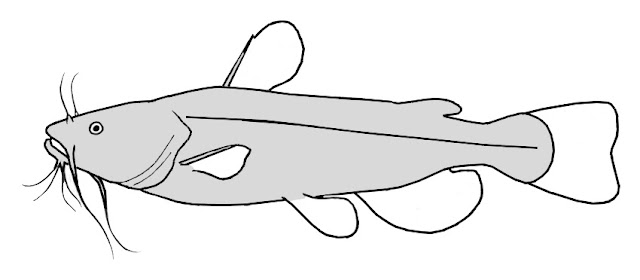
The drawings in the book are by our Italian colleague Roberta Barbieri who has been part of the HCMR team since the late 1980s. This is certainly one of the most important aspects of the book - not just decorative. (Catfish).


Finally some notes about HCMR's new book:

The new annotated checklist of Greece’s freshwater fishes was  published in April 2015, the latest such booklet since Economidis’s 1991 seminal popularized checklist. The 134 page book features a brief introduction and carefully coded annotated accounts for 160 species. Particular emphasis is given to the interpretation of recent name changes and taxonomic validity. The book stresses the conservation value of Greece’s freshwater fishes; 47 taxa are noted as exclusively endemic to Greece and there are still important knowledge gaps on the taxonomy of several taxa. Many species are threatened at a global scale and there are fears that some may already be close to extinction; a notable example being the Vistonis Shad (Alosa vistonica) endemic to Lake Vistonis, a large wetland system which has suffered from extreme water abstraction, salinization and pollution. This book’s compilation is based on a group effort; it is authored by 12 members of HCMR and is illustrated with fine line drawings made by Roberta Barbieri. Professor Konstantinos I. Stergiou provides a forward and lends support to initiatives that strive to scientifically compile and maintain national fish checklists.


-------------------------------------------------------------------------------------------------------------------------
And finally some thanks to all who helped so much.

Firstly there are many poeple who keep reminding us to dessemintate our work to the public - to popularize our work. These people send us photos and location information about fishes in Greece - and this book is really inspired by them.

I want to thank some people for really working carefully on this book. First of all Alkis Economou who passed through the book with fine-toothed comb so many times. The rest of the team worked extremely hard - it's hard to explain how hard it is not making mistakes in a checklist! Evan simple things like the fishes totally lenghs need to be checked and re-checked. The English was edited my good cousin in Minnesota, Emily Green. And finaly Dimitra Bobori, Jörg Freyhof and Nicolas Bailly did an excellent job of reviewing and finding even more uncertainties and details. I especially want to thank Jörg Freyhof - who is an expert naturalist and knows about lists. And finally our friend Aris Vidalis for publishing with patience.  

Saturday, August 29, 2015

Samothraki: Nature conservation ideas 2015

Personal thoughts.
What Samothraki needs…
(Late July 2015)

Samothraki is “on the edge”….On the edge of the NW Aegean, the edge of Greece, the edge of change. It feels good to be between the Greece of yesterday and the present. Many things on Samothraki still bring to mind Greek “island-worlds” of the early ‘80s: few roads on the mountains, wild unbuilt coasts, real shepherd communities, a strong local dialect and living ethnography, relaxed island situations, hippies…Yet present-day Greece has affected Samothraki a lot and continues to affect it. 

As nature conservationists we often think about what a place “needs”...especially in such times of change. How to help it? How to save it! What to propose as important steps towards its well-being? An island-world such as Samothraki is suitable for such study, such thoughts and proposals.

I have some thoughts from a week’s stay during late July this year; but they are totally raw and unintegrated. I share them here. 

1) The overgrazing problem. With respect to over-grazing, yes there is an overgrazing problem  here (contra the case of “widespread abandonment” everywhere else in Greece with several outstanding local exceptions). The island is said to hold a gigantic number of sheep and goats (estimated by researchers at approx. 70 000 head). Although this is an incredible number, even if it is smaller, the effects are noticeable everywhere: nearly no tree regeneration anywhere on the island for at least three decades. So, although – total abandonment from grazing is now a “problem” in the rest of Southern Europe it’s not a problem on Samothraki... The lack of regeneration leads to deforestation after fires (a typical “vegetation degeneration” process commonplace in Greece about 50 years ago). To change this we need to really treat the issue of EU subsidies and agricultural policy…and also replant some trees (especially oaks). Oaks are suffering both from goats and over-cutting.  This issue is also a social problem, the shepherd communities are sensitive; it’s practically their mountain – this issue needs study, strategy and adaptive management. 

2) Deforestation. A lot of hap-hazard logging takes place and is unaccounted, unregulated or enforced by anybody. Life on Samothraki is totally lax in terms of any kind of biodiversity conservation enforcement. The Greek state seems to be absent. Due to the “crisis” the enforcement is more lax I think. So, you can make money by cutting trees – many hundreds of stately deciduous oaks, holm oaks, kermes oaks, terabinths, spiny pears, and planes… each year! Logging of this kind is crippling the landscape elements that make Samothraki so rich – each ancient tree is an ecosystem. Deforestation is a serious threat- Samothraki could look more “Cycladic” in the decades to come; the landscape may become more homogenized, simpler, poorer.

3) Marine ecosystems. The situation at sea is no better. Overfishing has certainly ravaged the steep slopes beneath the shores. No control (trawling near shore; spear-fishing is rampant; even dynamite is still used). My colleagues and I snorkel and see nearly no large fish. This is the Northern Aegean, not any open shallow oligotrophic Levantine backwater….here are some of the most productive waters in the Eastern Med basin…what else can explain this total stillness in the sea. It’s a disgrace. Do something about it? (A tragedy of the commons….Lets keep it quiet…no one will hear…). 

4) Protecting terrestrial habitats. I mean to remark on “really special and scarce habitats”; these are habitats and landscape units that make this island especially distinct and remarkable as a conservation hotspot. They are rare, scarce or particularly well represented here, compared to other Greek islands. Also these include places at the nexus of human-nature – cities, ports, beaches. Some comments: 

A) Coastal wetlands. What is their state of being? Is there any enforcement of legal protection enforced anywhere? Any special zoning or interest by the state (at all levels of government)? You guess the answer. 

B) Riparian forests. And the unique Platanus shoreline forests of the north coast. Any true protection? (Two of the best sites have been turned in to camping sites with little reference to their management as forest lands). Are these woods – forests and savannas demarcated and delineated as protected areas. Of course not. 

C) Dunes and beach landscapes. Aren’t they important for the “tourist image”? ...and the conservation of something extremely attractive for a few months of the year?  How are they treated? (These are extremely sensitive landscape features and threatened). 

D) Especially Scenic Landscapes: there are some especially scenic landscape areas. Are they identified and protected? Look at Pachia Amos: is this area a protected landscape? (...one of the most scenic spots in Greece) What of the small wetland complex immediately west of Kamariotissa (Agios Andreas) – should this area be turned into an industrial park? (Wind Farm? Cost-benefits?). 

E) Modern urban, peri-urban architecture. With the notable exception of Chora what is happening elsewhere? (Answer: Incremental change and unplanned building – and thanks to the economic crisis a momentary halt…). Already a few too many buildings such as hotels etc. are too close to the Palaiopolis landscape (the Island's major archaeological site). Scattered buildings are localized by other Greek island standards. Sadly the main port is typically ugly and modern looking. Greeks have good term for this “kakogoustia” (bad-taste). [However, an ugly port town - a gateway - can keep tourist masses away...]

5) Surface water management. Water is usually “not an issue” since Samothraki is rich in waters! (Same situation in Southern Euboea…rich until mismanagement creates a crisis!). But this kind of criminal negligence of water management does finally have serious land-use and conservation consequences. Water is usually “stolen” from the state-run bore-holes (lax attitudes have prevailed here too). The mayor told us 14 of these have now become “regulated” and a fee is finally being levied! However, water is pumped directly from rivers each summer and weirs help it go out to fields (also in PVC pipelines). What are the results: Some streams stop running to the sea during summer (artificially intermittent degraded states; Eels for example are now rare in the streams, perhaps this is one reason for their decline…). Second, this water stress affects the precious and fragile small wetland environments. Lastly there is some locally increased pollution since sewage and other effluent enters rivers with unnaturally low water flow creating localized pollution perhaps augmented by low self-cleansing situations due to the low or no flow conditions. This shouldn’t be happening on Samothraki. Finally, due to the wastefulness of attitudes and disorganized state of water dealings, there is a feeling of “water stress”. A new irrigation reservoir is being built and it will take waters from the Ksiropotamos River – locals are in disarray and unable to fathom the impact. Perhaps impacts will be small-scale and localized but what is the feasibility of this? (It’s not clear to me even though I did read the EIS….). 

6) Tourism as an incentive to protect nature? Do we really need a tourism strategy? (Some may say that the absolutely Ad Hoc is just great thank you very much!). Is there any interest in really expanding the tourism season? Or in bringing special tourism that focuses on nature, culture, archeology, events, science, and education. Sure, some tourist happenings are taking place (some medical conferences etc.) but I feel much much more can be done if selected stakeholders, experts, planners and protected area experts sit down and dwell seriously on a tourism strategy. I feel a kind of lax just-floating-by attitude pervades tourism development here. For example, the island has some amazing trails and trekking opportunities, these are poorly developed. These AMAZING wilderness trails rival Greece’s best (e.g. NW Samos and SW Crete…that caliber). Why doesn’t the government and conservation movement “capitalize” on this? Could this be a sustainable incentive for protected area development? What about environmental education – Samothraki seems like a great destination – the “edge” location is an advantage here…Samothraki could invite schools, teams, academic groups etc. from Eastern and Central Europe and Turkey. Samothraki is a breath’s way away from Thessaloniki, Istanbul, Edirne, Bucharest, Sofia. 

7) A Protected Area? The island is a Natura 2000 site. On paper. What can be done? I will begin by saying that the regional government (and municipal government should take a stand – and fast before it’s too late…). They should both work to promote the best possible plans for a protected area and promote the completion of a special environmental study (and management plan) needed by Greek state law to have a functioning de facto protected area. This is a priority for the island for the following reasons: a) It will bring money and a new kind of “energy” to the island and its incentives since it is immediately connected to EU structural funds, smart developments, agricultural reforms, the overgrazing issue etc. …all seen as priorities by EU bureaucratic approaches. b) If drafted with care and negotiation it will help legislate the protection of some important landscapes, special habitat types, scenic areas etc, etc. (However, for some aspects such as grazing, fishing, water management some special studies are also needed). We have proposed Samothraki National Park with a peripheral eco-development area and zoning to protect both special places and special ecosystems yet allow for sustainable development, agriculture etc. The protected area is large enough, with unmatched wilderness-values, spectacularly scenic qualities, varied cultural landscapes, world-class archeology, and biodiversity richness both on land and sea. The flora, fauna, woods and many special habitats are enough to make this area eligible for this kind of status. A lower key park designation (Nature park etc would also be fine but the area does have a distinctiveness and grandeur to be of National Park status – and this kind of recognition and distinction may help the island propel itself forward as a proper protected area of international dimension with special management initiatives backed by national and regional governments). The National Park idea is akin to the MAB reserve idea. Both are complementary, they lend distinction and are based on special zoning, and world-class promotion for conservation.

8) A research and education laboratory. Research on an island is of “local interest”. The locale should gain from this. Samothraki is attractive as a long-term research area (as were other Greek islands back in the ‘60s and ’70s.. i.e. for foreign university groups, mostly on archaeological, ethnographic surveys and such endeavors). And since several researchers already have fallen in love Samothraki, we have a responsibility to contribute towards policy-relevant “useful” science that aims directly at helping conservation and sustainability. Of course, this is not easy, research is easy. But research must help policy, must assist resource management and planning- and it can. So this is the reason I think it’s really important to focus on local research here. And it can be a good example for more such “useful” research in other islands as well. 

In summary, I want to stress that I do not feel the major problem on Samothraki is overgrazing – and I have had similar experiences with this in Crete, Evia and Skyros (etc.). The problem has a multivariate nature and is deeper. Rapid agro-pastoral changes are accompanied or driven by imminent cultural changes – a roller-coaster of change and uncertainty. Can we control this; should we? A really chaotic system –especially in times of economic and other crises. The main issue for me is the lack of a strategic design for conservation and development within a protected-area framework. So, I urge we keep our minds open and dwell in deeper inter-disciplinary approaches with as much local involvement as possible. 

My fresh musings may need refinement. I may have misinterpreted things- I am still working on these ideas with friends and family.  I thank my science friends on Samothraki for their contributions: Nikos (HCMR research leader), Marina, Jurgen & Panos (from Austria), Anastasia, Natalia and Vassiliki. I wish us back in Samothraki soon!

I share some snapsshots from this year’s field working in our Samothraki Nature Observatory work.


Eleanora's falcons hawking insects above Chora. We tallied 47 bird species on the island this year. 

Terebinths in full seed at Ksiropotamos.

Near Ksiropotamos.
Near Varades. Bracken and a savanah of Planes and Spiny Pears.

NE part of the Island. Maple hedgehoge shrublets. Yes Maple (Acer sp.). Overgrazed.

The goats.
Chora.

With the Tourists along the SE coast.
Dolphins are nearly always seen around the island.

North coast. 
Results of a rapid summer burn. NW of Chora.

Abandoned Olive Oil press at Ksiropotamos.
Nearby we found this kind man stewing sheep meat: the Shearing of the Sheep was taking place: a small festival.
Sheep shearing at Ksiropotamos.
Spending some time with the locals at the sheep shearing spot in the riparian forest.

Sheep shearing at Ksiropotamos.


Small salt lake, near Agios Andereas. Vassiliki scanning round.
Small salt lake, near Agios Andereas. Grey herons, Stilts.
Small salt lake, near Agios Andereas.  Anastasia taking water measurements.
Behind the beach near Agios Andereas. 


Friday, May 29, 2015

Phaliriko Delta Athens: Summer rain on naturalists meeting


May 28th 2015 - Phaleron Bay Athens

By the first week of May Attika's fields go yellow, drab yellow in the warming sun's glare. And sometimes we get a thunder storm. We had one today.

We organized to meet and discuss our views on our Nature Park Proposal at the Phaliriko Delta on Athens's coastal strip at the river mouth of the Ilissos.

The beauty and biodiversity of this 'vacant lot' ecosystem is something that enthuses me. This year we have Little-ringed plover nesting, perhaps the only pair in the Attika Basin.160 birds visit the site. Now in late spring the migration is already over but an assortment of birds were here to greet us: Barn Swallows, House Martins, Olivaceous Warblers, Zitting Cisticola, Sardinian Warblers, Black Swifts, Yellow-Legged Gulls. 

The area has remarkable potential for restoration, especially as the much-needed flood control infrastructure may tie in with wetland creation here. Already the site is a quazi-wetland.
Pools form after the rains. These pools simulate an ephemeral pond environment. Native tamarisks punctuate the herb-rich meadows. Already one of our colleagues has compiled huge plant-list for the site; some scarce and one-or-two rare plant species. About 20 butterfly species have been tallied as have several other unexpected critters, Leopard Snake, Balkan Green Lizard included.  The sea-life here is exceptional: a semi-natural urban delta system, almost estuarine (but with minimal tidal fluxes); eutrophic. Loggerhead turtles spend weeks here in spring and early summer and are rather easy to see. In these respects, as it is, the site does have much interest as a marine, wetland and infilled coastal ecosystem...right at the edge of Greece's capital city and port. 

However, as are many vacant lot ecosystems, this place is threatened by typically concrete-based ideas for development....so we are working against this. 

For more information in Greek, feel free to peruse over our proposal:


Here are my snapshots from these evenings meeting, immediately after the rain.