Showing posts with label Greece. Show all posts

Thursday, April 16, 2020

Amvrakikos Gulf Wetlands Greece 1999-2003


Amazing photo of the unique lagoon-within-lagoon system fo the Koronissia islets in the center of the Amvrakikos Gulf (photo from: https://www.driverstories.gr/en)


Amvrakikos Wetlands, Northwest Greece

I am privileged and honoured to be a small part of the history of conservation in the Amvrakikos Gulf (one of the largest wetlands and top wildlife sites in Greece). Through this short blast to the past, I just want to recall some momments...from some rather randomly found-and-scanned shots I found.

My first birding visits were in 1984 (I have cousins in Preveza...), then in early 1985 with the Hellenic Ornithological Society begun a wonderful time for many young Greek naturalists - the Dalmatian Pelican wardening programme (I'll try to discuss that time in another post...and to find those old photos...). I was a very young birder -but totally obsessed and so were so many others in the hay-day of the Environmental Movement of the mid '80s (analogous to the West's early '70s, definately a pivotal cultural movment period in Greece...).

After such semi-voluteering projects and many visits, even guiding the first Canadian ecotourists there, and assisting in the branding for ecotourism at Amvrakikos (and doing various studies), we landed an amazing extra-ambitious LIFE -Nature Project (1999-2003). We did a lot at that time; among other things trying to create the boundaries for the "protected area" and a new National Park. 

Most of the photos below are from this period (1999-2003).

The National Park was enacted on March 21st 2008 - it is far from a perfect delination and who knows what zonation will finally take place now that the new Special Environmental Studies are being completed for the area (unfortunately I am no longer personally involved in the area...). There are critical issues associated with land-use changes, hunting and disturbance around the periphery of the park (the so-called "shadow-effect" that the high-profile core of the area casts on important hotspots in the sourroundings). 

Our most recent paper, refers to the conservation area "shadow-effect" through some data on the status of lesser spotted eagles; see it here:


Also a summary overview of on of the LIFE Nature restoration works at Amvrakikos, recently show-cased here:


Just a quick flashback - cheers! 

The Salaora research station, was a refurbished former Ottoman costum's house. Through EU monies it was re-created in the late 1990s and this time into the Salaora Research Station. We have spent many nights here in luxury. And from this building we spotted the wonderful Aetomylaeus bovinus rays feeding in the shallows below (one of my first marine papers published)... This aerial photo I took during two spectaclar "documentation flights" with hyperlight planes over the Amvrakikos in 2002 (see below).
Kostas Manikas (at the oars) was the most knowledgeable warden and keen expert fisherman of the lagoons, helping ornithologists here since the 1980s. Here with my friend Dimitris Papandropoulos with the binos  - at the islet of the fishermen's lookout, on Logarou Lagoon. (In the box is a young pelican we confiscated from a tavern and we're returning it to the colony...what an ordeal that was...).
Yiannis Kazoglou (with the Swarovski scope) and Dimitris Papandropoulos in an expedition near Lake Voulkaria. During our Life project we did a lot of exploratory work in amazing places all around the Gulf - even in the south. In March of 2008 the area became a huge National Park. I guess we did have a role to play in this - but we were not happy with the structure and final boundaries, too little, too late we thought...
I went all the way to Kerkini to learn about domesticated water buffalos in this project with the expert direction of Yannis Kazoglou- these are our first buffalos in the Rhodia Swamp. An outstanding time and big-step re-introduction for us (the species was extirpated in the late 60s from the Amvrakikos). After this, other re-introductions followed (i.e. Sperchios Delta) and the numbers of this beast increased in a few of Greece's large wetlands. During the project (I guess in 2002, we helped two MSc students work on studying the effects of the newly introduced water buffalos -this was an excellent gift of voluteer science for the area. 

One of my most trusted comrads-in-arms is zoologist Haralambos Alivizatos; here at the very begining of the Life Nature project in 1999 (I'm on the scope, a Nikon). This is a rainy day probably in 1999 - I seriously don't recall where in the Amvrakikos it is. 
The artificial canals we created to re-wet the vast Rhodia Swamp with waters from the Louros river. In this winter photo (2002) we can see Dimitris Papandropoulos, Vassiliki Vlami (wearing black) and Dimitris Zogaris  (at about five years old...playing in the mud). This project was the largest most ambitious and most unusual wetland biodiversity restoration initiative ever done in Greece at the time. (Of course larger and more expernsive efforts took place aftewards, e.g. Karla).  
The is Father Agathagellos of the Profitis Ilias Monestery of Preveza. He and his monastery were firm supporters of the conservation cause and helped me personally on many occasions.


Yes we did fly over a small flock of Greater Flamingos...in Logarou lagoon.

Getting ready to do some flying!!!  ...for aereal photography in 2002 (no drones back then..). Last before Left (the tall one) is my good friend Dan Brown; one of the best naturalists who has ever worked with me at Amvrakikos. Dan came over from Bangor University (where I did my MSc degree) and spent much time helping us out.


Well this is an important air-photo I took of our four artificial islents in Avleri (Tsoukalio Lagoon). We built them to protect the Dalmatian Pelican colony. An important time for us - and new know-how developed.

We tried a lot at Amvrakikos and had amazing ideas to do new things - especially with the help of Thomas Arapis from Oikos Ltd. Here we are building the enclosure for the water buffalos and also doing some water works re-flooding outside the village of Stroghilli. 

Ornithology was responsible for a lot of our conservation initiatives at Amvrakikos. Here is pioneering ornithologist Kostas Papaconstantinou (siting), his wife ornithologist Niki Kardakari (in red) and my wife, ecotourism expert Vassiliki Vlami (at Left). We're on the Vouvalos islets in the middle of the Gulf surveying birds. Photo from 2000.
We did a lot of bird explorations at the time throughout the Gulf -even the tiny islets. On left is the Ornithological Society's "Captain C. Papakonstantinou" with video camera. Vassiliki Vlami  (bottom R). With the Hellenic Ornithological Society bird exploration. Photo from 2000.
A BIG problem concerns landscape change and incremental changes happening with new roads, new citrus plantaions, rock quarries. This scene is next to the village of Louros, within the peripheral area of the National Park. Photo from 2002.

Critically important are some nearby hills and woods; where raptors such as the lesser spotted eagle nest. This is the Quercus frainetto forest of Mount Valaoritis. The site is outside the Natura 2000 boundary (but within the peripheral zone of the park); and unfortunately a smal rock-quarry and road construction displaced the nesting eagle in 2000.  Photo from 2001.


The Louros river is the life-blood of the western part of the wetland; here at the Petra Bridge. Valaoritis mountain in the background. 
With my mentor Alcibiades N. Economou and the famed ichthyologist Professor Peter Miller we did the first gill-netting research in Rhodia Swamp in 2001. This is on the Louros embankment. Note the "protected area" logos - the first ones we designed with OMEPE and OIKOS Ltd for the LIFE Nature project (this is before the National Park was enacted). 
The semi-abandoned fish-farm basins of the Psathotopi-Fidokastro area: here we discovered a new population of breeding bitterns and much much more...
Typical wintry scene at Logarou with the city of Arta in the background. Along with the Dalmatian Pelican recovery we say a remarkable inclrease in herons and egrets in the last three decades. This photo we took with my friend Aris Vidalis on one of our winter visits.


My last visit was about 10 years ago with the film crew of Vaggelis Efthymiou. We drove with jeeps up to Mavrovouni for the sunset over the vast Rhodia Swamp. 


Sunday, January 3, 2016

How many species of freshwater fish in Greece: A new book!


New checklist  May 2015

How many species of freshwater fishes in Greece?
The ichthyologists at IMBRIW- HCMR have for years worked on answering this question. Its not easy. And it is important.

We're talking about "species" - a supposedly solid taxonomic unit.
well...it is not that solid or easily defined!

The concept of species has evolved. And now, following the Phylogenetic Species Concept (contra the Biological Species Concept) a major revision of species entities has taken place. In Europe the 'revolution' crash-hit us when Maurice Kottelat and Jörg Freyhof published their "Handbook of European Freshwater Fish" in the summer of 2007. This book provided a kind of whole-scale validation for many new species of inland fishes in Europe ("new" chars, whitefish, salmons, trout). All of a sudden we had many  new species, many of them formally and/or formerly known as subspecies just a few months before. Following the new 'evolutionary' approach to species definition, the notion of sub-species is dead. So even if our country is already famously rich in fish species - what do you do when many of the former entities are split-up with new shiny names?

Now how many in Greece?

In April 2015 we published our annotated list and conservatively defined the number at 160 species firmly following our colleagues Maurice and Jörg. Our new checklist booklet is not one to purport brevity - so if you do read it you will see that we do point to the controversies the new species concept has created.

Now how did we keep track?
This is not easy for the following reasons:

a) Several species groups are poorly studied and need to be re-assessed; studies are in the pipeline that will certainly increase the species number, especially where former subspecies existed. So we expect to see at least another 10 species entities arise within the decade - this is a conservative estimate but we have firm evidence that new species units will be described in the genera of Squalius, Eudontomyzon, Alburnoides, Knipowitschia, Barbatula, Gobio, Rutilus and maybe others!

b) Some species are not only created but may be "lumped" into others and re-assessed not as species but as local population units at best. This may be possible but I predict not many such changes will occur. There are some fish that may fall into this category (one or to Cobitid loaches I believe). Also the new taxonomic work may show that species that were to exist in this country are now proven not to exist since the Greek populations belong to other species. (We did "lose" two species in this way during the last list revision - Salmo dentex and Barbus rebeli where recently deleted from the Greek fish list).

c) Aliens species.They come and "go". Now we confirm 23 species are aliens (the last list had 29!) We have proved that several species where never really established and we have no evidence of several species that were included on Greece former ichthyofaunal list. This issue needs careful monitoring. 

d) The evidence of many Mediterranean marine transient fishes in fresh waters is growing; surely the line is not black-and-white. Already many fish that breed solely in marine waters are included in the freshwater list (grey-mullets and eel for example). And including these migratory fishes is commonplace in most inland faunal country assessments worldwide. Some marine fish are common, widespread and often found in pure freshwater conditions not just the brackish river mouth extremes (a.k.a. transitional waters). Our 2007 list estimate guesstimated that at least 55 'marine' species are frequent migrants or transients into transitional waters (river-mouths, coastal marshes etc). So we need to work on criteria to include the most frequent - pervasive marine transients in the inland waters list. I wager this will help the inland waters list increase by about another dozen fishes within the decade. 

So its at 160 and 47 are exclusive endemics to the Territory of Hellas. 

Where do we go from here?

Web-based ichthyofaunal tracking tool: Fishlist.gr

We are now building a special website that will include all photos/drawings of fishes in Greek inland waters. Plus added information on identification, distribution and conservation and their common names (we especially worked hard to help standardize common names). The web-based tool will also be in Ελληνικά. The first phase of this project will be on air after June 2016. So please keep watching IMBRIW at: http://imbriw.hcmr.gr/en/


The fish checklist booklet is available free-of-charge as a PDF download at http://imbriw.hcmr.gr/en/wp-content/uploads/2015/05/FINAL_MARCH_2015_FreshwaterFishlist-1.pdf and hardcopies may be ordered for libraries and scientific institutions from info@fishlist.gr

The book can also be ordered free-of-charge, if one writes a polite note to us at: 

c/o Mrs. Sofia Giakoumi,
HELLENIC CENTRE FOR MARINE RESEARCH - HCMR
Institute of Marine Biological Sciences and Inland Waters - IMBRIW
46,7 km Athens-Sounio, Anavissos, Attiki, GR-19013 Greece
Tel.: +30 22910 76393
The Aoos river near the Greek-Albanian border: Several new species recently became named and valid as such in this river just in the last 10 years. Still we have doubts about the valid names of at least couple of species (Squalius, Chondrostoma). Research is needed to clear up the taxonomy in this globally important ichthyofaunal area.
Without genetic work it is no longer possible to identify most trout species in Greece. There are five species of native trout. However, unfortunately these fishes are being genetically polluted by mixing through unregulated stocking practices. Stocked fish sometimes show deformities they made in hatchery enclosures (see dorsal fin on this fish from the upper Acheloos - caught at near Anthousa Village in 2007).


The Endengered Beotian Riffle Dace (Τelestes beoticus). This species has a very restricted distribution and seems to require good flowing waters - it may be rarer than we think. More research is urgently needed. (Photo near Livadia in the Kiffisos river catchment).
One of the most enigmatic fishes in this part of the world is the anadromous Atlantic Sea Lamprey. This one was caught by a spearfisher on Kefallonia. We have anectodal evidence for the fish in the Louros river, it may spawn elsewhere. It si a protected species and very rare in Greece. (photo from Tassa Gouzi (Τάσσα Γρουζή) from Kefalonia, downloaded from: http://pronnoi.blogspot.gr/2013/04/t.html). The find was published  in https://www.researchgate.net/publication/266030219_First_confirmed_record_of_Petromyzon_marinus_Linnaeus_1758_from_west_Greece

Common Carp in Greece...does the wild form exist? Probably not,  as our book states. Perhaps the wild stock should be considered extirpated. This photo from the Aliakmon River near Polyphyto reservoir shows a wild-like form of Carp. It did look a lot like the sazan type of the Danube to my experienced friend, Uwe Dussling (Photo by Alkis Economou).

Manos Sperelakis, Yannis Kapakos and Graphics Artist and Publisher, Aris Vidalis (R) with a pallet of Books at HCMR.


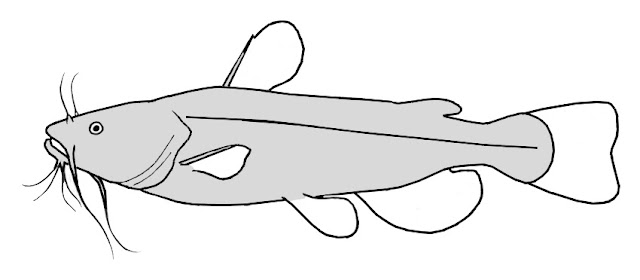
The drawings in the book are by our Italian colleague Roberta Barbieri who has been part of the HCMR team since the late 1980s. This is certainly one of the most important aspects of the book - not just decorative. (Catfish).


Finally some notes about HCMR's new book:

The new annotated checklist of Greece’s freshwater fishes was  published in April 2015, the latest such booklet since Economidis’s 1991 seminal popularized checklist. The 134 page book features a brief introduction and carefully coded annotated accounts for 160 species. Particular emphasis is given to the interpretation of recent name changes and taxonomic validity. The book stresses the conservation value of Greece’s freshwater fishes; 47 taxa are noted as exclusively endemic to Greece and there are still important knowledge gaps on the taxonomy of several taxa. Many species are threatened at a global scale and there are fears that some may already be close to extinction; a notable example being the Vistonis Shad (Alosa vistonica) endemic to Lake Vistonis, a large wetland system which has suffered from extreme water abstraction, salinization and pollution. This book’s compilation is based on a group effort; it is authored by 12 members of HCMR and is illustrated with fine line drawings made by Roberta Barbieri. Professor Konstantinos I. Stergiou provides a forward and lends support to initiatives that strive to scientifically compile and maintain national fish checklists.


-------------------------------------------------------------------------------------------------------------------------
And finally some thanks to all who helped so much.

Firstly there are many poeple who keep reminding us to dessemintate our work to the public - to popularize our work. These people send us photos and location information about fishes in Greece - and this book is really inspired by them.

I want to thank some people for really working carefully on this book. First of all Alkis Economou who passed through the book with fine-toothed comb so many times. The rest of the team worked extremely hard - it's hard to explain how hard it is not making mistakes in a checklist! Evan simple things like the fishes totally lenghs need to be checked and re-checked. The English was edited my good cousin in Minnesota, Emily Green. And finaly Dimitra Bobori, Jörg Freyhof and Nicolas Bailly did an excellent job of reviewing and finding even more uncertainties and details. I especially want to thank Jörg Freyhof - who is an expert naturalist and knows about lists. And finally our friend Aris Vidalis for publishing with patience.  

Saturday, August 29, 2015

Samothraki Nature Observatory: Trek through the wilderness


Samothraki Nature Observatory: Trek through the wilderness

Late July 2015. 

The HCMR workers and friends finally did a trek to an area that we always wanted to explore (and obtain water samples, bug samples, vegetation data etc.). The upland transect across the mountain from the Fonias Valley to Vatos. 

I highly recommend a trek like this so I post our itinerary. Of course we may have detoured a bit to get our samples from springs and streams and scenic views etc, so maybe this itinerary should be modified to make an ecotouristic trek less challenging. However, the trek does need a knowledgeable local guide since 90% is off-trail and in difficult conditions. The trek is approximately 20 Km long starting at the road's end at 750 m and reaching a height of about 1350 m. and descending to sea level at Vatos Beach. Two nights minimum must be spent in the field and water is taken from springs and clean streams. 

Stars denote places where we overnighted: Upper Fonias and Lagdistres. The route (in Red) is charted by approximation on this Google Earth image.
Here is a summary and some snapshots: 

Day one: 19:00-21:30.  Trailhead from near Koufouklio peak (c. 750 m) reached by truck (up the zig-zag road). Then took path (well-marked) to "Karya" – near the upper part of the Fonias Valley. Camped at small make-shift free camp sites riparian forest next to river. Slept under stars, most without tent. Warm.

Day two: First part. 05:30 to 14:00. Walk up left major tributary of the upper Fonias towards Louloudi Peak. Veer left off river corridor up goat tracks in a funnel-shaped cone beneath the peak. VERY Steep, no trail, hands-to-rocks conditions - could be dangerous. Finally came out to rocky ridge immediately East of Louloudi after spring (about 1350 m asl). Ascent to granite-like boulder crest. Descent to col between the Fonias and Ghiali valleys. Three huge rounded ganite boulders (the "Kafanedes") mark the spot of descent into the Ghiali Valley (veer Left). Descent left to main stem of Gialli aiming for characteristic rock formation far in the gorge, way far below. Finally meet river with deep pools and perennial tributary coming in from L. Continue into gorge to a huge deep pool just before gorge becomes impassible. Rest here.

Day two:Second part. 22:00 – 23:00 (under full-moon). Hike into oak and Montpelier Maple forest up to col of Kotzamanis Peak (Right of the Peak) at a moonscape site called “Lagdistres” (at about 800 m). Sleep here. All without tents. Warm.

Day three: 07:00 – 11:30. Leave Lagdistres to descend to Agia Thekla spring (nearby, c. 30 mins.). Inspect traditional shepherd’s hut (one of two or so found on the mountain). Spring with great cold water. Later in about ’15 meet Kresmastos Stream. Continue on westwards through open landscape (almost like Crete hear...). Phrygana and plantlife with northern Aegean flora. Encounter rare plant community of Peucedanum longifolium. Descend down towards Ksydni area. There is a large Platanus grove on the slope. Then a view of Vatos beach. Descent veering towards L. Rest and swim at beach. Take water from upper part of pool in the cobble channel (springs in river cobble and gravels). Catch the tourist boat back to Therma (if it is not too windy). We were lucky and caught the boat at 17:00.

The Samothraki Nature Observatory research team members included Nikos, Yiota, Natalia, Anastasia, Vassiliki and myself. We were accompanied by many friends and supporters of the cause. We thank Phillipos, Yannis, Vaios, Marios and all who participated. The snapshots I post are only a small part of the material collected. A wonderful experience, but not to be taken lightly.

Day 1. Near trail head at about 800 m. Descending into Fonias Upper Valley.
Camp at Fonias.

Bedrock pool below Louloudi.
Day 2. Early morning in the Western tributary stream of Fonias - only Alder in the riparian here.
Team leader, Nikos, at the begining of the second day.


Early morning in the Western tributary stream of Fonias - only Alder in the riparian here.

Above the tributary.


Athletic training shoes should not be worn in these slippery granite slides.
Rest stop with Nikos in the steep bedrock valley below Louloudi.
Up Louloudi.
Perrenial spring at about 1300 m. or so.  Louloudi.
Campanula.on Louloudi.
Fonias on L and Ghiali on R. Granitic rocks.
Rounded boulders known as "Kafenedes" at the col above Ghiali. 
Ghiali valley with maple and Alder. And a huge raging stream.
Day 3. Goatherd shelter at Agia Thekla. 
The stream of Kremasta. Alder woods. 
Collecting bugs at Kresmasta.
Rare plants and rock formations.
These are called Peucedanum longifolium. 
Descent in the windy slopes - much like Crete here...
After a short stop in a Plane tree grove. Refreshing!
Steep descent after the Plane trees.  No trail. Northern Montane Phrygana.


Vatos Beach from Above.
Vatos Beach from the boat that takes you back to civilization.