Friday, January 31, 2025

Kenya in January 2025

 Kenya January, 2025

Conservation, ecotourism and birding (avitourism) have a close relationship in Kenya. 

The whole story sounds like a joyous one, its long and complicated, and growing! 

Of course, being a conservation scientist, I find the experiance of visiting Kenya with Kenyan experts invaluable. This time we spent a wonderful six days familiarization trip and explored some of these important conservation aspects. We were participating in a project to explore citizen science promotion in protected areas and wetland areas. This work follows our first trip in Kenya in 2024 (which I detailed with 8 posts on this blog...use 'search' button - 'Kenya' - to find them on this blog...).

JANUARY 2025 TRIP   

Some points on ecotourism development in this country that I find interesting:

-      Birding is amazing in Kenya (as it is in other East African countries I guess). Species diversity is high and fantastic-looking birds, many amazing non-passerines, are easy to see espeically in open areas and wetlands.

-      In my prespective, birding is not well promoted despite the presence of an excellent revised field guide book to East Africa, many eBird hotspots, many easy birds to see in combination with game spotting. Most tourism targets protected areas such as National Parks and private conservancies.

-      Many great birds are outside the NPs or other protected areas; but, there is no need to stay at the very pricey game lodges if you are on a budget. Tropical nature is everywhere if  you can plan carefully.

-   The open-cover (open habitat) protected areas and the typical game-spotting experiance also produce amazing bird lists. The vehicle is a 'hide' and you traverse extensive areas with constant stops; its a great birding introduction and incredibly easy to see lots of species up close. (Most people are looking mostly at large mammals; but they inevitablly see birds, some are shocked by the birds!). However, again, birds are not the main target...can this change?

Of course its not just birds and mammals, there are so many other biodiversity interests in this country, and the landscape and the agro-pastoral cultures. It is very interesting to me because in some way it the landscapes do have similarities to Mediterranean landscapes (i.e., goat/cattle grazing/ wood-gathering/ occupational wildfire influences). 

Kenya Fam Trip 2025 details

First you may ask what a Fam trip is? A Familiarization trip for me is a field-based trip where me and my team participate in order to learn, collaborate, experience and think about what to do together with local experts on research items of common interest. It is like going ot a conference but with very specific targets on the research theme. This was my second trip to Kenya. Again we discovered that a self-guided trip of only 6 days can be extremely interesting for the naturalists involved. We found that a short-trip, a familiraization-educational trip like this can bequite easily done. However it needs a lot of preparation, pre-trip preparation. 

These are the areas we visited this year:

·         Kuranguru Coffee Estate near Thika (farm ponds and coffee plantations)

·         Chania Falls at Blue Post Hotel and associated river habitats

·         Great Sagana Resort (and the upper tributary of the great Tana River)

·         Naro Moru Area (specifically near the Tree Hyrax Guesthouse and surroundings)

·         Ol Pejeta Conservancy

·         Mount Kenya National Park (Naro Moru Route Park Gate Area)

·         Nyahururu Area

·         Lake Nakuru National Park

·         Southern Part of Lake Elementeita

·         Lake Naivasha (northeastern shore only)

·         Mungo Swamp (near Limuru)

·         Nairobi National Park


This is our circuit loop taken in January 2025. This was organized intentionally to be comparable with the circuit loop of 2024. We counted birds at each of the 19 sites we visited using eBird as a citizen science platform. Our work is supported through invitation by a member of the National Museums of Kenya.

Some snapshots follow:


Lake Nakuru. This is near the airport landing strip where you can get out of the car and sit under the Yellow Fever Trees. Total bliss.

Lake Nakuru: African Harrier-hawk - Polyboroides typus, one of Africa's many amazing and unique raptors.

Lesser Flamingos at Lake Nakuru.

The morning scene at the southern edge of Lake Nakuru.

Inspecting agricultural wetlands at one of the coffee farm near Thika. Warmest thanks to the staff of Kuranguru Coffee Estate.

At the Blue Post Hotel at Thika you can get up close to wild monkeys such as this one. This is a good place to see wild (habituated to human presence) Kolb's Monkey (Cercopithecus mitis kolbi) a rather rare range-restricted subspecies. This is a species is related to Sykes' Monkey that is more widespread (according to iNaturalist mapping). 

The Tree Hyrax Guesthouse on the lower slopes of Mount Kenya. This is a good base for the agro-pastoral and forest landscapes on the western slopes of the mountain.  

Western slopes of Mouny Kenya, at the National Park Gate (Naro Moru Park Gate Area). An amazing place but it is potentially dangerous to walk like this due to buffalo presence. We stayed close to the main road. This was frowned upon by the local rangers, and I understand why. Best to be in the company of a trained ranger in such situations. Despite the risk, we say some fantastic birds and also o herd of water buck (these big red deer sized animals showed some alarm and actually approached us a bit; as if perhaps to shoo us off...).  

Ol Pejeta Conservancy. Wild elephants; these are my first.

This is our first lion sighting. You will not easily see lions in Kenya. We did not do lion tracking or have a  safari guide with us. But we were looking hard, especially at this wonderful place, the Ol Pejeta Conservancy.


This is NOT something I would ever do and I guess my partner is OK with this photo and I wil show it to give you a sense of the road-side situation in Central Kenya. In many areas away from official protected areas you see antelope and zebras and sometimes they are really not wary of people. These are wild animals and potentially dangerous. They are oblivious of people more than scared or approachable. Please stay at a safe distance if you are not aware of the local tempermant of the animals. They are wild. (Photo is from the wonderful landscapes around Lake Elementaita).

This is Manguo Swamp, a well-known birding hotspot west of Nairobi (and yes, the donkeys are domesticated). Although it’s an important wetland, it’s not nearly as peaceful as this photo makes it appear—there are people around almost constantly. If you decide to visit, please be cautious with your car, valuables, and personal safety. We were approached by a group of young men who seemed more than just curious, and we fortunately managed to get back to our car and leave quickly.

Worldwide, there is no other place I know where a capital metropolis is so close to wildlife.

Lioness at Nairobi N.P. (We were so fortunate to find her on an intermittent stream-bed sunning herself). She was totally oblivious to the jeep.  

Vassiliki Vlami and our researcher friends at Nairobi N.P.

Nairobi National Park. Of course we were interested in the landscape. Note the grazing patterns (and despite the lack of elephants here). 

With our research friends at the Athi river in Nairobi N.P. 

Nairobi National Park is something of a pilgrimage area for urban naturalists. I can honestly say that if you have just a few days, you can easily visit from Europe and just ramble around Nairobi; this N.P. is a must for anyone visiting. 
I highly recommend this family business for rental cars, please inquire here: Kompact safaris Kenya car hire | budget friendly Kenya car hire/ self drive 4x4 Nairobi


Saturday, November 30, 2024

Extirpation Confirmed: No Pungitius Sticklebacks at Kokartza Wetland!


November 2024

Kokartza Kilkis, Northern Greece

Kokartza Kilkis is a tiny hamlet of 30 souls in the middle of the Kilkis steppe in Central Macedonia, not far from Thessaloniki. This could be a rather famous place for Greek ichthyology. It was here that the late Professor P.S. Economidis discovered one of two Northern Greek populations of a fish similar to the Southern Nine-Spine Stickleback (Pungitius aff. platygaster). In fact there are two Pungitius stickleback taxons in Greece, the southern population, at the Spercheios valley which was initially named Pungitius hellenicus (published by Stephanidis in 1971), and the northern population (at Aravissos- in the Loudias system and Kokartza- in the Axios/Vardar valley). Yes the northern ones are considered similar to the other European/Ponto-Caspian ones, loosely named Pungitius platygaster

However there is a important note: Both sticklebacks (the northern Greek and Spercheios populations) are genetically more closely related to each other then the Southern Nine-back Sticklebacks, the "true" Pungitius platygaster

The map above from an old Sovient publication shows the wide range of the Pungitius platygaster populations (related to the more widespread Pungitius pungitius) and I have incerted (in red) two areas of the Greek populations Pungitius. These two dots are the Pungitius aff. platygaster in Northern Greece (Aravissos and Kokartza) and Pungitius hellenicus in the Spercheios Valey near Lamia in Central Eastern Greece.

Thanks to research being done by Alcibiades Economou and colleagues, we are still trying to figure out the biogeography, genetic relationships and species status of these tiny fishes. Although the two populations have diverged from other Pungitius they are also quite distinct units. Perhaps even to the species level, i.e. two species, distinct from Pungitius platygaster, both originating from it.  In this posting I am refering to our northern Greek fish as Pungitius aff. platygaster for the first time. (The tiny word "aff" or Species affinis" is a term used in biological taxonomy to mean that a proposed species is closely related to, but not the same as, the species listed after it. The Latin word "affinis" translates to "closely related to" or "akin to). With the recent genetic analyses available, perhaps we could call the northern populations Pungitius aff. hellenicus or it may be described as a new species in the future! 

Anyway, the Northern Greek Sticklebacks are still being officially called Southern Nine-Spines, Pungitius platygaster, pending a thorough review and wider genetic analysis. And we are assessing their conservation status based on their distribution within Greece (I did the IUCN Greek Red List review recently). Note that the other Northern Greek Pungitius population is restricted to Aravissos springs, part of the Loudias-Lake Gianitsa system, neighbouring to the west of the Axios valley. It would be great if we could get some genetic material from Kokartza.

So the question is: do they still exist in Kokartza? 

We needed to go to Kokartza village! Where we too late? (...2024 was an exceptional drought year). Maybe we overlooked the issue and we may not have persisted in asking Economidis about this earlier. If I recall correctly, P.S. Economidis had told Alcibiades Economou and I that he had searched elsewhere in the Axios Valley and found it nowhere. However, in the 2008 Greek Red Data book account he gives the impression that it was extant at Kokartza; he gives Kokartza as a 'point on the map' (Economidis and Chrysopolitou 2008).  

Of course using Google Earth you can easily find both the Kokartza hamlet and its tiny reedswamp wetland where the spring's 'well' located (right next to the pump house). We decided to visit late this November. 

The Landscape

The 'Well'


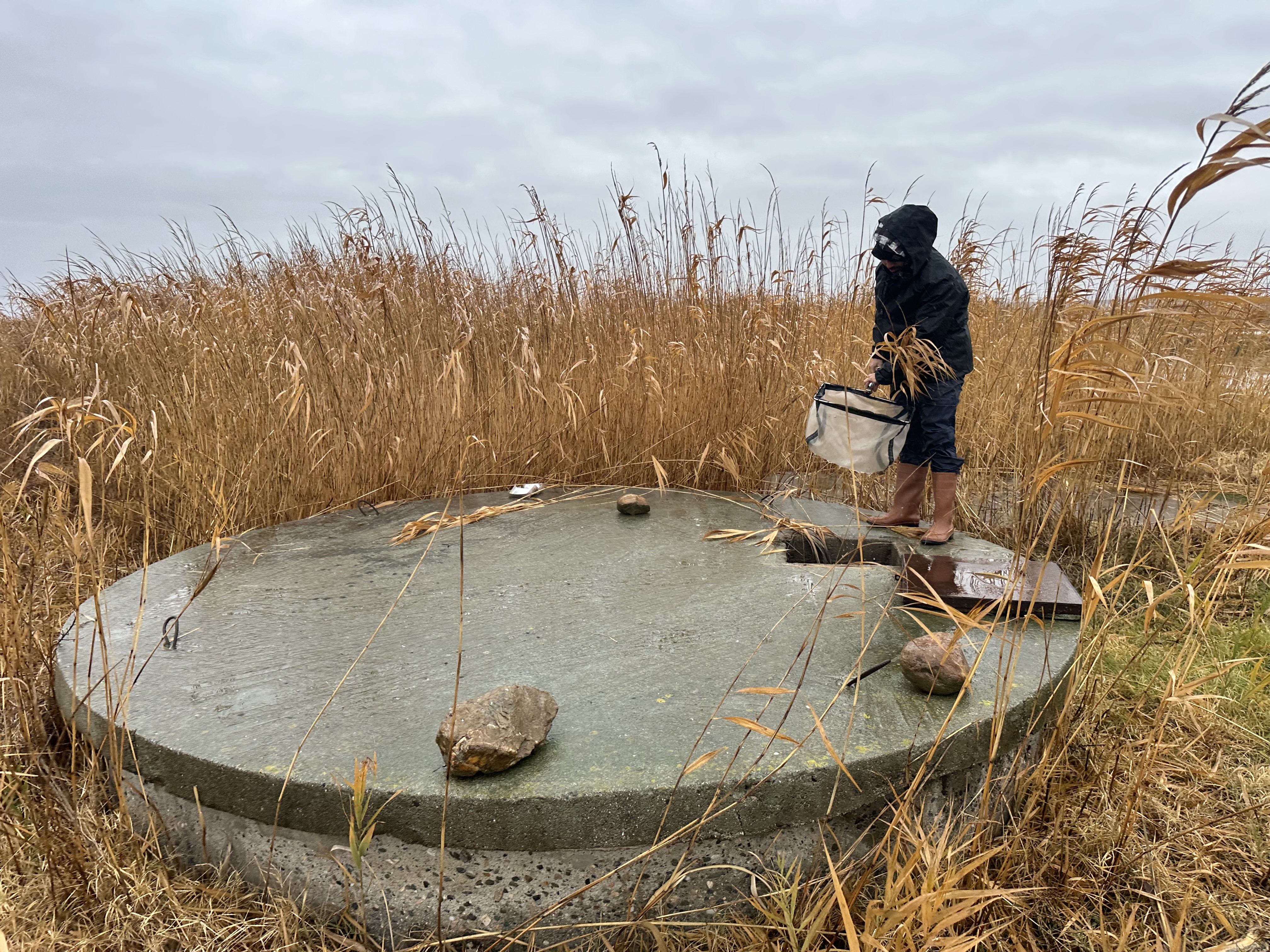
Professor Economidis talks about a 'filthy well' when refering to Kokartza - the only place the species exists in the wetland of Kokratza. During our visit we found no drop of water in the sourrounding tiny Phragmites reedswamp and two rather modern-looking well-like structures; one deeper - the round one and one very shallow, a rectangular cistern. Locals said that long ago this was a cold water spring and was known as a drinking-water source. There is a pump-house next to the well.

We used a long dip-net to try to see if there was any life in the two well-like structures. In the very shallow rectangular cistern we found nothing but a toad (Bufo bufo). No invertebrates in the water. The concrete block hatch on top had toppled down and  light was now penetrating into the shallow cistern. But there was no aquatic vegetaion. An animal (mammal) was scurring inside, but we did not find it. We rescued the toad. 

The large round well is deep and we could not search that deeper water with the dip net. We did several attempts of dip netting in the upper part near the surface and along the walls. No plants of course in the water - this well is totally covered by concrete, no light penetrates.  The top was totally sealed save for a small opening bolted with a heavy concrete block. We removed the concrete block to investigate. We thrashed around with the dip net. We found nothing, no life, no insect or other invertebrate life. The water body recived no light. It had a murky blue hue, not clear. Nothing. 

Perhaps this confirms extirpation of the Kokartza Pungitius population. But we will proabably make another pilgrimage to this site again in the near future. 

Dedication

I dedicate this post to the remarkable man behind the name of P.S. Economidis (1934-2021). One of the most interesting men I have ever met and a remarkable natural historian. I knew him very little, but on and off called on him during a period of about 20 years. We went on a few trips together (Evia, Rhodes, Northern Greece, etc).  We liked each other, but he was a 'difficult' man and many people would be cruel to him, or maybe they would misinerpret him. I guess he was mad at the world. He was protective of his data. Many colleagues were probably envious of his strong mind and incredible memory and the deptsh of his natural history knowledge. I kept notes on nearly all my discussions with him. He was also a philosopher and a Patriot; a kind of wonderful Zorba The Greek of the Icthyological world. May he Rest in Peace. 

References

Economidis, P. S. "Endangered freshwater fishes of Greece." Biological Conservation 72, no. 2 (1995): 201-211.

Economidis, P.S. and Chrysopolitou, V (2008). Pungitius platygaster. Red Data Book of Threatened Animals. 

Economidis, P.S. & V.P. Voyadjis. (1985). Les poissons des systèmes d'Axios-Doirani et de Gallikos (Macédoine, Grèce). Biologia Gallo-Hellenica, 10: 89-93.

Wang, Y., Wang, Y., Zhao, Y., Kravchenko, A.Y., Merilä, J. and Guo, B., (2022). Phylogenomics of northeast Asian Pungitius sticklebacks. Diversity and Distributions, 28(12), pp.2610-2621.


Monday, November 18, 2024

Geomythological tour of the Peloponnese!


A Geomythological Peloponnese with College Year in Athens
November 12th to 15th 2024

We made a rainy-weather trip to the geomythological hotspots of the Northeastern Peloponnese. 
These are easily reachable even on a one-night trip from Athens. But we went for three nights with the following overnight locations:

- Nafplion: Cornth Canal / Mycenae - the archeological site and small museum / Lerni - home of the Lernean Hydra 
- Kalavirta: Lake Stymphalia / Lake Doxa
- Kalavrita: Cave of the Lakes / Chelonospilia and nearby springs of the Ladon / Mount Chelmos /             Vouraikos Gorge (descent with the rack-and-pinion railway train).

A wikipedia definition of Geomythology (also called “legends of the earth," or "landscape mythology"):

"the study of oral and written traditions created by pre-scientific cultures to account for, often in poetic or mythological imagery, geological events and phenomena" 

Examples include the labours of Heracles - the slaying of the Lernean Hydra which alludes to the draining of the karstic spring-fed foods and malarial marshes of the area of Lerni near Mycenae.

In exploring the ancient's views of their world we can be guided to study modern landscapes as well. 

Here I share some photos.


THE SITES

The Cornth Canal

Ancient Mycenae


Lerni Spring (home of the Lernean Hydra)


Lake Stymphalia


Lake Doxa

Cave of the Lakes and the Upper Ladon Valley


Vouraikos Gorge


                                                                           THE BIRDING

Western Rock Nuthatch, Mycenae

Eurasian Tree Sparrow, Kalavrita

Middle-Spotted Woodpecker, Lake Stymphalia

Birding begun on the 12th, so it was only 4 days. Ok we did not bird, but I included what we observed even during this rather broad ranging road trip.