Sunday, January 17, 2016

Karpenisi Center for Environmental Education: "Fauna in Danger" Seminar

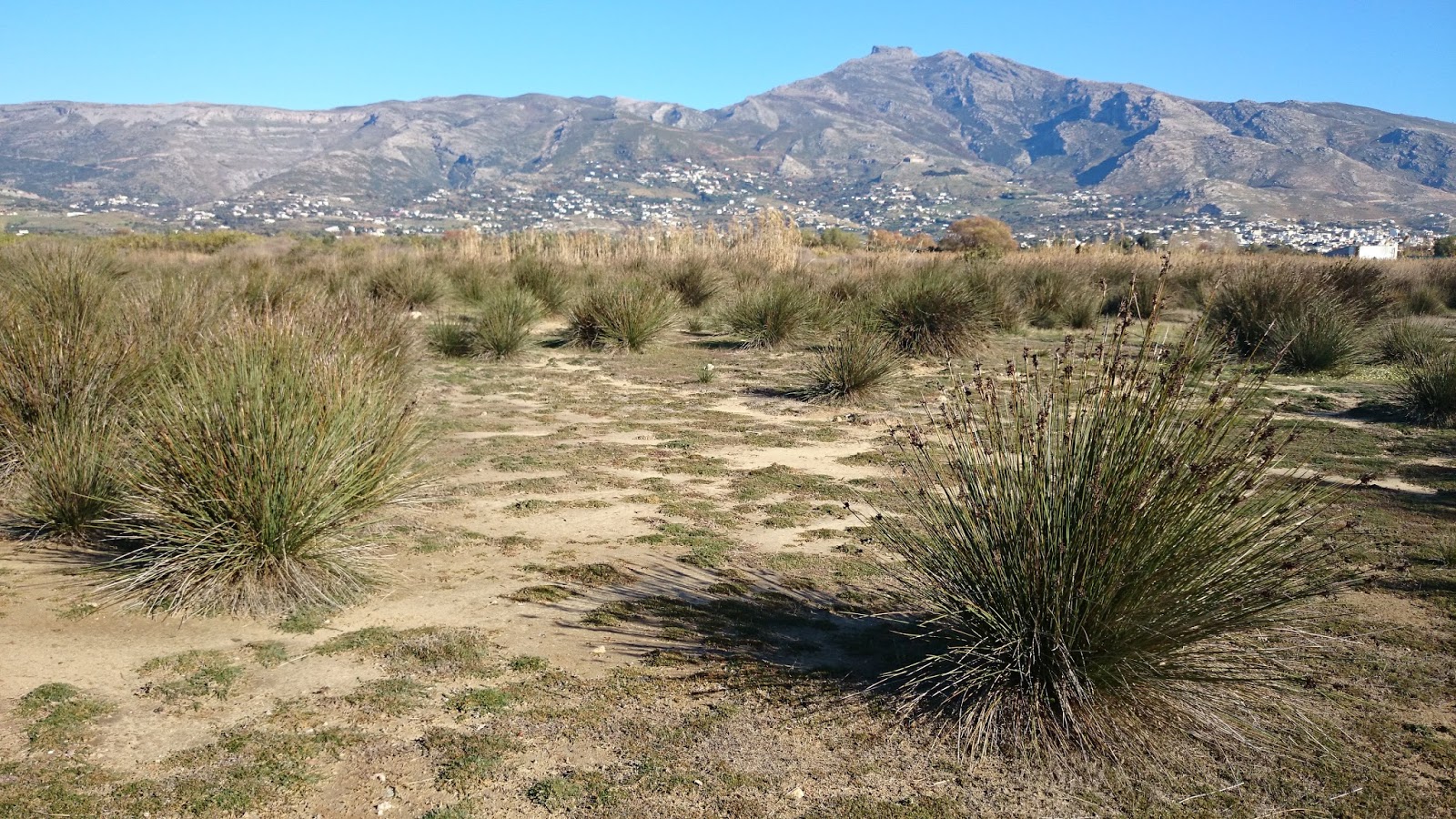
Near Karpinisi... (photo from the Center for Environmental Education http://kpe-karpen.eyr.sch.gr/)


Karpenisi Center for Environmental Education 
January 15,16,17 2016

We had a wonderful trip teaching and electrofishing at Karpenisi in Evritania once again - visiting the same site we fished back on the 9th and 10th of March 2012 to look for trout.


Karpenisi is a mountain town about 300 kms north of Athens, at 960 meters elevation. It is totally enclosed by the Mountains of Roumeli - the southernmost flank of the Pindos Range (an extension of the Dinaric Alps). The rivers and streams flow westwards here -part of the great Acheloos basin- and there is lots and lots of water; and very thick forests everywhere. 


Here the local Environmental Education Center hosted a huge group of school teachers - about 70 participants (!!) in a seminar of the educational network called "Fauna in Danger". I focused on fish but some really important celebs from other fields included Costas Papaconstantinou (fragmentation), Charitakis Papaioannou (chamois), Vassiliki Kati (wilderness, birds), Christos Thomaidis (rock partridge), and veteran envi-educators Manolis Kopanakis and Stelios Sylaiounis. Some spouses and children were also with us so the group was really big.   


The weather was horrible! Rain, rain, cold rain! But we all learned so much from the experience.


I was looking to get some fin samples of the tout. The local trout belongs to a range restricted species now called West Balkan Trout or Salmo fariodes. We found some at a spring-fed tributary stream which we had visited in March 2012 but this time only juvenile fishes, a year old, where found. It was surprising they were only about 10 to 12 cm in size and no large fish in sight. We worked hard. 

Some random shots taken mostly be my spouse Vassiliki Vlami are posted bellow.


Sunday, January 3, 2016

How many species of freshwater fish in Greece: A new book!


New checklist  May 2015

How many species of freshwater fishes in Greece?
The ichthyologists at IMBRIW- HCMR have for years worked on answering this question. Its not easy. And it is important.

We're talking about "species" - a supposedly solid taxonomic unit.
well...it is not that solid or easily defined!

The concept of species has evolved. And now, following the Phylogenetic Species Concept (contra the Biological Species Concept) a major revision of species entities has taken place. In Europe the 'revolution' crash-hit us when Maurice Kottelat and Jörg Freyhof published their "Handbook of European Freshwater Fish" in the summer of 2007. This book provided a kind of whole-scale validation for many new species of inland fishes in Europe ("new" chars, whitefish, salmons, trout). All of a sudden we had many  new species, many of them formally and/or formerly known as subspecies just a few months before. Following the new 'evolutionary' approach to species definition, the notion of sub-species is dead. So even if our country is already famously rich in fish species - what do you do when many of the former entities are split-up with new shiny names?

Now how many in Greece?

In April 2015 we published our annotated list and conservatively defined the number at 160 species firmly following our colleagues Maurice and Jörg. Our new checklist booklet is not one to purport brevity - so if you do read it you will see that we do point to the controversies the new species concept has created.

Now how did we keep track?
This is not easy for the following reasons:

a) Several species groups are poorly studied and need to be re-assessed; studies are in the pipeline that will certainly increase the species number, especially where former subspecies existed. So we expect to see at least another 10 species entities arise within the decade - this is a conservative estimate but we have firm evidence that new species units will be described in the genera of Squalius, Eudontomyzon, Alburnoides, Knipowitschia, Barbatula, Gobio, Rutilus and maybe others!

b) Some species are not only created but may be "lumped" into others and re-assessed not as species but as local population units at best. This may be possible but I predict not many such changes will occur. There are some fish that may fall into this category (one or to Cobitid loaches I believe). Also the new taxonomic work may show that species that were to exist in this country are now proven not to exist since the Greek populations belong to other species. (We did "lose" two species in this way during the last list revision - Salmo dentex and Barbus rebeli where recently deleted from the Greek fish list).

c) Aliens species.They come and "go". Now we confirm 23 species are aliens (the last list had 29!) We have proved that several species where never really established and we have no evidence of several species that were included on Greece former ichthyofaunal list. This issue needs careful monitoring. 

d) The evidence of many Mediterranean marine transient fishes in fresh waters is growing; surely the line is not black-and-white. Already many fish that breed solely in marine waters are included in the freshwater list (grey-mullets and eel for example). And including these migratory fishes is commonplace in most inland faunal country assessments worldwide. Some marine fish are common, widespread and often found in pure freshwater conditions not just the brackish river mouth extremes (a.k.a. transitional waters). Our 2007 list estimate guesstimated that at least 55 'marine' species are frequent migrants or transients into transitional waters (river-mouths, coastal marshes etc). So we need to work on criteria to include the most frequent - pervasive marine transients in the inland waters list. I wager this will help the inland waters list increase by about another dozen fishes within the decade. 

So its at 160 and 47 are exclusive endemics to the Territory of Hellas. 

Where do we go from here?

Web-based ichthyofaunal tracking tool: Fishlist.gr

We are now building a special website that will include all photos/drawings of fishes in Greek inland waters. Plus added information on identification, distribution and conservation and their common names (we especially worked hard to help standardize common names). The web-based tool will also be in Ελληνικά. The first phase of this project will be on air after June 2016. So please keep watching IMBRIW at: http://imbriw.hcmr.gr/en/


The fish checklist booklet is available free-of-charge as a PDF download at http://imbriw.hcmr.gr/en/wp-content/uploads/2015/05/FINAL_MARCH_2015_FreshwaterFishlist-1.pdf and hardcopies may be ordered for libraries and scientific institutions from info@fishlist.gr

The book can also be ordered free-of-charge, if one writes a polite note to us at: 

c/o Mrs. Sofia Giakoumi,
HELLENIC CENTRE FOR MARINE RESEARCH - HCMR
Institute of Marine Biological Sciences and Inland Waters - IMBRIW
46,7 km Athens-Sounio, Anavissos, Attiki, GR-19013 Greece
Tel.: +30 22910 76393
The Aoos river near the Greek-Albanian border: Several new species recently became named and valid as such in this river just in the last 10 years. Still we have doubts about the valid names of at least couple of species (Squalius, Chondrostoma). Research is needed to clear up the taxonomy in this globally important ichthyofaunal area.
Without genetic work it is no longer possible to identify most trout species in Greece. There are five species of native trout. However, unfortunately these fishes are being genetically polluted by mixing through unregulated stocking practices. Stocked fish sometimes show deformities they made in hatchery enclosures (see dorsal fin on this fish from the upper Acheloos - caught at near Anthousa Village in 2007).


The Endengered Beotian Riffle Dace (Τelestes beoticus). This species has a very restricted distribution and seems to require good flowing waters - it may be rarer than we think. More research is urgently needed. (Photo near Livadia in the Kiffisos river catchment).
One of the most enigmatic fishes in this part of the world is the anadromous Atlantic Sea Lamprey. This one was caught by a spearfisher on Kefallonia. We have anectodal evidence for the fish in the Louros river, it may spawn elsewhere. It si a protected species and very rare in Greece. (photo from Tassa Gouzi (Τάσσα Γρουζή) from Kefalonia, downloaded from: http://pronnoi.blogspot.gr/2013/04/t.html). The find was published  in https://www.researchgate.net/publication/266030219_First_confirmed_record_of_Petromyzon_marinus_Linnaeus_1758_from_west_Greece

Common Carp in Greece...does the wild form exist? Probably not,  as our book states. Perhaps the wild stock should be considered extirpated. This photo from the Aliakmon River near Polyphyto reservoir shows a wild-like form of Carp. It did look a lot like the sazan type of the Danube to my experienced friend, Uwe Dussling (Photo by Alkis Economou).

Manos Sperelakis, Yannis Kapakos and Graphics Artist and Publisher, Aris Vidalis (R) with a pallet of Books at HCMR.


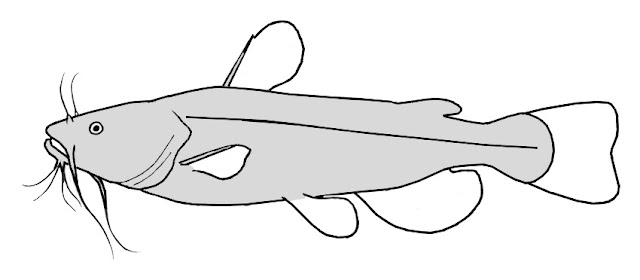
The drawings in the book are by our Italian colleague Roberta Barbieri who has been part of the HCMR team since the late 1980s. This is certainly one of the most important aspects of the book - not just decorative. (Catfish).


Finally some notes about HCMR's new book:

The new annotated checklist of Greece’s freshwater fishes was  published in April 2015, the latest such booklet since Economidis’s 1991 seminal popularized checklist. The 134 page book features a brief introduction and carefully coded annotated accounts for 160 species. Particular emphasis is given to the interpretation of recent name changes and taxonomic validity. The book stresses the conservation value of Greece’s freshwater fishes; 47 taxa are noted as exclusively endemic to Greece and there are still important knowledge gaps on the taxonomy of several taxa. Many species are threatened at a global scale and there are fears that some may already be close to extinction; a notable example being the Vistonis Shad (Alosa vistonica) endemic to Lake Vistonis, a large wetland system which has suffered from extreme water abstraction, salinization and pollution. This book’s compilation is based on a group effort; it is authored by 12 members of HCMR and is illustrated with fine line drawings made by Roberta Barbieri. Professor Konstantinos I. Stergiou provides a forward and lends support to initiatives that strive to scientifically compile and maintain national fish checklists.


-------------------------------------------------------------------------------------------------------------------------
And finally some thanks to all who helped so much.

Firstly there are many poeple who keep reminding us to dessemintate our work to the public - to popularize our work. These people send us photos and location information about fishes in Greece - and this book is really inspired by them.

I want to thank some people for really working carefully on this book. First of all Alkis Economou who passed through the book with fine-toothed comb so many times. The rest of the team worked extremely hard - it's hard to explain how hard it is not making mistakes in a checklist! Evan simple things like the fishes totally lenghs need to be checked and re-checked. The English was edited my good cousin in Minnesota, Emily Green. And finaly Dimitra Bobori, Jörg Freyhof and Nicolas Bailly did an excellent job of reviewing and finding even more uncertainties and details. I especially want to thank Jörg Freyhof - who is an expert naturalist and knows about lists. And finally our friend Aris Vidalis for publishing with patience.  

Thursday, December 31, 2015

New Paper: Fish in an intermittent river


Towering White Poplar near the village of Vrondama along an intermittent section of the Evrotas


New Paper: Fish in an intermittent river

Our fish team at IMBRIW - HCMR has been studying the Evrotas river for a long time. Alkis Economou and others, including Roberta Barbieri, did lots of investigative work there in the '90s. Kottelat and Barbieri described a new fish there (the Evrotas Minnow, Pelasgus laconicus in 2004). And the river has become a kind of Long Term Research Area especially after '05 with the a series of projects promoted primarily by Nikos Skoulikidis. Our aspiring PhD student, Leonidas Vardakas who hails from Sparta, has done his best to work on the river's fish assemblages, the drought effects and other applied ichthyological issues. I wish him a good ending to the PhD in 2016!   

 Our recent paper, analyzes patterns in spatial and temporal distribution of fish communities in the Evrotas. The river hosts three endemic range-restricted species of high conservation interest. The distribution patterns of fish assemblages, which also include marine transients and migratory fishes such as the Eel has been poorly studied in eastern Medterranean streams. These analyses are important for river type classifications (biotic typologies, WFD assessment applications) and they support conservation planning and actions. 

For further information please read: 

Vardakas et al. 2015

To find out why the Evrotas River is called an "artificially intermittent" river please read:

Skoulikidis et al. 2011

All photos below are from early expeditions to the river; the fish photos are all take at the bridge of Skala in the Evrotas Delta in 2006. 


The springs just upstream of the bridge of Sparti. Most of the fishes are Spartian Minnowroach. 

View of the Evrotas in late summer from the bridge of Skala.


The Vrodamas Gorge. Our research this year in the Natura Fish Project helped promote the proposal for the extension of the Natura 2000 site of the Evrotas Delta to include this remarkable small canyon.

Emblematic species: Evrotas Chub. Yes, totally exclusivelly locally endemic!

Grey mullet species such as this Chelon sp. are very common in the lower part of the river. 

One of my personal favorites, the River Blenny.

The Spartian Minnowroach was known in Greek by the peculiar name "Bafa" a true and crazy misnomer which we changed to Χρυσή Μενίδα (Golden Minnow). Its a beautiful fish. 

Spartian Minnowroach (above) and Evrotas Chub (below) for comparison.

Map of the Evrotas river basin in Southern Greece showing fish sampling sites along the river's longitudinal axis (published in Vardakas et al. 2015)

Saturday, December 26, 2015

Stavrakas and Skareas: Birds of Attika!


Birds of Attika

Autumn 2015, Wild Greece Editions, Athens 

This is a big win for Modern Greek literature. Its a multi-purpose, richly illustrated account of the avifauna of Attika, the region around Athens. Written my friends Lefteris Stavrakas - a renowned amateur birder here in Athens and friend Spyros Skareas an agricultural scientist and avid birder and bee-keeper. Both of them lead birding tours 'round Athens and Greece, so they know the birding audience really well. Both are keen conservationists who give a lot of their time volunteering to save places. So, this book is crafted from the heart. It is real and rare. Especially for Modern Greek letters.

Now most of my audience perhaps doesn't know that natural history in modern Greece is really lagging behind many other countries in Europe. So this kind of book can really do good and can really change paradigms about how the public "sees" places. I find great scientific, tourism and educational interest in this book.

Scientific Interest
"Birds of Attika" (Τα Πουλιά της Αττικής) is a guide with a lot of careful scientifically-checked material that has never been published before. The most important aspect is the annotated checklist showcasing 309 species. There is lots to learn from this list. For me one of the best things in the book is the list!

Tourism - Outdoor Recreation
The book describes "where to find birds" in Attika for the first time (it is one of the few such tools in Greece - other include work on Crete, Lesvos, Northern Greece). There is no other such account published anywhere for Attika - and in fact, Attica always had a lot of bad press about its nature. Clear maps and directions are provided and they prove that these top sites are really worth visiting. Attika is split up into five areal units. The best sites are described in detail within each areal unit. Some sites such as the Erythres plain and the Assopos Gorge will surprise even the avid Athenian birder.

Education
The book can really help environmental education in Athens and Attika. Teachers, educators, scientists, academics etc will now be able to lead their students for birding forays.  Also its a great idea to teach teachers and educators to use birds in engaging in students and learning. The book also gives a lot of information on other wildlife, plants, wildflowers etc. that enrich wider natural history learning.

Generally the book is wonderfully illustrated - amazing photographs of birds will enthuse new-commers to the sport. Paschalis Dougalis has also lent his real-to-life bird paintings.

Finally, if I may say a few things that I didn't like in the book. First the graphics art is a little "old fashioned", for example, postage stamp-sized pics for landscapes. Some landscapes are truly beautiful, they need more space. The photography is superb, but it would be nice to say where the bird photos are from; some are not from Attika- its OK but maybe they should say so (i.e. the incongruous photo of a flock of Red-breasted Geese is a little of a shock). A first edition of a book like this could not be without tiny errors, I even found one in the checklist. These tiny issues do not diminish the quality of the book. The book is already a very large and substantial undertaking (236 pages) so it is understandable that the photos must be small. Also I agree with the book's relatively compact field-guide size. You need to take it along for directions....

I highly recommend the book as a gift to anyone. Even a non-Greek reader will gain a lot from it. Its also a really eccentric topic for the Greek audience, anybody giving it to an Athenian will be remembered with deep gratitude. The book is a big win for modern Greek literature.  And I do hope it is published in English ASAP.

Best of luck to the book - I hope it is widely distributed. 


Friday, December 25, 2015

Kampos Karystou Euboea Greece

I have been visiting and taking nature notes at Vidra Pond since summer 1984. This is a personal pilgrimage so please excuse the selfie.


Kampos Karystou Evia (Euboea) Greece
December 23rd 2015 

One of my home turf sites is the Plain of Karystos, also known as Kampos Karystou. This is located in the southern part of Euboea Island near the tiny port town of Karystos, where there is a very large Natura 2000 area (part of the EU Natura 2000 ecological network of protected areas). However the Karystos plain is no longer in the Natura 2000 site because it was excluded from the larger area in 1999 after a band of locals black-mailed the Greek government into effectively shrinking the Natura 2000 site in order not to include the then touristically very valuable coastal area. However, paradoxically the nearby Natura 2000 site is still called OROS OCHI - KAMPOS KARYSTOU - POTAMI - AKROTIRIO KAFIREFS - PARAKTIA THALASSIA ZONI (GR2420001). Anyway...

During the late '90s some locals did something unspeakable in their fear and rage against the inlcusion of their private property within the proposed Natura 2000 protected area. They cut over 200 willows lining the mid Rigia stream and dumped a few hundred truck-loads of construction site debris in the coastal wetlands of Rigia and infilled the artificial ponds of Souvala. The foundations of two large buildings were also built in the middle of Rigia Marsh in an effort to prove that the (wet)land is PRIVATE. These acts of sabotage have disfigured the Karysos Plain's best habitat areas quite a bit, but much wetland still exists and it is still a beautiful plain to enjoy a natural history tour. The unique thing about the plain is that it is enriched by high ground water levels and even during a period of prolonged drought there is still much water. This winter local farmers are complaining about the lack of rain-fall and the weather is automn-like. I visited on a day-trip from Athens (Ferry from the port of Rafina to Marmari) and tallied 37 species of birds during the 4 hour survey. I describe the tour here. 


I started in Karystos driving and stopping at each numbered site. In red is the driven route and in yellow the mini-walks I made at each stop. The tour took place from 11:15 to 15:30 and then I ended up in Marmari to take the ferry back to Athens.

Lala stream river mouth (site 2) just west of Karystos. The landscape is Cycladian almost.

Lala stream (at Pigadi Pasa) just before the river mouth (site 1). Near here was the very famous "Disco Vatrachos" in the mid '80s for those who remember... (Appropriete since Vatrachos means Frog).
Veiw seaward from Rigia Bridge (site 2). The lowermost part of Rigia has permenant water for about 1000 meters - even during the longest droughts. 

Rigia river mouth - a closed "estuary lagoon" (Site 3). This really interesting habitat type is really a closed stream mouth but it does form a near permenant pond on intermittent streams throughout the Aegean. The beach acts as a barrier and breaks only during winter and spring rains. 

Rigia river mouth - reed bed. Site 3.
Rigia river mouth - a closed estuary lagoon. Site 3.
Rigia river mouth and the Rigia marsh (Αλμύρες του Σαραβάνου). Mount Ochi in the Distance. Site 3.
What I consider Otter prints in Rigia marsh. Now you really need to have seen a lot to interpret this from these bad photos in very soft mud. Dog and fox prints where also present. Site 3
Otter prints in Rigia marsh. Site 3. Otters are really scarce on the islands of the Aegean. This plain has a tiny isolated population.
Otter prints in Rigia marsh. Site 3. I add more shots since i am not 100% sure. I found no spraints anywhere.
Glass-worts (probably Salicornia) at Rigia marsh. Sheep trails. Site 3. 

Mid part of Lala Stream. Site 4. 
Vidra Pond. Site 5. 
Vidra Pond. Mount Ochi towers above. Site 5.  This location is on the south side of the pond - the only site where it is possible to peer inside the wetland since it is overgrown all arround. This opening is at:  38° 1'6.38"N,  24°23'46.41"E.
Vidra Pond is an artificial clay pit dug in the early 1970s, it is about half a hectare in size and has Eel, Gambusia, Knipowitschia caucasica goby, and grey-mullets. I saw two or three huge grey-mullets jumping today. Site 5. 


Arundo cf. plyni reed cane in an abandoned field next to Vidra Pond (Site 5.). This is the field you need to cross to access the pond from its south side. The pond is in the distance where the reddish willows are. Stop on the dirt road at postion  38° 1'1.33"N,  24°23'43.18"E and open the tiny wire fence and walk in diagnally veering right for 180 meters, towards the willows. A GPS will help!


Mid Rigia. This is another pool in the stream bed and it is intermittent at this area. This part of Rigia was practically logged to degrade the willow wood that existed in the '90s. Site 6. 
Striped-necked terrapins were really abundant! Amazing for a winter day. Site 6. Since these photos are taken with my Sony Z1 cell phone I cannot not get close-ups. They are wary and I have found parts of them in otter spraints in the past.
Souvala Pond (what's left of it after extensive in-filling). Chaste trees all around. Smoldering burnt rush meadows in foreground. Shepherds burn the Juncus acutus in the winter. Site 7.
Dead pond terrapin killed by burning of the rush meadows. Site 7.
Intermittent upper part of the Rigia stream. Its almost like a wadi. Tree frogs were croaking here and during the long scorching summer it is usually totally dry. The chaste tree bushes are great reptile habitat refuges.The area is heavily grazed here. Site 8.

Unusual eutrophication in one of the pools in the intermittent part of the upper Rigia stream.  Perhaps untreated waste is dumped here - this is a common event in many agro-pastoral plains.  Several frogs were active .Site 9.

Rush beds (dominated by Juncus acutus) and open wet meadow habitat north of the bridge of Rigia. Its a very very dry winter, you can tell here. Usually frequent winter rains flood these habitats. They are heavily grazed. Site 2. 


2018 - UPDATE

For anyone interested in the conservation prospects of this site WWF-GREECE has published an article on this at: wwf.gr:oi-ygrotopoi-toy-kampoy-karystoy.

The article by Nikos Georgiadis refers to the extent of the wetland thata has been in-filled by construction-site debris and other trash in the last year (bright green delineations below). The wetland areas are delineated in red and given codes on this helpful map also.

Map courtesy of WWF-GREECE showing the three wetland units of the Kampos Karystou (Karystos Plain Wetland).