Monday, January 6, 2020

Lake Ohrid basin fishes


Lake Ohrid 
Late July 2019

The summer light on Ohrid's surface: the "light of Zeus" - its ancient name Lychnidion.

The lake has 30+ m. visibility and spectacular "coastlines" - some similar to the Ionian island coasts.
Gin-clear spring trout waters in a southern Balkan lake.

Then the ichthyofauna (about 20+ native species) - legendary for its endemics, especially the unique and unresolved taxonomy of the local lake trouts, the interesting enigmas still persisting and so much still unknown....

This is Ohrid. 
There's nothing like it, nowhere else on Earth.

And the lake is shared by North Macedonia and Albania, between the prestigious historic town of Ohrid (UNESCO sitec) and the less-populated and still somewhat "underdeveloped" Albanian coastline.

Vasso and I went in late July - when all of Skopje is relaxing by the Lake; but it was a work-trip so we just did a lot of that. It was my first formal collaboration with North Macedonia. We worked closely with the local scientists, enjoyed the wildlife and hope to return. Of course, our warmest thanks to our close friends in North Macedonia!

Some of our snap-shotes shared here.


The amazing karstic springs at Saint Naum, southern part of the Lake. 
A dice snake (Natrix tesselata) among many fishes on the eastern shores of the Lake. 


This is my most sentimental "Lake Ohrid Shot": a typically amazing concentration of fishes in gin-clear waters within a Phragmites reed bed. I had time for just two snorkel surveys on this trip -need to go back...
Alburnoides ohridanus and Pachychilon pictum feedin on inverts on a rock I overturned. 


One of the headwaters streams that enter the Lake; here up in the mountains its just a cold-water trout creek -  with huge Coltsfoot Petasites leaves. 
Sampling during our international effort. Researchers from Greece and North Macedonia working on fishes together....


We studied three streams and sampled nine sites over a period of about a week in North Macedonia. Wish we could have stayed more. Wonderful friends made. 
The range-restricted endemic Barbel of the Ohrid -Drin system (Barbus sp.). This beautiful specimen caught in the river-mouth of the Sateska river, north shore of the Lake.


We visited a fish-farm with trout that are from the lake - presumably Salmo letnica - and we were assured by researchers of the Hydrobiological Institute that these are all of this species. 
Salmo letnica (Karaman, 1924), Ohrid trout. This species has been introduced from Lake Ohrid to the transboundary Prespa Lakes (Crivelli et al., 1997) in the 1950s,where it may possibly also hybridise with the local endemic trout Salmo peristericus. The degree of establishment of this introduced taxon and its current status within Greek territory is unknown. Many thanks to our colleagues in Ohrid for getting us this close to trout at the trout farm.

The Belvica Salmo ohridanus (3 on R) and the Ohrid Trout Salmo letnica (big one on L). At Saint Naum taverna.
Amazing visibility in the NE part of the lake. These are Dreissena zebra mussel patches on rocks below lake shore cliffs. 
Large shools of Alburnus skadarensis swim by as if they are large marine clupeids. 


Fishing with policemen friends I made on the NE side of the lake.
The western - Albanian - side of the Lake.
The village of Lin in Albania, western side of the Lake.

The southeastern shores of the lake.


Sunday, December 29, 2019

Manikiatis River, Euboea Island


The Manikiatis System
Late December 2019

We explored the Manikiatis River in winter...just before the strong winter snows, heavy rains and freshet floods. Rivers in the Med change usually just after Christmas - when an erratic turmoil takes place from flood flows. Here we are just before a major snow storm...and we collected some nice fish data to think over. 

The Manikiatis basin is very interesting - it has a lot of perennial water and is a famous endemic hot spot in the Western Aegean Ecoregion - with two range-restricted fishes and certainly many unknowns. It is a precious landscape and riverscape - beautiful centuries old oriental plane riparian forests, amazing karst cliff-scapes - the most impressive inland limestone cliffs on Euboea and some of the most spectacular in southern mainland Greece (i.e. the resemble southern Crete's spectacular cliff-scapes). Also, huge cave systems and amazing sink-holes, big karstic springs. Cultural landscapes with varied vegetation, oak-woodlands, arbutus, heaths and forests of endemic Greek fir. All this in need of protection. Poorly studied, poorly appreciated. 

In winter we do not know where the fish are, how they behave, how they survive, what their habitats look like. Do they use intermittent tributaries or intermittent uplands? Where to do their populations stop in the longitudinal gradient? How do fish assemblages change? What natural forces (natural barriers to dispersal etc) affect them? We know very little. Very little is enough to do conservation - some steps needed are obvious, but its complicated. We need to engage with these places and their biodiversity. We need to connect society, heritage and biodiversity. Conservation science is the solution: learn, monitor, promote, start acting with specific conservation actions in defence of biodiversity.

Some thoughts here..


Sampling with electricity in cold conditions, 1 degree Celsius, light snow at 600 m. elevation.
In winter all fish are concentrated in these pools, next to no fish in the riffles-rapids part of the stream.
Xerovouni plateau and a the small perennial stream - an off-catchment of the Manikiatis with underground connection to the main stem.  Note the Greek Firs (Abies cephallonica), Tree Heather heaths and Oriental plane - even at 700 m + elevation.
Squalius catch at the Manikiatis stream, new location in the mountains above Manikia and Seta. But still an undescribed species!!! Called "Squalius sp. Evia" for now.
The enigmatic Evia Chub, Squalius sp. Evia: this is from the newly discovered population on Xerovouni mountain.

The Evia Chub, Squalius sp. Evia: this is from the newly discovered population on Xerovouni mountain.
The Evia Chub, Squalius sp. Evia: these fish from the main stem of the Manikiatis river at the outlet of Manikiatis Gorge. They probably move throughout the system - but natural and human-made barriers stop them. In contrast to the endemic Evia Barbel (Barbus euboicus) they are not restricted to certain perennial reaches of the river. 
The biogeographical enigma of this distinct population of Squalius is distinct and unique in the western Aegean coast (Read: Geiger et al. 2014- snippet of the cluster from their publication above). The Evia Chub, Squalius sp. Evia is not related to the other Squalius of Western Aegean mainland (i.e. Sperchios river near Lamia). The fish at Manikiatis are closely related to fishes from Thrace, Anatolia and Lesbos. Last time the Aegean was "connected" (i.e. river connections) was about 5 million years ago (during the drying out of the Med - in the Messinian Salinity Crisis). Could this population be a relict from that time? It may well be as has been indicated by other fishes of the Western Aegean Ecoregion (e.g. a recent paper on the Alburnoides Sprilins of Anatolia shows that there is a 4,09 mill years distance between A. economoui and A. smyrnae (Read: Bektas, Y., Aksu, I., Kaya, C., Baycelebi, E., Atasaral, S., Ekmekci, F. G., & Turan, D. (2019). Phylogeny and phylogeography of the genus Alburnoides (Teleostei, Cyprinidae) in Turkey based on mitochondrial DNA sequences. Mitochondrial DNA Part A, 30(7), 794-805.)

Manikia Village - has given the name "Manikiatis" to the river. Manikiatis river is sometimes mentioned as Manikiotiko or Manikiatiko. Manikiatis is proper.
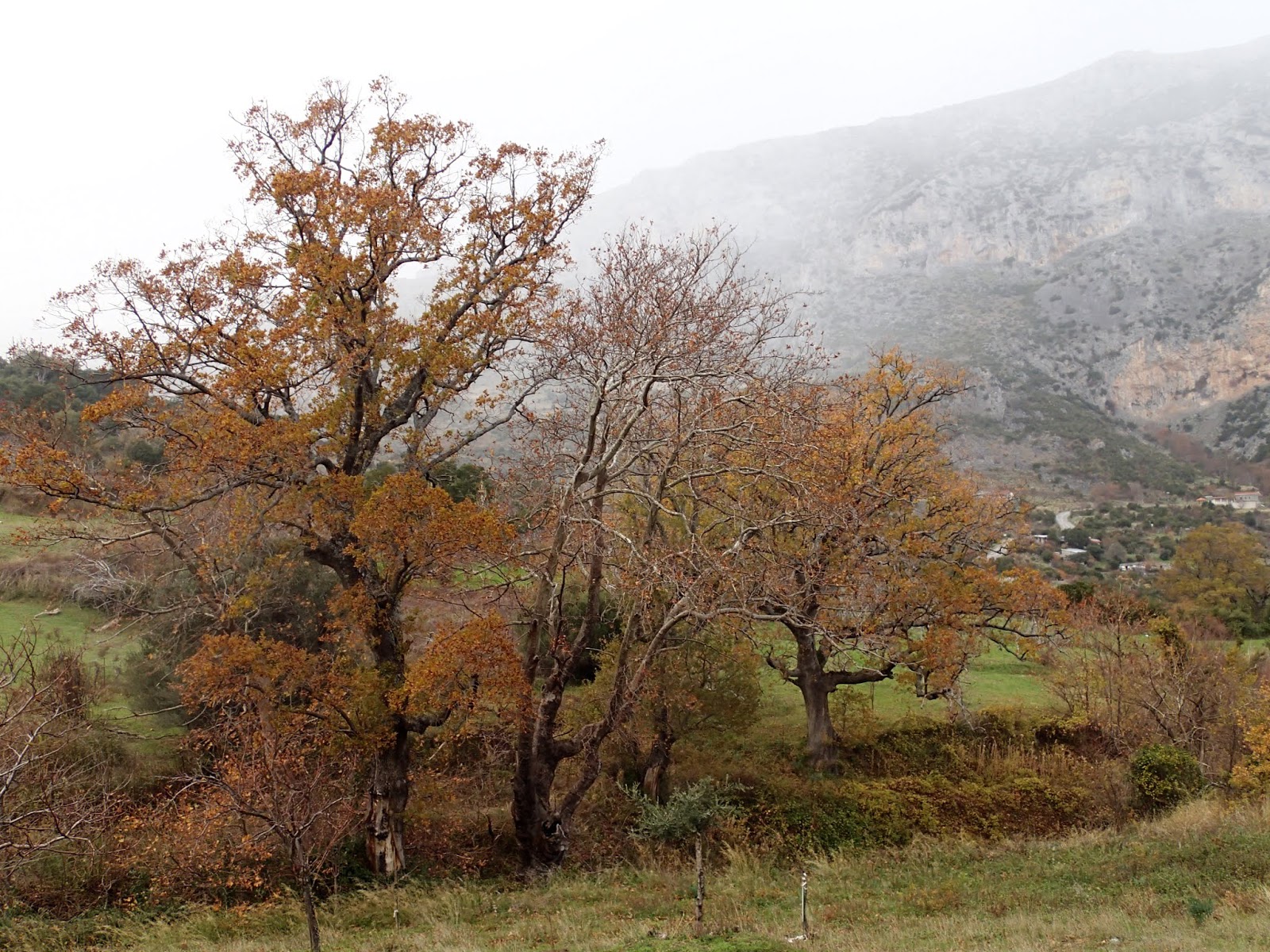
An oak and planes on a tiny tributary streamlet, near Manikia.


The medieval stone-arched bridge near the village of Vrissi on Kolethra tributary of the Manikiatis river.

The bridge near the village of Vrissi on Kolethra tributary.
Part of the river flows as an intermittent stream, immediately downstream of the Manikiatis Gorge.
Manikiatis Gorge in the distance. Bridge near Vrissi village on main stem.
Young eel found in the mid section of the river, before the Manikiatis Gorge.
On Central  Eubeoa we stayed at the Panorama Hotel at Platana,  we thank Katerina and Ilias for their hospitality and the wonderful views of the Aegean Sea.


Monday, December 9, 2019

Samothraki in Winter


Samothraki in Winter
December 6th to 9th 2019

A winter visit to Samothraki is nearly totally non-touristic. The overwhelming majority of visitors come here in mid-summer, so the ferry is now nearly empty. The place is totally different, calming, serene, wilder.

The occasion was a public meeting at the Chora. The issue concerns the the development of wind farms on Mount Saos!! We are against this idea - so is the Municipality of Samothraki - so we had a confrontation with the developers (one company showed up); all went very well.

So Vasso and I took some time to do some bird counting in the hills above Chora and at the Agios Andreas Wetlands (near Kamariotissa). We spotted 23 spp. in the Wetlands and nearly 20 in total above Chora. Just watching the ravens play in the sky is enough - in total quiet and peace. Highly recommended as a winter naturalist's retreat.


Kamariotissa, islands' port; early winter on Mount Saos.

Chora.
Above Alonia in the "Koufoptera" area; just a half hour's walk from Chora.

Oriental Planes at a spring above Alonia (western part of the island).

In winter Samothraki is full of Buzzards (Buteo buteo); this one above Alonia.
Above Alonia: wilderness.
The small pond just west of Kamariotissa (in the distance); unfortunately this place was chosen as the site for the future development of the island's sewage treatment plant.  Developments like this although bringing incremental changes slowly degrade important ecosystems.

Our first Flamingos; three immatures at the salty lagoon, Agios Andreas Wetlands.

They were actively feeding in the shallows.

Black-necked Grebe, Agios Andreas lagoon.

Black-necked Grebe, Agios Andreas lagoon.
Peregrine falcons were observed on two occasions this one at the Agios Andreas Wetlands Area.
The small lagoon south of Agios Andreas within Agios Andreas Wetlands: can you see the reflection of the moon?

The small lagoon south of Agios Andreas within Agios Andreas Wetlands. 

Long wintry walk.
Long wintry walk: Vasso Vlami took some of these photos - must give her more credit.

Encounter with an old billy-goat, almost too-friendly.
A group of Ruddy Shelducks (Tadorna ferruginea) - rare birds.


Reed Bunting at sunset.