Friday, October 10, 2014

Samburu County Assembly from Kenya visits HCMR


October 2014 Hellenic Center for Marine Research Anavissos Attika

The Consulate of Kenya provided us with a visiting group of Kenyan dignitaries from Samburu County Assembly who met with researchers at HCMR headquarters in Anavissos. During their brief morning visit to our premises they were informed of our work as an education component to their tour of Greece.

The group visited HCMR library and were briefed by librarian Mrs. Popi Panagiotoglou. I later accompanied the group to a nearby beach close to our premises, Agios Nikolaos. At Agios Nikolaos, we visited the old Byzantine church at the Tombolo headland, a WWII bunker, the views to the south across the cliffs and the lagoon wetland...now a legally protected area (and a great attraction for visiting distinguished guests!).  

All our new-found friends loved the meeting at our premises, the views and the Aegean Sea! I was impressed to learn that our Attika landscape is somewhat similar in form to the beautiful hill country at Samburu County Kenya!! Anyway, this time of year the Attika coastline has lovely gentle shine and tranquil peace. 

It was so wonderful to meet members of the Samburu Assembly and exchange ideas - including interest in collaboration. The tour was conducted with great care to detail by Mr. Njeru Bernard Gitonga (the tour leader from Kenya) and my friend Smaragda Adamantiadou who works at the Consulate. I thank the honorary consul Mrs.Vicky Pantazopoulou from the Consulate of Kenya in Athens for her initiatives to bring Greece and Africa closer together.

---------------------------------------------------------------------------------------------------
For more about Samburu County Assemblay:
http://samburucountyassembly.or.ke/office-of-the-speaker/


Sunday, September 28, 2014

What is Birding? in Athens...


Birding with our dog Teemo. He is leashed to my belt so I don't lose him.

Birding is a kind of quirky observation-meditation activity that usually non-scientists do. But it is a scientific way of observing nature. Its a way of 'being imersed' in nature, very much like hunting perhaps.

I bird in a big city, in Athens.
All my life I have thought that birding in the middle of a city can only be a bit boring.
This is not true. Anyone can learn to appreciate birding in a city - its interesting to observe; good recreation. This is not exactly an easy thing to do in a city that is not green, nor very open, nor well-planned for nature. Also a very dry and hot city for at least five months of the year. Athens.

The zen of birding.
You stalk birds.
You go into a real trance and think of nothing else; you hunt passively. Real observation, focus.

What you see:
Once in a while you see birds, you focus on them up close with your expensive binoculars. You study birds more as individuals. Sometimes you take a camera to take pics - to impress others. Sometimes you just have a 'bad' day. No birds. Sometimes a surprising lack of anything interesting shows up. But more often than not, I get surprised. I see new things.

Thanks to birding. 

Thursday, September 11, 2014

Natura 2000 project: Surveying with P.S. Economidis


A.N. Economou, former Directer of IMBRIW- HCMR with P.S. Economidis (R): Two important ichthyologists under Mt Iti.
Sept 11th 2014

Panos S. Economidis, Professor Emeritus of the Aristotle University of Thessaloniki, a pioneering Greek ichthyologist. A foundation-scientist of Greek ichthyology, especially important in shaping our understanding of freshwater fishes, their systematics and biogeography. 

It was a real pleasure to be in the field again with this legend of fish systematics - a man who has been active in Greek ichthyology since the early 1960s. He continues to be active writing and participating in research; he is now 80 years old. 

He has done so much for Greek ichthyology yet most of this work is unknown by the wider public in Greece. No other ichthyologist has published so much and such important natural history aspects in this country. For me some of his most important achievements include: "Catalogue of the Fishes of Greece" (1973); the amazingly descriptive and interpretive PhD on freshwater fishes of Eastern Macedonia and Thrace (1974); his work on systematics of many endemic fishes (The goby family; Barbus, Cobitis and other genera); his biogeographical regionalization work (e.g. with Banarescu 1991); his "Checklist of the Freshwater Fishes of Greece" (1991) and his pioneering species conservation assessment work. He has also written widely on many issues in the popularized literature, both on freshwater and marine fishes. Economidis's career included many fruitful collaborations with foriegn big-name scientists who visited Greece to work with him on the taxonomy of fishes. He and his associates discovered several fishes new to science in our waters. Professor Peter J. Miller named an entire genus of fish in his honour: Economidichthys. And there are fishes honouring him with reference to his name: Salaria economidisi and Rutilus panosi. Under the tutelage of the Late Professor Antonis Kanellis, Economidis also pioneered carefully constructed common names and standardized them during his contributions in two National Red Data books. He coordinated the conservation assessment of threatened fishes in the latest National Red Data list in 2009. 

Economidis is a strict and hard scientist working in a country that is wonderfully chaotic but 'soft' about issues such as fish conservation. He has been out-spoken and often a confrontational conservation and fishery management critic. He has a beautiful command of the Greek language and has a photographic memory - going back many decades. I do not agree with all he says, but every time we meet I urge him to write more, especially the popularized aspects and the history of the science in Greece. I enjoy a good and long discussion with him, especially on the history of early fish research, on places and species systematics; and on famous and not-so-famous persona of our field. Three days with Economidis is not enough. 

Here I share some snapshots of our three-day survey trip from Sperchios to Mornos rivers. The legendary fish-man of Greece, Economidis, was accompanied by Vasiliki Chrysopolytou of the Greek Biotope and Wetland Center (EKBY), my personal mentor A.N. Economou, and our super field ichthyologist, Vassilis Tachos from HCMR. All this within the frame of our Natura 2000 fish survey project.


Economidis: In active discussion on the biogeography of freshwater fishes, Moschochori Village, Sperchios Delta.

Economidis and Zogaris:  I feel like 'standing on the shoulders of giants", a great privilege to learn from a legendary fish-man.
The Natura 2000 fish crew: Exploring reed-choked canals in the upper part of the Sperchios river delta. 
Keeping Protocol: Vasiliki Chrysopolitou from EKBY helps in the quality control aspects of the survey method.
View from the Sperchios marshes ditch. Where are the fish? (Only three species caught here). 
One of the upper Sperchios Delta's canals with cool spring waters and seven species of fish! 

Sperchios canal was full with Marathon Minnows and many amphipods.
Top: Three-spined Stickleback; Bottom: Greek Stickleback. The latter one of the rarest fishes in Europe!

Sampling with the seine net in the river-mouth of the Achinos Stream near Karavomylos (Maliakos Gulf).
Grey mullets are typical transients in small river mouths such as the Achinos.
An unexpected catch: A huge marine prawn (Penaeidae) had entered the river mouth at the Achinos river.
Vassilis electrofishing in a spring-fed canal in the Mornos Delta. Super hot-spot for rare fishes....but hard to catch.
Vassilis Tachos HCMR's super field ichthyologist checking and re-checking the habitat and pressures protocol, on site at Mornos Delta. 
The freshwater blenny, Salaria fluviatilis, one of my favorite inland waters fishes - in the spring fed canals of Mornos.
Beach seine netting for estuarine fishes in the Mornos Delta. 

Unidentified and uncaptured fish, biggish bottom feeders: potentially Albanian Barbels Luciobarbus albanicus.

Economou and Chrysopolitou: Taking careful notes of fishes caught during the electrofishing survey.


Super-clear cold spring waters extremely important for endemic fishes: This area that is just beyond the boundaries of the local Mornos Delta Natura 2000 protected area: Boundaries should change...


Thursday, September 4, 2014

What's this minnow worth?


An unknown species of Minnow Phoxinus from a spring in Eastern Thrace
(image provided by Serdar DÜŞEN & Gürçay Kıvanç Akyıldız).
What is this fish worth?

Some ways to answer, in all honesty:

1) The value of a single species should be accounted for not by money but by time. Evolutionary time... and more!

I was sent this photo of a little minnow (...a Phoxinus minnow, still unclassified, unidentified...).
It lives in a cold water spring in the headwaters east of the Ergene river in NW Turkey (Trakya). It has probably been there for hundreds of thousands of years, surviving in the special cool-water springs. If they dry-up now or become polluted, the minnow will vanish.

2) Each species is part of our natural heritage. Heritage and history. Do you know or appreciate so little about your history?, your natural heritage? Do you appreciate any other values other than monetary accounting?  Biodiversity loss is a desecration of heritage.

3) Extinction is a loss of the treasures of natural selection. The loss of genetic adaptation, of ecological relationships within communities and ecosystems. It has taken thousands of millenia to develop these natural living networks...Do we have any right to exterminate a product of evolution?

3) This small fish is a rarity. For this reason alone its value far outweighs many commonplace human achievements (e.g. irrigation networks, military fortifications, religious shrines etc). The fish lives in a tiny bit of paradise: a rarity in the landscape, the cool-water spring. Some people will ask "How much is a spring ecosystem worth?" Its nonesense reall...But people will drink it up and exploit it if someone doesn't speak out. The fish is one of many reasons to speak out!

4) In scientific terms, the fish can recite a biology, a history, a geography, a cultural relationship. It can tell us a lot, but will we listen? It is a wider indicator of climatic, geologic and hydrological conditions. It lives in a sanctuary, the natural spring, is a part of a "bio-geo-historical monument". And the fish is only a small part of the ecosystem it lives in. Saving the fish, saves a whole ecosystem. The scientists - naturalists can describe the spring in detail (just like archeologists describe a historical monument). Trust the scientists! They spend their lives exploring species, places and connections.... And laws that protect this fish and its place are built on this scientific understanding.

5) A spring without its minnows loses half its fascination. Knowing about the fish, observing it in its waters offers sensations and emotions so deep that they give value....and quality to our lives. Without the fish, its native habitat would seem half dead.

6) Someone needs to speak for the fish! And I for one feel it is my privilege to participate. 
We as scientists, naturalists and travelers must confront the question: "what is it worth?"

What a shallow and sterile economistic view of life on Earth! What nonsence.

I feel there is an intrinsic value here that we must appreciate more than any monetary values. It is part of the cultural ecosystem services provided by nature to humans. The naturally evolving brilliance of wildness; the uniqueness of life-forms and their connections with places and with us. This is the major incentive in acting to defend the fish and this little paradise that sustains it. 

And yes, nature conservation is a cultural act. Without cultural development no one can understand intrinsic values or be able to conprehend natures treasures. Without understanding you cannot see the beauty, or the spirit of the meaning; or feel love for a place. A major incentive should be love; that is why we work for conservation.


A famous Turkish spring, the "Aulocrene" of classical literature, near the Anatolian town of Dinar; it is now called Karakuyu Gölü (Western Turkey, near the Springs of the Great Meander River). Its waters are crystal clear and cold! Places like this are hot spots for aquatic biodiversity. 


Comments:

#1. I thank Dr. Serdar DÜŞEN and Dr. Gürçay Kıvanç Akyıldız for supplying me with the minnow photo - it is one of many such photos I recieve for idntification.

#2. I dedicate this note to all the people in the countryside in all Mediterranean countries who have tried to answere the nonesensical question "what it is worth". You will succeed!

Thursday, August 14, 2014

Breksiza Wetland near Athens: Turtles!


Breksiza Wetland : Turtles!

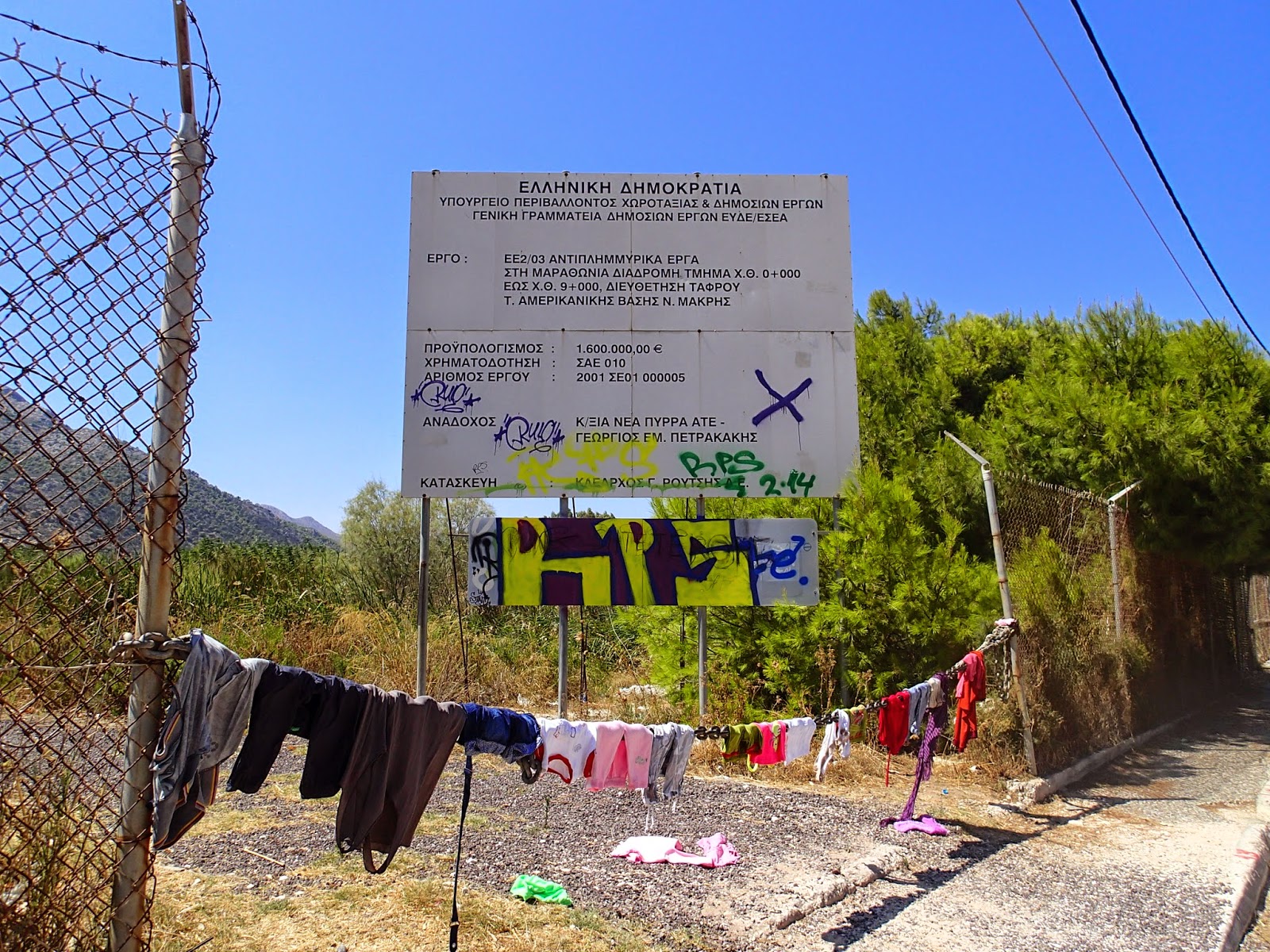
The former USA Military Base at Breksiza was dismantled after the end of the cold war. No naturalist knew that a tiny wetland was hidden inside! Then the local government etc. turned this prized piece of open ground into in to a dump; then with the 2004 Olympics at least 1.6 M Euros were paid for anti-flooding works on site. Its scandalous: I will not show the huge ridiculous culverts and high-grade concrete canals etc here – a totally unfounded claim for “anti-flooding public works scam”.  There is no upland catchment for flooding, no river valley, only a karstic spring-wetland….*

Ok, now turtles.

Many people like Turtles, especially when you see them in clear spring waters with the little ‘fishies’ and you can throw them some popcorn or bread. You get the idea….This kind of 'summer fun' takes place at Breksiza wetland behind Nea Makri beach (about 35 km due east of Athens). 

I reacted to the call to go and see if the “turtles are dying from the pollution-choked waters at Breksiza”. An environmentalist friend found me on my cell. So, Dimitri my son, a 17 year old impatient spear-fishing macho type and I drove over to Nea Makri on this blistering hot midday. Ok.

These are our observations and photos in 15 mins we spent watching the turtles:
  •        The turtle numbers did seem marginally lower (we had counted at least a couple of dozen two years ago- but this may be just the timing of our visit - I think they go into aestivation during a very hot summer sometimes...). But the composition is as in the past: We counted 10 Mauremys rivulata (Stripe-necked Terrapins), 3 Trachemys scripta (Red Ear Slider – an American invasive sold at pet stores everywhere) and one Emys orbicularis (European Pond Terrapin). All these at the tiny pool with clear spring water rushing in from the large spring-fed pools upstream of the “Sanctuary of the Egyptian Gods” just north of Nea Makri proper.
  •         The native terrapins about – both species – are native wildlife, protected by EU Directives and Greek law, for those who do not know better; PLEASE DO not feed these animals; PLEASE do not introduce domesticated (often disease-ridden captive alien species such as Aquarium turtles). Turtles are very smart (!!!), they will become conditioned to feeding, but they will also find a way to find food. I have actually seen them foraging for grapes in vineyards at the Karystos wetland during a very dry drought. What will kill them is the destruction of the wetland at Breksiza….
  •          There were a very few foam bubbles in riffle of the canal waters at Breksiza. Probably from detergent used to wash clothes, since several of families of Gypsies squat around the waste-ground and sell trinkets near the beach. So the “foaming polluted waters” probably refer to this.
  •           Terrapins are rather resilient to water pollution; and the water is still flowing strongly, actually even entering the sea a few meters downstream of the culvert (…the “super-culvert paid by EU taxpayer’s money!!!).
  •      We also made some serious fish observations. Two age classes of grey-mullet (Liza sp.) and to our amazement a predatory fish stalking them….it was a sea bass about 10 cm in size (see below). My son’s opinion is that it is in fact a Striped Sea Bass (Dicentrarchus punctatus), a rather rare fish in Greek freshwaters (see former blog posts of mine on this). I think it is the first time it is reported in the wetlands of Attika (although truthfully we have’nt searched much…).
Finally my son was a bit nerve-wracked by my insistence to stay and “photograph” the turtles, but we did’nt fight on this. The midday sun was glaring at 38 or so degrees.

I thank my environmentalist friend for phoning to ask to go check on the turtles. We’ll be back soon.
  

*A natural wetland always existed on site – sacred also to the watery Egyptian Gods who have a sanctuary on site! (See http://www.greekmonuments.com/Marathon/egyptian_gods.html). Its a spring-fed clear water wonder- this tiny relict spring. Of course it was almost thoroughly drained when the refuges from Makri landed here from Asia Minor in 1923 and then again I guess by the Americans. So please, why the 1.6 m. European Euros for flood protection? It could have become a beautiful wetland nature park. How many of us feel disheartened about this wasted opportunity at Breksiza? 


One of the two spring-fed 'streams' from the spring-lake wetlands of Brexiza. Agriliki Hill a foothill of Penteli in the background.
The river mouth of the stream above entering Marathon Bay, looking NE towards the nearby Schinias National Park.
Pre-construction estimate of 1.6 million Euros for anti-flooding works and gypsy clothes drying at Breksiza.


Dimitris walks through a part of the 'savannah' near the wetland (on R). Agriliki hill in the background - a fragment peice of 'Wild Attika'. What an opportunity for NATURE PARK. (Wake up!!!!).
Fence in former USA Military Base of Nea Makri. Thanks USA.
Pond terrapin above (a rare species, needing clear lotic conditions) and the more hardy Striped-necked Terrapin. Both native turtles in need of protection.
The beautiful alien from the pet-stores, Red Ear Slider an American speceis at Brexiza. Only large adult individuals seen. Please do not throw your pets away. 
To my surprise, the turtles were peristantly looking for food hand-outs!!! Just like in Florida. Ok. This is not cool.
European Pond Terrapin. A rarity in Attika; "Near Threatened" in the Greek Red Data Book, a declining species in this country. 


Young Stripe-necked Terrapin. Also "Near Threatened" in the Greek Red Data book. Both speices are protected by the Habitats Directive as well. Now you know the names...remember them**
What species is this?


The fish on the top Left is a Sea Bass with spots. Lots of spots. Dimitris says its definately a Dicentrarchus punctatus. The others are Mugilids (Liza sp.).
You can watch the fishes (little Grey-mullets) and the Turtles. Wild!


** Names of the Turles in Ελληνικά:

Stripe-necked Terrapin = Ποταμοχελώνα (ή Γραμμωτή Νεροχελώνα)
European Pond Terrapin = Βαλτοχελώνα (ή Στικτή Νεροχελώνα)
Red Eared Slider = Κοκκινόλαιμη Νεροχελώνα

Thanks for listening students!

Dikelas Night Dive at Karystos


Mid August 2014 Karystos, Euboea Island Greece

Best ecotour experience: A night dive!
For youths, to break-free of civilization as-we-know-it, nothing compares to night diving. On this dive Thaleia and Artemis of the Dikelas Dive Center in Karystos guided a team of five – two of us included a 12 year old Constantine and my 17 year old Dimitri.

Just 10 minutes speed-boating southeast of Karystos: Waves rocking, dizzy– until we were set free outside, go under, GO!

We actually did two dives one before sunset, one at about 22:00; 40 minutes each; down to 24 m depth. But behind the snap-shot flashes and filming was an eerie trance, beckoning kids across ages. Overwhelming and mysterious pelagic majesty.

You do not feel fear, but awe and out-of-this world scenes flood new experiences. The lights exaggerate the alien feeling. The same scene two hours ago was totally different.

The numbers of fishes at night are much lower, but some really interesting encounters take place; a menacing Moray Eel, several octopi, larger-than life breams, bright red cardinal-fish and scorpionfishes, sleeping rabbitfish, varied patterned parrotfish, amazing colours everywhere.


I highly recommend this gift to any family.