
February 1st 2014
I lived in Canada between 1986 and 1995; although I was born and partially raised there, this was the time I became most attached to it. I was fortunate to be active in protected area campaigns as a naturalist. I would call myself then a young naturalist-activist. This was a special time in Western Canada - many critical steps were taken to expand the protected area network and also to protect land and wetland in and around the sprawling city of Vancouver. One of the many success stories from that time-period was work done to envision, organize, campaign and ultimately create a peri-urban protected-area at Maplewood Flats in North Vancouver.
It should be known, although history has been written sometimes sloppily, that Maplewood Flats was not an easy or gracious gesture by the then Port of Vancouver to the citizens of the city. At the Flats we put on a fight - we were pitted against the Vancouver Port Corporation a big government authority that wanted to develop everything. YES nearly everything. The social and societal aspect of this grass-roots movement helped develop strong ties among local naturalists, NGOs, and government: a win-win situation developed. The end result was the creation of a new small protected area, where an ambitious restoration project took place, at the edge of an industrial mega-harbour. The "Flats" has become an out-door school. It is now co-managed both by government and an industrious naturalist-run NGO, the Wild Bird Trust (WBT) of BC.
Maplewood Flats is important: An Important Bird Area where 246 species have been recorded, and a place to meet like-minded naturalists, to bring issues of wildlife and natural history to the for. A small nature house is being expanded to an interpretation center and a government environmental monitoring facility is also located on site. Wild Bird Trust, its passionate local volunteers, helps manage and contributes to wildlife monitoring.
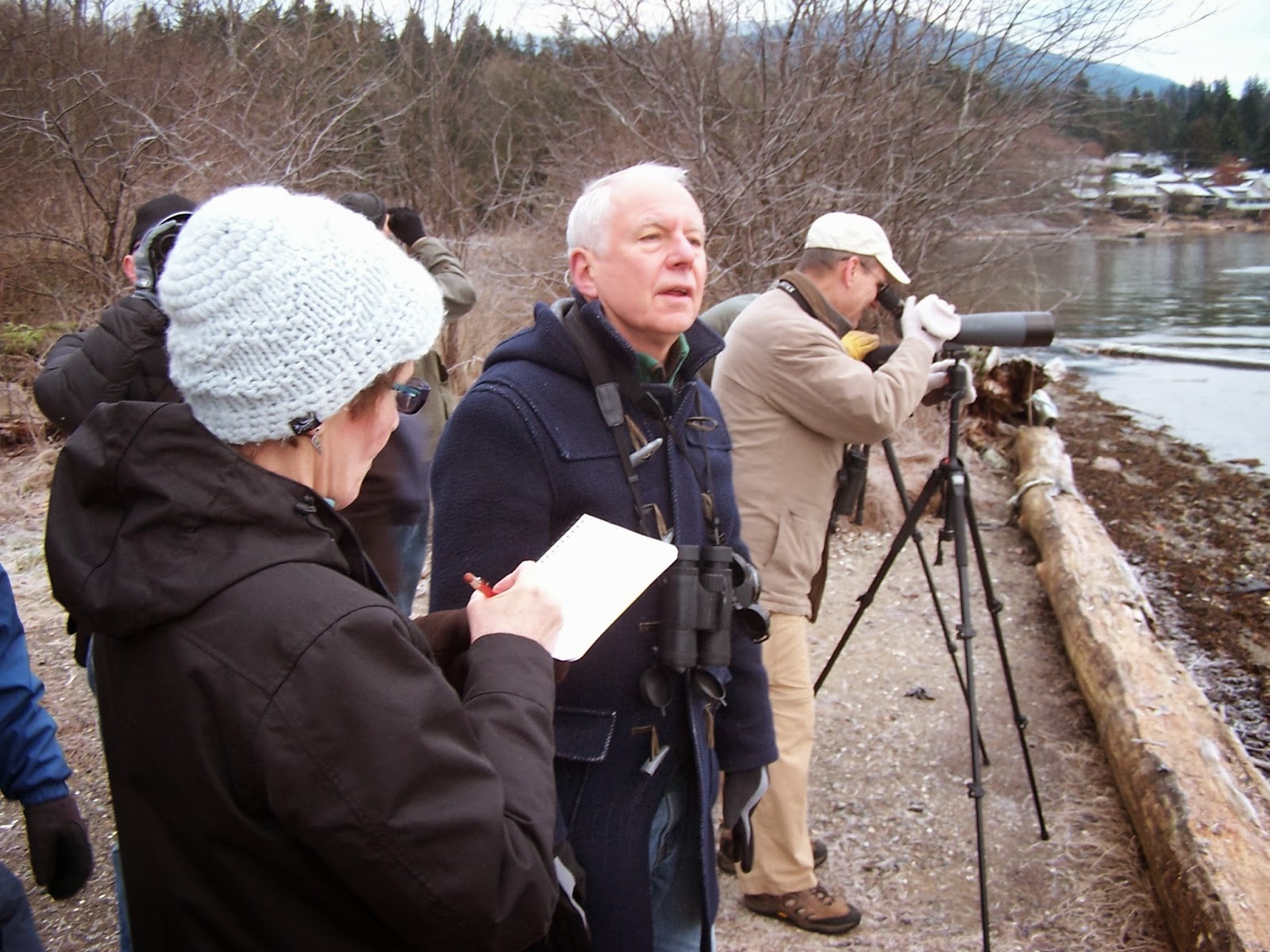
On the first of February, I participated on a bird survey that has been standardized and is a routine citizen science contribution for nearly 20 years now. I spotted 36 species during the two hour walk - but was mostly talking to old friends and new-made friends who are really excellent naturalists. I want to thank my old friend Kevin Bell, former curator of the Lynn Canyon Ecology Center, for being there for Maplewood Flats. Kevin Bell is no doubt the instigator and God-Father of this protected area. I feel I should write more about Kevin and the many others who worked so hard, for so long, for so much!!! Because we must be grateful in the end we, the citizens and the city has won. Times have changed from the late '80s and early '90s but its important to recall the history of a conservation movement and the actions that really did change the world for such a small but important corner of Burrard Inlet.
And to remember the work and contribution of Kevin Bell, for contributing so passionately to local natural history and to culture.
UPDATE: Many years later the history of the area is still told in the papers (some historic facts skewed): http://www.nsnews.com/community/deep-cove-crier/for-the-birds-saving-maplewood-mudflats-1.6508067


UPDATE: Many years later the history of the area is still told in the papers (some historic facts skewed): http://www.nsnews.com/community/deep-cove-crier/for-the-birds-saving-maplewood-mudflats-1.6508067


 |
| This is the small group of us - winter birding! Its obvious I make an effort to stand out! |
 |
| And my Irish-Canadian friend and comrade-in-arms Kevin Bell. From 1986 to 1992 I learned so much from him and the conservation work he championed. I was of course well-trained to help fight, having come back from Greece with some bitter experiences (...). I have so much to say about Kevin...now just a big: Thank You! |


