
Mid-August 2013
RAPID FISHWATCHING SURVEY
In between "upland wetland-stream work" on Samothraki I managed to get 7 rapid snorkeling dives.
These I call "Rapid Fishwatching Surveys- RFS"; an easy look-see technique to record the fish community (i.e. species richness, relative abundance (guesstimated per spp. per dive), and record of larger or interesting individuals (specimens larger than 15 cm noted). Of course this can be combined with photography. Three of us did quick snorkels but only I recorded fish on a wrist-pad underwater. The other two colleagues mainly spearfished (N. Skoulikidis =NS and D.Zogaris= DSZ, my teenage son) . The results of my RFS are not that spectacular but they are worth mentioning, especially since so little knowledge of inshore shallow coastal fishes exists for Samothraki.
These I call "Rapid Fishwatching Surveys- RFS"; an easy look-see technique to record the fish community (i.e. species richness, relative abundance (guesstimated per spp. per dive), and record of larger or interesting individuals (specimens larger than 15 cm noted). Of course this can be combined with photography. Three of us did quick snorkels but only I recorded fish on a wrist-pad underwater. The other two colleagues mainly spearfished (N. Skoulikidis =NS and D.Zogaris= DSZ, my teenage son) . The results of my RFS are not that spectacular but they are worth mentioning, especially since so little knowledge of inshore shallow coastal fishes exists for Samothraki.
RESULTS
 |
| Fig. 1. Google Map of sites snorkeled. |
Seven sites were visited (mapped above). Here some locality and habitat details are given; the sampling effort (i.e. CPUE) estimation is probably best assumed relative to the time spent in water but local conditions and personal interested affected this. Observations - and length of stay in water- are all relating to my time and personal documentations. Observations by NS and DSZ are given in parentheses. [In brackets the date of survey at each site is given]. I may publish a species list elsewhere, species identifications of all photographed fishes are not yet verified.
These are the sites and scenes I saw:
1. Agia Paraskevi (NE side). Small reef-islets just offshore tiny church beyond typical cobble beach.
c. 60 mins. very clear (visibility 15 + m.); beautiful seascapes, mixed bottom; checked quite well, Perfect quite snorkeling mid-day conditions.[14.08.2013]
-20 Fish taxa observed.
-Largish mugilids (i.e. grey-mullets) and large numbers of Salpa (Salema Breams).
(NS spotted a Dusky Grouper nearby; but I saw not a single specimen)
2. Yiali (SE side). Shallow swim near steep-dropping cobble-boulder beach. Quite clear. Very deep water offshore.
c. 40 mins. Swim at sunset. Clear waters rather monotonous boulder-dominated environment. [13.08.2013]
c. 40 mins. Swim at sunset. Clear waters rather monotonous boulder-dominated environment. [13.08.2013]
- 18 Fish taxa observed.
- Lots of spearfishing takes place here (4 individuals were spearfishing at this far-off place).
(DSZ saw a huge Moray Eel; None of us saw any groupers or any large pelagics. Ok, I expected sharks here!!).
3. Agios Petros (E side) near Kipi. VERY strong west-east current very turbid situation; visibility 8 to 10 m at best.
c. 60 mins. Snorkeling near spear-fisher this time (DSZ), poor visibility and high waves impeded careful observation. [14.08.2013]
c. 60 mins. Snorkeling near spear-fisher this time (DSZ), poor visibility and high waves impeded careful observation. [14.08.2013]
-15 Fish taxa observed.
- Lots of bigger-sized fishes here; dusk dive proved quite rich.
4. Agistro (NE side). Near Agistro River Mouth there is a Cape with varied bottom (close to small building labelled "Samothraki Diving Center" - which was closed). Extremely strong west-east current making observations and swimming difficult. Varied rocky but shallow. [15.08.2013]
c. 20 mins. Not adequately sampled - incomplete survey. Turbid: less than 8 m. visibility - strong current impeded observations.
- 11 Fish taxa observed.
- More than four spearfishers working the area.
- More than four spearfishers working the area.
(D.S. Zogaris saw a school of fantastic large billfish type fish that remain unidentified - seven largish specimens he says.Other fishermen gave us a huge Mugil cephalus they had hit; they had also speared a huge octopus - maybe 3 kg).
5.Aegaion Hotel Beach (N side; just west of Therma Harbour). Typical cobble boulder bottom with some posidonia beds and sandy flats offshore.
c.30 mins. Late sunset snorkel, very rapid and recreational view not all habitats checked. [18.08.2013].
- 11 Fish taxa observed.
- Lots of Salema Breams.
- Lots of Salema Breams.
6.Pacheia Ammos (SW side of Island). Varied seascapes. First went to the west (large house-sized boulders) then the sandy area and to the east (cliffs).
c. 90 mins. Late afternoon snorkel. Wide range of habitats checked; spectacular area. [19.08.2013]
- 29 Fish Taxa observed.
- Only place several species seen on island including Thalasoma pavo.
- Fantastic but really small Stingray Dasyatis pastinaca.
7. Pygos Gateluzi East (N Side). About 2 km east of Palaiopolis archeological site.
c. 15 mins. Midday break, not surveyed just checked; but placid conditions. [20.08.2013]
c. 15 mins. Midday break, not surveyed just checked; but placid conditions. [20.08.2013]
-17 Fish Taxa observed
- Typical same stuff seen along most beaches of north coast.
DISCUSSION
-It is interesting for me that several spp. of fish common in the south are missing (e.g. parrotfish, cardinalfish, groupers). Other species are present but extremely scarce and seemingly localized (Serranus cabrilla, Thalassoma pavo). Of course I compare this to experiance in the Centeral Western Aegean.
-Generally waters were clear and at two of the seven locations as clear as the clearest in the Central or Southern Aegean.
-Waters were generally warm (not like Samos or Lesvos - the Eastern central Aegean up-welling area).
-Generally waters were clear and at two of the seven locations as clear as the clearest in the Central or Southern Aegean.
-Waters were generally warm (not like Samos or Lesvos - the Eastern central Aegean up-welling area).
-There is no doubt in my mind that these areas are over-fished and especially by spearfishers. Species such as Grouper and the large labrid wrasse (Labrus spp.) are very very rare now. I saw only three specimens of Labrus sp (one my son shot!). I saw no Groupers at all.
-Despite the above comments in many places Sparids, Mugillids and Salema Bream were in much larger numbers and generally larger than those seen in Central West Aegean waters (i.e. Eubean Gulf/ Southern Euboea).
-Despite the above comments in many places Sparids, Mugillids and Salema Bream were in much larger numbers and generally larger than those seen in Central West Aegean waters (i.e. Eubean Gulf/ Southern Euboea).
- The local igneous rock geology makes the underwater scenes different from a limestone/marble or metamorphic rock dominated seascape. Rocks are rounder here. The characteristic round boulder-cobble beaches of the north coast are iconic of Samothraki, but very boring. Few bays, out-lying reefs, islets exist to make the forays exciting on the north and north-east coast.
- This first survey trial is a very crude subjective quick-glimpse and cannot given much scientific understanding. More work, either casual snorkeling of this type (RFS) or more structured observation is necessary and could be very interesting for education and monitoring.
PHOTOS
PHOTOS
 |
| Northern Aegean Light! 15 m + visibility at Agia Paraskevi. |
 |
| I got good videos of these tiny Salema Breams. Agia Paraskevi |
 |
| Big Grey-mullets by-pass Dimitris - my spear-fishing teenager - at Agia Paraskevi. |
 |
| Painted Comber Serranus scripta. Agia Paraskevi |
 |
| The Wrasse Symphodus mediterraneus. Agia Paraskevi |
 |
| View from chapel of Agia Paraskevi. |
 |
| Coast towards Yiali from Kipi Beach - wilderness! |
 |
| Ok, this is where I would expect a GWS to come into view (Yiali). |
 |
| Yiali. I think this is over-fished; these breams should be bigger - too many spearfishers... |
 |
| Agios Petros, close to Kipi - very strong current, rich habitat. DSZ is searching for groupers...nothing! |
 |
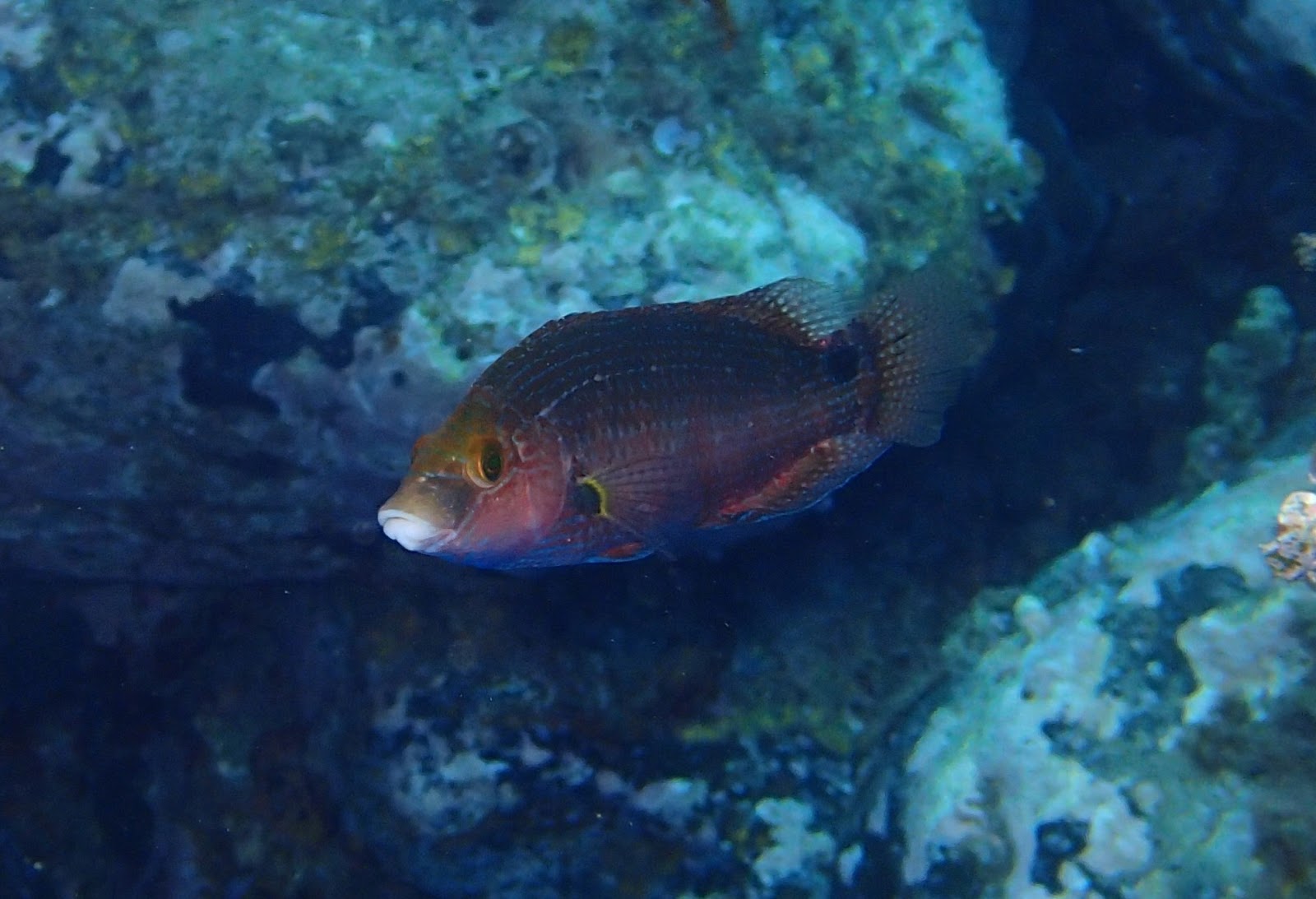
| A "huge"wrasse, Lambrus merula. This genus has probably suffered gravely from spearfishing. DSZ shot this one - I cannot forgive him! |
 |
| Aegaion Hotel Beach. After sunset. |
 |
| Aegaion Hotel Beach. After sunset (small Salema Breams). |
 |
| Pacheia Ammos: The most beautiful beachscape and seascape on the island: threatened by beach-side developments... |
 |
| Striped Red Mullet, Mallus surmellatus - most people don't now they come in different colours (Pacheia Ammos). |
 |
| Red Mullet Mallus barbatus - note no stripes on dorsal; called "Koutsomoura" (snub-nose in Greek) at Pacheia Ammos. |
 |
| Brown Comber Serranus hepatus; only one spotted (Pacheia Ammos). |
 |
| Small gravel goby called, Bucchich's Goby Gobius bucchichi (Pacheia Ammos). |
 |
| The Common Seabream Pagrus pagrus (Listed as ''Endangered" in IUCN assessment). Only one spotted at Pacheia Ammos. |
 |
| The only elasmobranch seen: The Stingray Dasyatis pastinaca at Pacheia Ammos (3 m. depth). |
 |
| Common Octopus at Pacheia Ammos (defensive posture on sand, perhaps mimicking a ray or something dangerous...). |
 |
| The commonest flatfish in Greece in the shallows is the Wide-Eyed Flounder, Bothus podas (Pacheia Ammos). |
 |
| Nearly 20 m. visibility at Pacheia Ammos. |
 |
| Cliff habitats to the East of Pacheia Ammos. |


