Monday, December 9, 2019

Samothraki in Winter


Samothraki in Winter
December 6th to 9th 2019

A winter visit to Samothraki is nearly totally non-touristic. The overwhelming majority of visitors come here in mid-summer, so the ferry is now nearly empty. The place is totally different, calming, serene, wilder.

The occasion was a public meeting at the Chora. The issue concerns the the development of wind farms on Mount Saos!! We are against this idea - so is the Municipality of Samothraki - so we had a confrontation with the developers (one company showed up); all went very well.

So Vasso and I took some time to do some bird counting in the hills above Chora and at the Agios Andreas Wetlands (near Kamariotissa). We spotted 23 spp. in the Wetlands and nearly 20 in total above Chora. Just watching the ravens play in the sky is enough - in total quiet and peace. Highly recommended as a winter naturalist's retreat.


Kamariotissa, islands' port; early winter on Mount Saos.

Chora.
Above Alonia in the "Koufoptera" area; just a half hour's walk from Chora.

Oriental Planes at a spring above Alonia (western part of the island).

In winter Samothraki is full of Buzzards (Buteo buteo); this one above Alonia.
Above Alonia: wilderness.
The small pond just west of Kamariotissa (in the distance); unfortunately this place was chosen as the site for the future development of the island's sewage treatment plant.  Developments like this although bringing incremental changes slowly degrade important ecosystems.

Our first Flamingos; three immatures at the salty lagoon, Agios Andreas Wetlands.

They were actively feeding in the shallows.

Black-necked Grebe, Agios Andreas lagoon.

Black-necked Grebe, Agios Andreas lagoon.
Peregrine falcons were observed on two occasions this one at the Agios Andreas Wetlands Area.
The small lagoon south of Agios Andreas within Agios Andreas Wetlands: can you see the reflection of the moon?

The small lagoon south of Agios Andreas within Agios Andreas Wetlands. 

Long wintry walk.
Long wintry walk: Vasso Vlami took some of these photos - must give her more credit.

Encounter with an old billy-goat, almost too-friendly.
A group of Ruddy Shelducks (Tadorna ferruginea) - rare birds.


Reed Bunting at sunset. 

Tuesday, November 19, 2019

Western Aegean Freshwater Fish explorations: HCMR Yellow Fish project (Xerias Istiaia and the Beotian Kifissos)


The Xerias River on Euboea Island. Part of it is naturally intermittent - but there were spring in the Delta. An important N2K protected area. 

13-18 November - Eastern Central Greece

We are doing some late season fish sampling to gather assemblage data in rivers and wetlands and little-known areas that still have serious gaps in our databases. This for a new HCMR project "Yellow Fish", an awareness generating and outreach project to protect rivers and other waters from human negligence and neglect. Some sites we visted are protected areas, some are near N2K boundaries but just outside and not targetted at all for preservation, conservation or restoration.

See the initiating report for this project (in Greek) here:
Kitrino_Psari_HCMR-IMBRIW_EKPAA

I provide snap-shots from the recent reconnaissance electrofishig trip in the Western Aegean Ecoregion waters: two sites are shown here: one in the far north of Euboea Island and one in the mysterious Beotian Kifissos river. Both sites yielded fish discoveries.


 The Xerias Delta of Istiaia Wetlands of Northern Euboea Island

Mikro and Meglalo Livari (Lesser and Greater Lagoons) in the Xerias Delta.

Xerias a few hundred meters before its river mouth.
Yours truly at Xerias, note the dip-net I bought in Albania this summer: Had real big probs with my wrist and thumb this September - now I'm functioning 100% (I know you may not care about these intricate details...). 
Xerias bridge and the "water fall": BIG big problem for fish:total migration barrier.

Fish cannot climb this: FISH cannot CLIMB this. (Wake up!!!). This is within a Natura 2000 protected area and we need to act for some pretty rare and threatened species - this is is a priority.

The grey mullets - the Mugilids - they are important for otters as food (but they cannot swim up beyond the bridge barrier....).

This is another vulnerable - but nearly totally freshwater - and running-water- freshwater fish: the River Blenny (Salaria fluviatilis). We only found a single specimen and only below the bridge. THEY CANNOT climb up the bridge...(The population is obviously seriously threatened - we have not found them anywhere else in the Xerias river - we have checked last year). 
New species for Northern Euboea: an obscure dwarf goby, probably in the genus Knipowitschia. No idea it was here - also below the bridge (but it usually tolerates brackish conditions and would probably survive a severe drought (probably). 


And...yes we found Barbus euboicus within the Natura 2000 site of Mikro and Megalo Livari for the first time. In a recent publication my European colleagues determined that this species is NOT Barbus sperchiensis as formally alleged but the rare island endemic - the Evia Barbel. Important fish also threatened by barriers. 

We looked at the lagoons - there were Gambusia holbrooki (Eastern Mosquitofish), and lots of birds.
Wild Mute Swans - everyone loves birds, what about fish?

This is not totally irrelevant: an Egyptian Desert Cockroach (Polyphaga aegyptiaca - female): the first I see in Greece was even more exciting for me than any swan - any day...We found at a restaurant veranda in the quaint seaside town of Limni about 45 km. south of Istiaia. Best meal-discussion ever! 


The Osios David Gorge and Waterfalls 


In the dark cold waters of the perrenial stream flowing near the famous falls of Osios David, this small stream has a NEW FIND: A chub! Look at the dark complexion on this fish; dark fins like the Squalius orpheus of Thrace. Now one knows what it is yet. Where it came from? Dimitris and I visited the area on a separate date with the ferryboat from Agios Konstantinos. (Catching these fish was not easy - and we were really exciting having YouTube videos of the dark specimens from amateur underwater footage). 

The Beotian Kifissos River 

Dodwell's lithograph from 1805 featuring the spring-fed Melanos Potamos in the Kifissos valley. I should say we met up with our good HCMR colleague Dr. Christos Anagnostou at Livadeia and worked with him in this amazing and little-studied area. I post the piece of art to remind us all that these landscapes may have changed a lot - but the natural spring-fed waters and open cultural landscape nuances are still here. Conservationists be aware!

Mavroneri springs, near the village of Mavroneri. This place is not the site depicted in Dodwell's painting but it is very similar and in a rather natural state as a spring-fed wetland. 


Mavroneri Spring.

Walking with Christos Anagnostou along the Melanos Potamos. Beautiful cultural landscape. (Several sheepfold in the area with semi-fierce dogs; wolves and wild boar present occasionally). Note this area is about 100 Km north of Athens...

Mavroneri Spring and the church dedicated of course to the water deity...John the Baptist (Ai Giannis). 


The Beotian Kifissos at the Davlia Train Station. Waters were crystal clear and at low-flow (but not the artificial base flow of late summer, I guess). Fish were scarce -low density, very few large fish. I reckon its because of very low water levels in summer - we had some drought conditions in late summer this year (other years are worse). So...the potential dominant problem here may be water abstraction for agriculture.  This probably affects the fish populations.
Note the clarity of the waters... This is a distinctive river type as a fish assemblage type a four species community in cold waters in winter, warmish in summer (and rapid lowering of flow in summer and all through autumn) but with an extremely strong freshet  flood from spring snow melt from the Parnassus range. The river is embanked and straightened to a degree - to protect from flooding. But generally conditions seem fairly semi-natural. 
Sampling here with a three man team is not at all easy; the back-pack electrofisher does not work well in waters deeper than 1.3 m. The idea is to "surprise" the fish at natural barriers or when they take cover in cover -at falls, under-cut banks, tree roots (...they can see us well!).

Of the Kifissos fishes....Telestes beoticus (Beotian Riffle Dace): THE most emblematic endemic of the area.

Pelasgus marathonicus (Marathon Minnow): The "swamp-minnow" that also lives and thrives in slow-flowing river conditions; often in springs but can tallerate warm waters as well; a survivor! 

THE NEW FIND (!!): when I saw this fingerling I nearly panicked!! Its a chub (Squalius sp.). We have never found a chub -any chub- in the Kifissos. However, the late Alexander Stephanides had mentioned some kind of chub-like creature in the nearby Beotian Assopos - which had never been seen thereafter (read Economou et al. 2007). What could this chub be?
Better looks at the newly discovered Chub specimens in the Kifissos (they could easily be introduced translocated fishes - we don't know). So we are researching this. 
The second most EMBLEMATIC endemic of the region: Luciobarbus graecus (Greek Barbel). This was the commonest species along with the "easy-to-catch" Marathon minnow.


Luciobarbus graecus (Greek Barbel)
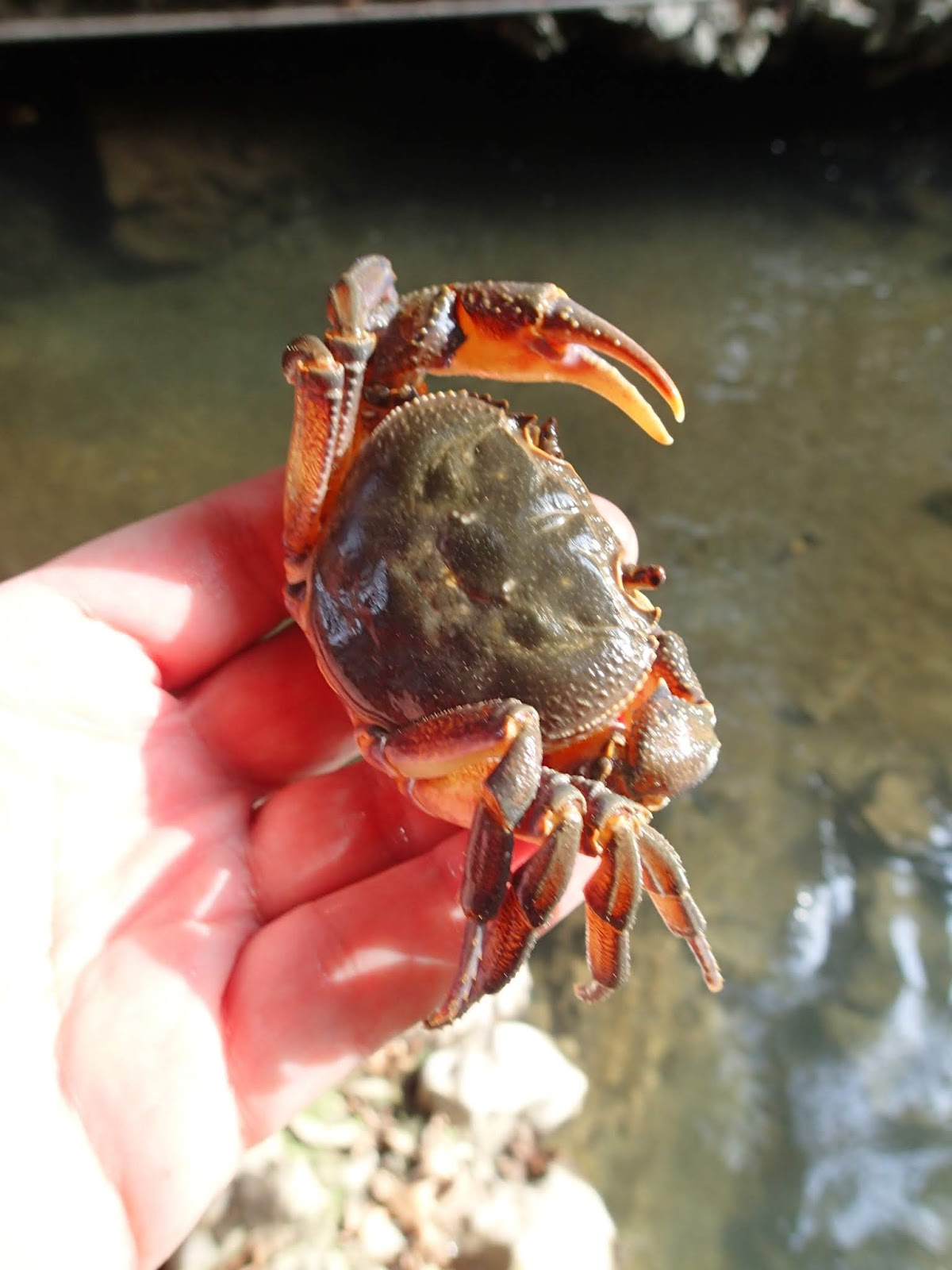
Potamon fluviatile (River Crab) - IUCN "Near Threatened" species. 
Spraints left by otters - Lutra lutra.

The upper part of the Kifissos - with a wonderful Platanus orientalis woodline (and many other tree species as well). This place not in the area's Natura 2000 delineation.
Mavroneri springs: This place not in the area's Natura 2000 delineation.


Sunday, October 20, 2019

Aliens stimulate us to research aquatic natural history

This is not a goldfish, it is an alien asiatic carp!: Raphael Biagini caught this 14 kg. Koi Carp in a lake in France (https://theawesomer.com/colossal-koi-carp/60431/#).


October 2019 - recent papers and prospects on freshwater alien species

We have a BIG problem with freshwater alien species in Europe!

This realization has helped spawn a wave of awareness campaigns, regulations and new research that is also supporting basic natural history surveys. Surveys for species distributions and characterizations of aquatic biocommunities are all happening to monitor and track aliens. This has created something of a positive windfall for natural history research in aquatic environments in Europe: Thanks to the alien species problem!

I remember in the late '80s and '90s when scientists were saying they were "not interested" in the natural history: the species lists, distributions, descriptive stuff etc- these were things nerdy old-fashioned birdwatchers do, not scientists. ...It was the molecular, mathematical, bio-statistical, modeling stuff (and a little later, the GIS stuff) that got the grants. Of course there was the focal species approach, i.e. 'endangered species' work, but the holistic natural history long-view and understanding of "distributions and assemblages" was really not in vogue. Well my friends, this has changed...

Today, you can go snorkeling on holiday and find a "publishable alien fish record". We are witnessing a tropicalization of the Mediterranean; a biotic homogenization of our lakes and rivers - and this may be big for science and for amateur naturalists - who can certainly participate! We need to track this, to monitor the changes - to help assess the real threats. We are able to use citizen science (a research approach I never heard of in the eighties or nighties). Money has always been thin for natural history research, but maybe the "aliens" have provided a new stage... Aliens are helping scientists become better naturalists: You need to know what to distinguish as "alien". You need to understand the workings of biocommunities, the history, multiple human pressures... and biogeography is back! And we are trying to do good science with this.

At HCMR we recently developed a simple assessment procedure, applied to rivers, streams and springs, the so-called "lotic waters" of Greece. We are also looking at interpreting some of the problems these alien and "translocated species" are creating (or are thought to be creating...). The philosophical aspects of aliens and translocated species are also fascinating. Revenge for the naturalist!

In the last few years, I am working closely with several researchers at HCMR in Greece, and in Cyprus on this issue. We are doing many little things to build a picture: a) state-wide assemblage patterns and impacts of freshwater fishes in my lab with Nikos Koutsikos and the HCMR/Univ. Aegean team, b)  eDNA work in Cyprus, c) tanslocated and alien impacts from molecualar to assemblage level with several European colleagues, and c) presenting new range distributions and interpretations/evidence of impact of several "new finds" including freshwater fish and aquatic invertebrates from Greece. We have done some screening of fish impact and also some proposals for awareness, costing of measures and control. Its a big, chaotic thing, but quite fascinating for the naturalist and conservationist.  

See some of our alien fish species papers/research reviews below:

  • Tracking non-indigenous fishes in lotic ecosystems: Invasive patterns at different spatial scales in Greece - April 2019 - Science of The Total Environment 659:384-40
www.sciencedirect.com/science/article
or
Tracking_non-indigenous_fishes_in_lotic_ecosystems
  • Does rainbow trout justify its high rank among alien invasive species? Insights from a nationwide survey in Greece- January 2019- Aquatic Conservation Marine and Freshwater Ecosystems
Rainbow_alien_invasive_species
  • The racer goby, Babka gymnotrachelus (Kessler, 1857) invades the Evros river: Evidence of recent establishment in Greece - March 2019- Knowledge and Management of Aquatic Ecosystems 420(13):1-5
  • First confirmed record of an established population of sailfin molly, Poecilia latipinna (Actinopterygii: Cyprinodontiformes: Poeciliidae), in Europe - October 2017 -Acta Ichthyologica Et Piscatoria 43(3):311–315
First_record_of_sailfin_molly_Poecilia_latipinna_in_Europe
  • First record of Pontian Monkey Goby, Neogobius fluviatilis (Pallas, 1814) in the Evros River (Greece); Is it an alien species? December 2011 - Mediterranean Marine Science
Pontian_Monkey_Goby_Neogobius_fluviatilis_Greece

  • IUCN  Regulation 1143/2014 review: Information on measures and related costs in relation to species considered for inclusion on the Union list: Channa spp. (Snakehead fishes)
Information_on_measures_and_related_costs_Channa_spp


  •  IUCN  Regulation 1143/2014 review: Information on measures and related costs in relation to species considered for inclusion on the Union list: Ameiurus spp. (Catfish species)
Information_on_measures_and_related_costs_Ameiurus_spp


  • IUCN Regulation 1143/2014 review: Information on measures and related costs in relation to species considered for inclusion on the Union list: Lepomis spp. (Sunfish species)
Information_on_measures_and_related_costs_Lepomis_spp


Enjoy the reading - and please keep natural history in mind...