Wednesday, June 3, 2015

EcoFlow Seminar: Secret Valley near Marathon Attika


June 3rd 2015 ...somewhere near Marathon 40 Km from Athens

The first days of June were always my favorite in this part of Greece. Birds are still singing, the sun is a warm summer sun but the fields are still colourful, the waters still flowing in intermittent streams.

Some days are memorable, especially when you discover something. Today we visited a valley with a small spring-fed stream which apparently no-one knows - evidenced by the complete absence of trash. Not a single piece of trash. Let me spell it out for you: no sign of humans, natural, amazing etc.

Ok we had to hike a couple of Kms but no one walks....

The reason for all this was to demonstrate fish sampling technique and protocol for the Ecoflow seminar with univeristy students.... and under the tutelage of our esteemed colleague, Francisco Martinez-Capel.

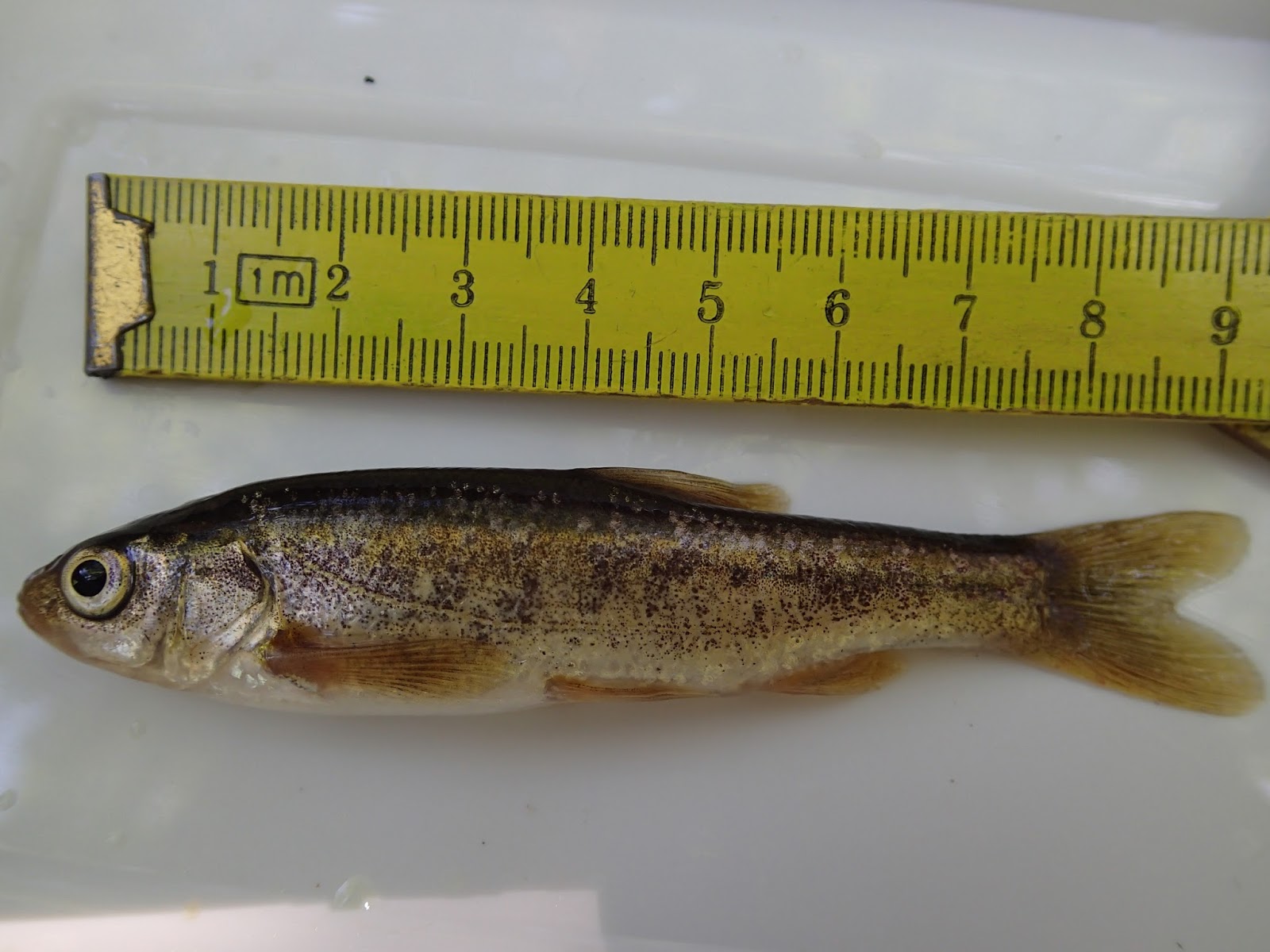
Now the discovery: We found fish! Ok this was not exactly a surprise because a good friend and local school teacher from Rafina, Antonis Lazaris, had seen the fish in this valley. So I was prepared.

But was I prepared to find a fish I could not identify?

Looking at the pics and superficially drawing conclusions: the fish look like native Telestes...a riffle dace! (Most probably the Beotian Riffle Dace - an Endangered species!!! found only in two river basins just north of Attika). It is the first ever Telestes we have ever found in Attika. Tomorrow the biological material we gathered is going to HCMR Lab. Good feeling this. All in a beautiful day; a good day's work. And in Paradise.
Thanks God.


Descending into what can be described like nothing else but Paradise. A natural riparian corridor leafy and wooded, barely touched by the recent fire.
Outodoor classroom. 
I live in a city of 5 million people and no one knows about this. Good.
Woodchat shrike, Nightengale, Cirl bunting, Cetti's warble singing. Monumental Oriental Planes. Sedge thickets, tropical-like vines and Oleanders. 
Horse-tail glade (Equisetum) in very tall Oleander (4 m high!) under Oriental Plane. And underneath a cold spring-fed stream.
The water is totally drinkable. Cool. 
Wow! What the F*ck!!! Its not Pelasgus....Well what is it?
Please give them a gentle touch. If you love fish you will give them clove oil before you sacrifice them for science. (I want to go that way too...).
Our discovery: Its a Telestes sp. Drunk on clove oil, but still alive. Then Formalin solution and a piece of clipped fin in Ethanol. 
You would NOT believe the number of dragonflies and damselflies out today. We also found two amphibians, and Potamon crabs. 
We sampled two sites for fish in a standardized way; this is the lowermost sites. More reedy and warmer than the cool-water spring-fed upstream part.


Tuesday, June 2, 2015

Francisco Martinez-Capel in Athens

The University of Athens Buildings on Penepistimiou Street this morning.

The Ecoflow Project and specifically an initiative taken by both the University of Athens and HCMR are hosting a good friend of mine from Valencia who  can teach us a lot about ecological flows in Mediterranean streams. This is really difficult and complicated applied science, it is a great privilege for us.

Today we had a great seminar at the Kostis Palamas University Building in downtown Athens. Tomorrow and the next day we will be doing field work in the streams of Charadros (downstream of Marathon Dam), Rafina river and Erassinos river.

For those who do not know my friend, here's a short blurb:

Francisco (Paco) Martinez Capel is a forestry engineer and Associate Professor at the Universidad Politécnica de Valencia, Spain. He has studied river ecology and freshwater fishes extensively, and received his PhD at the Universidad Politécnica de Madrid. He is particularly interested in studying fish, invertebrates and riparian vegetation in environmental flow studies and water management, for the restoration of freshwater ecosystems, especially in Mediterranean rivers, in seasonally semi-arid environments. He has also explored the impact of dams on endangered species in rivers. Currently, his main lines of research include: a) Response curves for fish and aquatic invertebrates exploring the habitat-biota relationships at microhabitat, mesohabitat and regional scales; b) Modelling relations between stream flow regime and riparian vegetation; and, c) Application of habitat modelling in environmental flow studies at the segment scale and also methods for regional-scale assessments. He has worked both in Europe and in Greece with us; but also in Ecuador, Brazil, Tanzania and other exotic places.  Paco lectures at the School of Civil Engineers, School of Agronomical and Forest Sciences (Valencia) and the Polytechnic School of Gandia, Spain. His principle teaching aspects include river restoration and rehabilitation, and also forest hydrology and watershed restoration.

I thank Niki Evelpidou and her team from Athens University and Christina Papadaki from HCMR who helped to make this seminar a success.


Professors Niki Evelpidou and Paco Martinez-Capel.

Paco descrives the first multivariate habitat suitability models developed in Greece!

Pavlos Kottas from AVmap explaines the software tool being developed within the EcoFlow Project.
Part of the good people at the Ecoflow Seminar. 

With Paco in the posh 19th century interior space of the University Building. 

The Kostis Palamas Building of the University of Athens on Academias Avenue.

Friday, May 29, 2015

Phaliriko Delta Athens: Summer rain on naturalists meeting


May 28th 2015 - Phaleron Bay Athens

By the first week of May Attika's fields go yellow, drab yellow in the warming sun's glare. And sometimes we get a thunder storm. We had one today.

We organized to meet and discuss our views on our Nature Park Proposal at the Phaliriko Delta on Athens's coastal strip at the river mouth of the Ilissos.

The beauty and biodiversity of this 'vacant lot' ecosystem is something that enthuses me. This year we have Little-ringed plover nesting, perhaps the only pair in the Attika Basin.160 birds visit the site. Now in late spring the migration is already over but an assortment of birds were here to greet us: Barn Swallows, House Martins, Olivaceous Warblers, Zitting Cisticola, Sardinian Warblers, Black Swifts, Yellow-Legged Gulls. 

The area has remarkable potential for restoration, especially as the much-needed flood control infrastructure may tie in with wetland creation here. Already the site is a quazi-wetland.
Pools form after the rains. These pools simulate an ephemeral pond environment. Native tamarisks punctuate the herb-rich meadows. Already one of our colleagues has compiled huge plant-list for the site; some scarce and one-or-two rare plant species. About 20 butterfly species have been tallied as have several other unexpected critters, Leopard Snake, Balkan Green Lizard included.  The sea-life here is exceptional: a semi-natural urban delta system, almost estuarine (but with minimal tidal fluxes); eutrophic. Loggerhead turtles spend weeks here in spring and early summer and are rather easy to see. In these respects, as it is, the site does have much interest as a marine, wetland and infilled coastal ecosystem...right at the edge of Greece's capital city and port. 

However, as are many vacant lot ecosystems, this place is threatened by typically concrete-based ideas for development....so we are working against this. 

For more information in Greek, feel free to peruse over our proposal:


Here are my snapshots from these evenings meeting, immediately after the rain. 


Thursday, May 14, 2015

Freshwater Jellyfish in Greece


Fall 2014 Marathon Lake, Attika. 

Back on Sept 30th 2014 during a field research expedition, my colleagues and I were lucky enough to stumble upon a really interesting sight at an irrigation canal here in Attika: A freshwater jellyfish!

We immediately collected samples, did some research on this and published this in an obscure but charming scientific periodical (Journal of Limnology) since it is the first time we see it in this area and we got some interesting results in the DNA analyses showing that there are different varieties of these alien medusas in Europe... (please read our paper).

The species I have photographed here is in the genus Craspedacusta (first described by Lankester 1880). Craspedacusta in scientific naming roughly means "border guard", referring to the slightly stinging tentacles along the border of the body - the names was a synthesis from the Greek "kraspedo", meaning border and the Latin "custos", meaning guard.

Please, if anyone has any information of sightings from Greece I would be very appreciative in receiving any reports (with photos please).

The Internet is full of data on this interesting alien species, for example:http://www.soe-townsville.org/freshwaterjellyfish/

For a download of our paper on this issue:


Lake Marathon and the exact location where Craspedacusta sowerbii was found (map created by Ioannis Karaouzas)

P.S. #1. Our friends at the Greek Wetland Biotope Center (EKBY) in Thessaloniki also reported their find of Craspedacusta in Lake Marathon (also observed in late August of 2014 and directly inside the lake waters...); and they also found a huge bloom of Craspedacusta at one of the artificial reservoirs in the Nestos River, also in 2014! So the aliens may be widespread in Greece - we need to track it!

P.S. #2. I was informed by our former institute director that medusas were found in the the reservoirs and lakes of Central western Greece (Acheloos basin) in the past (however I don't know if it was this or another species). So....I'm very glad I posted this item. Reason for a new review of the subject matter, and a correction to our alleged "discovery", in a short communication.

Please send pictures if you have any more evidence!

Friday, May 8, 2015

Nature Park Proposal: Phaliriko Delta - gathering of naturalists

The Moschato Coast at Phaliriko Delta: 160 bird species recorded...it is an urban biodiversity hotspot!

May 8th 2015. Phaliriko Delta at Phaleron Bay, Athens

After forming a facebook group, discussing situations with many key environmentalists, the initiation of our campaign is nearly at a plateau. We need to move into a strategy phase. The good thing is that momentum has been quite good so far. Fortunately there is a genuine interest by some really great environmentalists who know about biodiversity and restoration potential.

We are now being specific: What we envision, the future desired state. The vision for a nature park; actually a partial wetland regeneration. We do not want a "hybrid park" (i.e. a typical over-build sea-side park with a tiny piece of nature). We do not want a typical urban park or a riviera development.

The most important aspect of this area is the Moschato Coast. This piece of "infill wetland and coast" is the land between the Kifissos and Ilissos River. It now belongs to The PUBLIC PROPERTIES Co. (PPCo S.A.), a corporation with the mission of developing and managing the private state-owned properties. The company is 100% owned by the Greek State and is supervised by the Ministry of Finance. Would they want at Nature Park?

Also the surrounding municipalities of Kallithea and Moschato also have a serious say. Would they want a nature park?

Another promising development, and to be completed by 2016. is the amazing Stavros Niarchos Foundation Cultural Center (SNFCC) which is being build right across the street beyond the old Olympic Games facilities. Would these kind neighbour's want a nature park?

In our minds, as conservation professionals, there is no question really - this prime waterfront property must be developed in a way that gives-back something to the landscape, to the historical significance of the Athenian coast, to nature and culture.


Please keep in touch....
https://www.facebook.com/groups/462905697208398/


View from the Ilissos river mouth. 
Right next door to the proposed Nature Park is a phenomenal undertaking by the Stavros Niarchos Foundation- SNF (and all these cranes working are an exciting surprise in a city living in economic depression!). The Foundation is supporting the development of the National Library of Greece (NLG), the Greek National Opera (GNO), and the 170.000m2 Stavros Niarchos Park. As Athenians we can only thank SNF for this generous gift to Athens, approx. €566 million.  We hope they will like the idea of a nature park right next to such an over-built coastline. 


Sunset at Phaleron Bay. We even spotted a Loggerhead Turtle today....This sheltered inner bay is rich and productive since two river estuary here. Part of the main reason for the biodiversity value of the Phaliriko Delta. 
These are the former plans for the Moschato Coast of Phaliriko Delta. "Green" but over-built and complicated, crowded and sterile in a biodiversity sense. Completion of this "rehabilitation" project would cost upwards of 250  million so the idea was trashed by the ruling government (and the economic depression). The Nature Park idea in contrast is simpler but actually quite specialized : design "nature infrastructure" for flood control, wetland restoration, education, nature-recreation, awareness and biodiveristy. 

Wednesday, May 6, 2015

Alyki Anavissou in Attika: Is it a wetland?


May 5th Anavissos Attika 

Aliki Anavissou (Alyki Anavissos) is a wetland!  It is located 50 KM south of Athens on the very dry southwest coast of the Peninsula of Attika, just before Sounion.

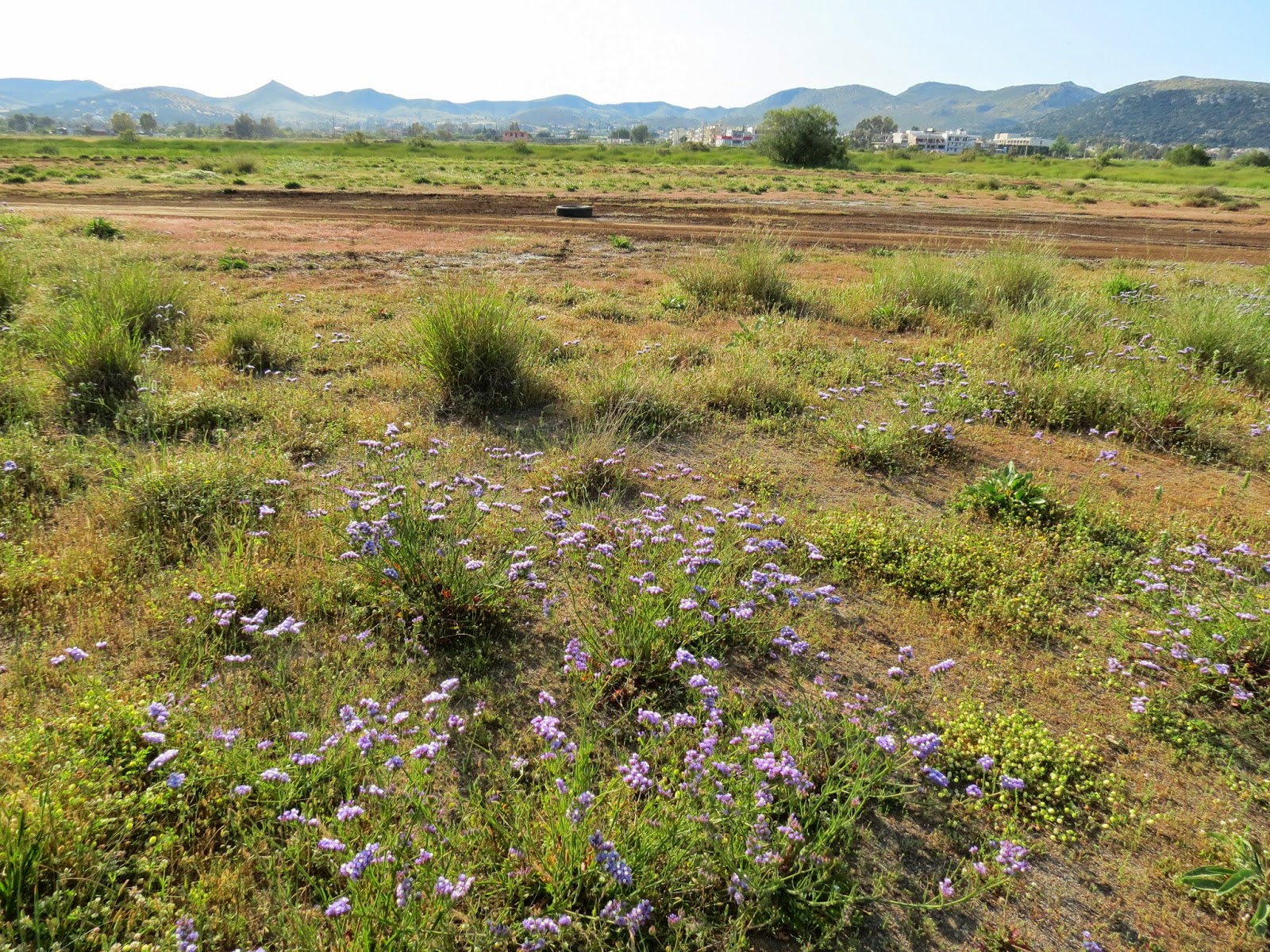
It was once a functioning saltworks and has been abandoned for decades. The abandoned land has regenerated, into marsh meadows, temporary pools, rough grasslands and scattered tamarisk brushlands. This year there were rains.

I visited when most of the water has evaporated away. But it was still very beautiful, full of promise. Ecological potential.

In a forty minute walk I took these spring pics, some great video and counted about 18 species of birds. The rushbeds glowing greeen, water buttercups filling up ponds, muddy spots and tiny shallow pools with the first green toads hopping about. What a beautiful start to a morning, just before work in the office.

For more information on this important conservation story download our presentation about it:
HCMR presentation on Alyki Anavissou