Friday, March 6, 2015

Archanes and Anemospilia Crete


First days of March 2015

If you just have a couple hours before a flight out of Iraklion...go to Archanes and walk on Youchtas.

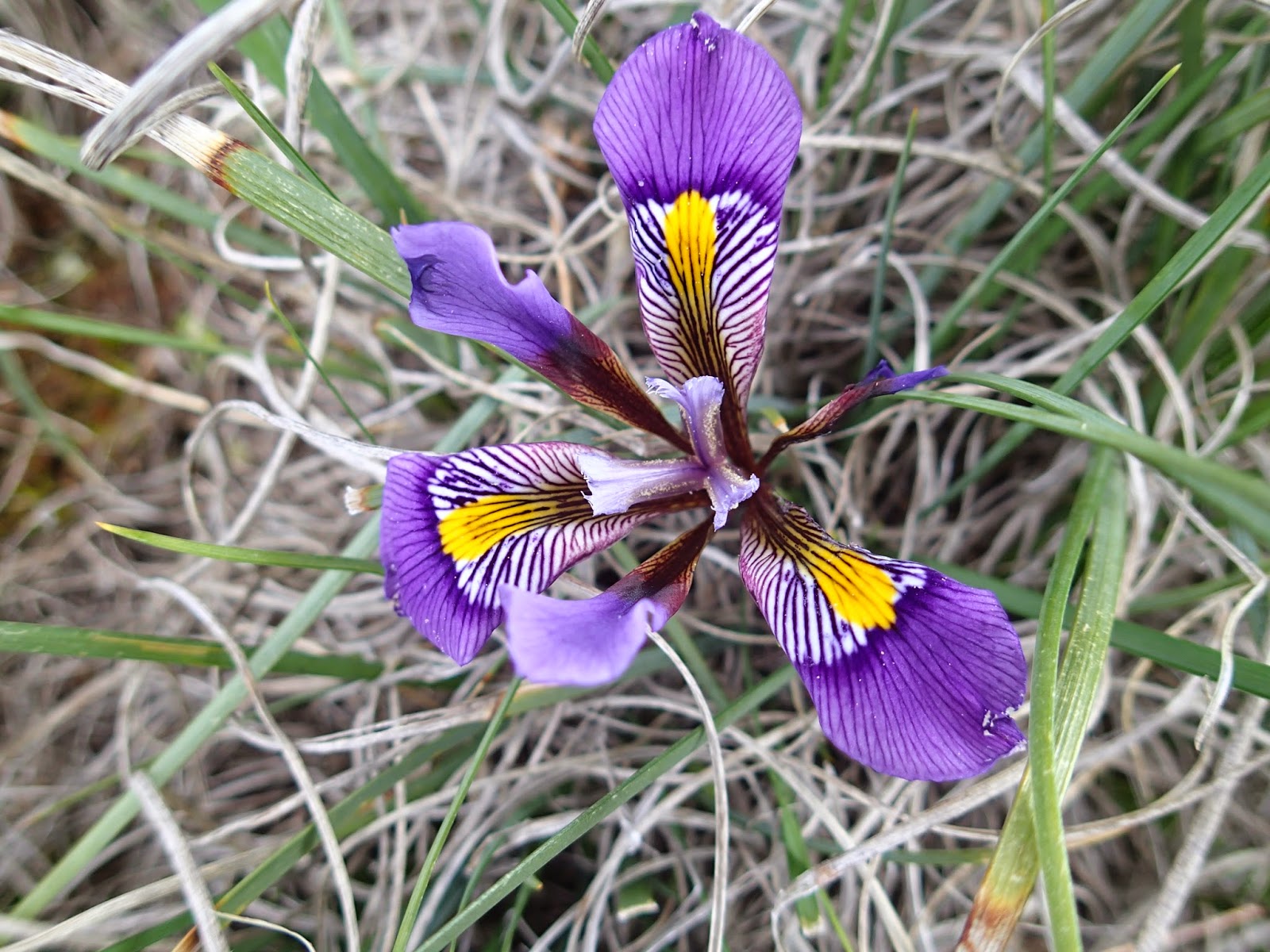
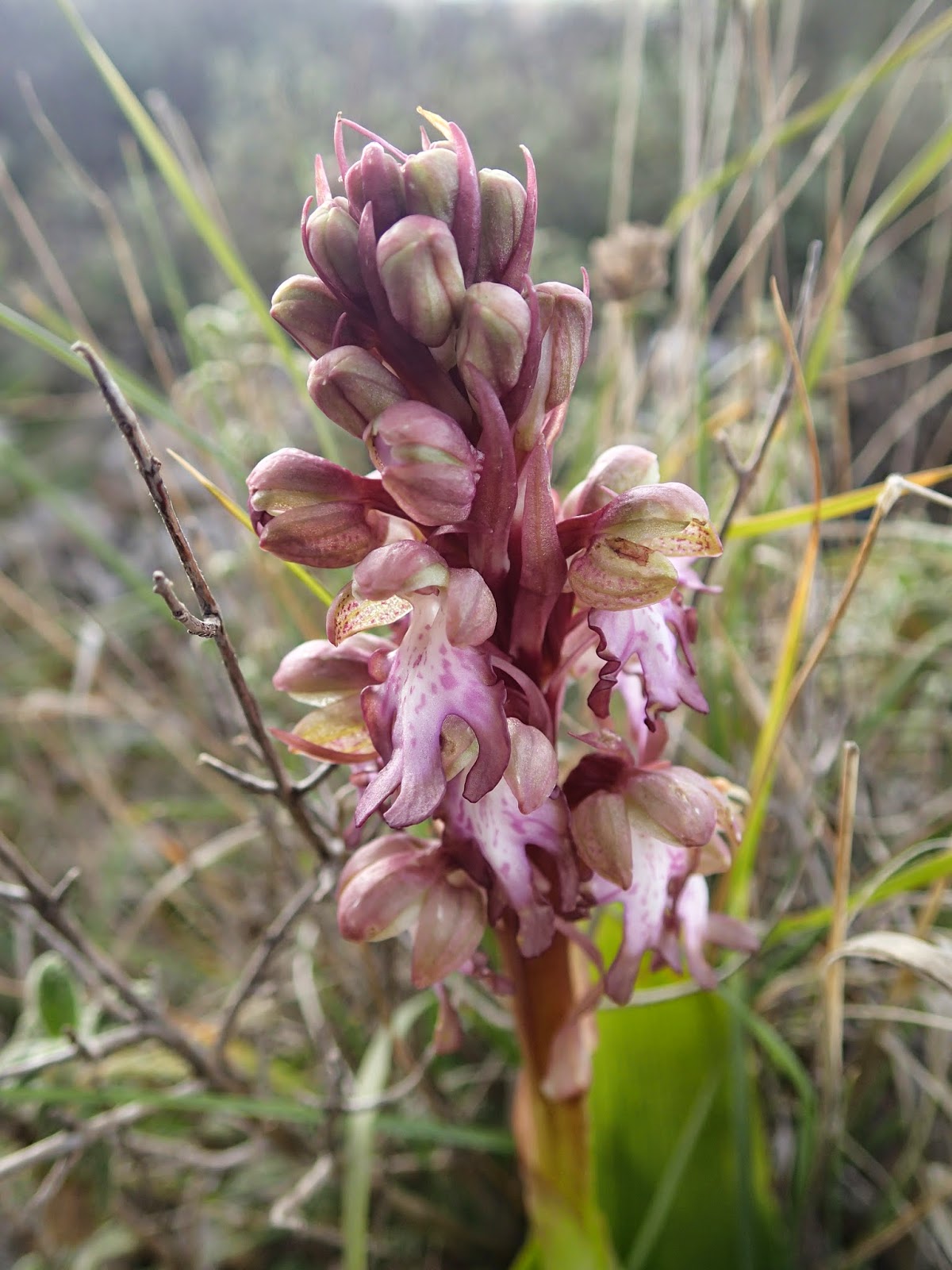
We did just that on a cold late afternoon a few days ago- it was well worth it. I want to just remark about the interesting synergy created by enhancing the archaeological site of Anemospilia with an effort to promote the local flora! Anemospilia - located on the phrygana hillside of Youchtas (a Natura 2000 site) at about 450 m. elevation is somewhat famous as a Minoan sanctuary were it was said a human sacrifice may have been preformed. This was made famous in a National Geographic article back in 1981 - even I remember reading it! So people my age visit...

Anyway, the site is fenced and really not much too see unfortunately. But the local Natural History Museum has taken an initiative to sign-post the flora. So you walk around the site's fence and learn your local flowers!!! This has been a rather wet year, and at this elevation few species are flowering. (Much snow on the high mountains still!). We were happy to find the first orchids, spurges, irises. And just enjoy the varied phrygana scrubscape.

Later, we visited the village...and asked why and how is it so well "preserved"? The "archeology" they replied. Thank God! At least there is a God of Archeology that has saved some Cretan villages, some landscapes. It is a beautiful village - and more should mimic it. Just 15' from bustling Iraklion.


Cretaquarium visit


       The beach at Cretaquarium on the last day of winter...

March 2nd 2015 Cretaquarium Crete 

The Island of Crete has Greece's largest and only modern style marine aquarium. It belongs to HCMR so any comments will be rather subjective and sentimental.

What I have been noticing is a big 'animal welfare' issue surfacing during the last few years and this has begun targeting aquariums and other zoological collections. Of course, Cretaquarium only has fishes and invertebrates (and the odd rehabilitating turtle).

Anyway these are my immediate thoughts after this visit:

- Fishes do feel pain. Big fishes probably may suffer in pens. Perhaps their world is poorer in a tank.  Most people can't tell.  But I think there is a cause for this localized suffering. When humans see fish - alive and real - they sympathize with these species. If humans begin to understand, they will provide policy and actions for conservation. Humans need to fight for fishes - so they need to know them to do so.

- Fishes are of critical conservation importance and they are especially difficult for people to care for. So I think this justifies captivity in good local-knowledge aquariums. Aquariums help illuminate and sensitize. They also bring out the living character of fishes. (See the grouper's faces in the photos below).

- Some large-sized fishes - in the pics below you may distinguish sharks, rays, meagres...these are impossible for people to appreciate because these fish are now amazingly scarce in the wild. So people see a vanishing heritage in an aquarium.

- You need to experience to "feel" deeply. If you don't feel you cannot love and what you cannot love, you cannot sacrifice for. We need a new generation of nerds and hippies working for conservation. These people are sometimes "born" in aquariums. Nature-lovers and environmentalists "become" when they are affected by scenes in-nature. Aquariums bring them close to the nature of fishes. So close, something clicks....

- Zoological collections are threatened by animal rights perspectives. Animals have rights. Humans have obligations towards them. But its a messy world. (Ugly, and stinking too). So to make it better we need to have real empathy and deeper appreciation. We also have to evaluate the "awareness work" aquariums are doing.

- The fields of conservation psychology and environmental ethics deal with the above issues I am presenting today. Read more on this.

Finally, I believe that fishes are part of human culture and part of a wonderful nature aesthetic that humans must learn to value more. So taking pics of captive fishes (even snap-shots like I do) can convey this innate and deep beauty. At aquariums sometimes you can fall in love...with a fish!

I spent just 15 minutes watching/photographing the fish in the aquarium today - I met with a couple of neat scientist-friends there; I took a walk on the beach next to the Aquarium. Made me happy.


Tuesday, March 3, 2015

Inland Waters Issue in Mediterranean Marine Science: Call for papers!


Inland Waters Issue 2015

I am very pleased to assist in announcing the following:

Mediterranean Marine Science will begin publishing an Inland Waters issue and is seeking outstanding original research and reviews dealing with inland waters ecosystems (fresh, brackish waters, wetlands and riparian zones). Preferred articles would be high standing scientific research beyond the local scale; these would also include aquatic biota, resource management and conservation issues.

Some of the important distinctions of this open-access scientific journal:
  • The journal Mediterranean Marine Science is published semi-annually by the Hellenic Centre for Marine Research, HCMR, Greece's largest public research institution for marine and aquatic sciences.
  • First published in 2000, replacing "Thalassographica", the journal published between 1976 and 1992 by HCMR's predecessor, the Institute of Oceanographic and Fisheries Research. 
  • It has been published online since 2000 by HCMR and from 2013 its electronic edition.
  • The journal is abstracted and indexed in WoS (Web of Science, ISI Thomson), SCOPUS and in Aquatic Science and Fisheries Abstract (ASFA). The content of MMS is indexed by ELSEVIER and archived in CITEFACTOR. 
Some advantages in publishing at HCMR's prestigious journal:
  • The Journal is one of Greece's very few scientific journals that has an international standing and its IMPACT FACTOR is at 1,7 for 2013
  • There is no cost in publishing (no publishing fee).
  • The journal Mediterranean Marine Science is published semi-annually by the Hellenic Centre for Marine Research (HCMR). 
  • Depending on the quality and completeness of the submitted manuscript, a paper can be accepted within 4 weeks of submission and published online in the journal as soon as the review process is completed. 
Specifically for HCMR's first Inland Waters Issue

  • Manuscripts must follow all specifications for submission and processing as in Mediterranean Marine Science and be e-mailed to the Journal. All manuscripts must be in English, preferably proofed by a native English-speaking colleague, before submission. English language must be perfected for publication.
  • Four handling editors will contribute to the processing of submission; each issue is expected to have between 10 and 15 contributions.
  • Manuscripts must be original work and can only be submitted by registering to the journal’s online system. Any communication about this must be directed to the online processing centre of the journal (see below).
  • Manuscripts for the 2015 Inland Waters Issue should be submitted to the journal office before June 1st 2015.
Please visit the Journal's website: 


Most readers of this blog may not be aware that the scientific publishing world is a complicated and competitive enterprise. It is also usually a very expensive undertaking. Mediterranean Marine Science is free open access journal with a very high Impact Factor for its short life span and very specialized research themes. However, due to the high demand for publishing there is a very high rejection rate; but please do not be put off by this. The development of the open-access online edition of Mediterranean Marine Science is possible through projects co-funded by the European Union and the Greek State. Since HCMR is a major public research centre it is a privilege to see this continue. Since we believe that publishing of high-quality science should be free-access and accessible to all, we should support this initiative. 


Friday, February 20, 2015

Eucalyptus in the Eastern Med: Evidence for wildlife values

One of the few times I have had the fortune of observing a Eurasian Scops Owl in Athens was on a Eucalypt in Attikon Alssos, Tourkovounia. 

For many years I have hated eucalyptus trees. I was a nativist, i.e. someone who despised non-indigenous species. Well that was many years ago, when I was a teen and a purist. As I have grown older I try to look at things more holistically.

The question is what to do with eucalyptus?

It is after all an alien genus from Australia that creates totally alien conditions with the eucalypt resin said to having a "repellent effect" to many terrestrial invertebrates. How do we deal with eucalypts in a wildlife resources and biodiversity conservation sense?

These are some notes on my observations in Greece, Cyprus, and Turkey.

Current state:

1. Its not everywhere. In the NE Med (outside Israel) eucalyptus is not as widespread or as abundant as it is in Iberia; there are few extensive plantations in fact. Frost does a lot of harm to it and many small plantations have failed (in mountain areas and in northern Greece, for example).

2. Does not spread. It is rarely in self perpetuation. I have seen some growth from seeds in Cyprus (Nicosia etc) and in vacant lots in Athens - but always singular trees (Nothing like the Acacia infestations in Cyprus or the 'tree-of-heavean' problem in Greece's  urban areas). So its not invading if not planted.

3. Does not seem to drain wetlands. It does probably cause wetland draining effects due to the amazing evapotraspiration ability. It is frequently planted in wetlands. In some areas there are groves of old outlandishly huge trees. However, the deep-shade cast over wetlands and riparian zones by these huge trees does combat evaporation of surface waters.

4. Native plants do grow beneath it. Very few species on native plants seem to grow under a dense eucalypt groves in my experience. This is a general observation and it needs empirical evidence. This I have observed in Portugal, but also recently in the Germasogeia riparian area on Cyprus. Alien acacias did grow vigorously under eucalypts on Cyprus. I am curious to see if other species grow well - for example Pistacia lentiscus was growing well under these trees.  In California it has been shown that many native plants do grow underneath but invertebrate numbers are depressed there.

5. Little evidence for all negative impacts to biodiversity. The wildlife uses of eucalypts has been poorly studied as a wildlife issue or alien invasive problem in Greece, Turkey and Cyprus. Generally most people think they are poor wildlife trees. Few bird species seem to nest in eucalypts.

Positive wildlife/biodiversity observations:

1. Important cover, shelter, roosts for birds. I have evidence that many large birds roost in the monumental eucalyptus trees. Big raptors commonly choose Eucalypts over native trees: Greater-spotted eagles in Amvrakikos chose a Eucalypt grove for several winters as a regular roosting site (Zogaris et al. 2003 - Threatened Birds of Amvrakikos). Many owls do too. Owls such as the Scops Owl pictured above and many other species frequent eucalypt trees. During migration, herons and egrets roost here also (I recall a grove at Koutavos in Argostoli Kefalonia that was full of heronids in spring migration).

2. Some birds feed on it. Although the leaves and resins are said to have an "insect-repellent affect", the flowers do attract diptera, butterflies and there are many little insectivore migrant birds that I have seen feeding in Eucalypts here in Athens.

3. Robust tree where all trees have been felled by humans. Many native large trees have been felled, do the non-indigenous Eucalypts fill vacant niche? In Greece & Turkey large Quercus ithaburensis, Quercus rubor, and othe tall Quercus, Populus, Fraxinus used be common riverside trees and these are now scarcer due to anthropogenic felling. So do eucalypts fill a vacant niche and supplement a key habitat in the landscape? Perhaps yes, in a wildlife habitat sense; they provide habitat that is scarce in the landsape. Eucalypts are also incredibly hardy, they can grow well in very windy locations (much of coastal Greece is very windy!); so these robust trees and tree groves, last long even after many many wind storms. They also can survive some low fires and they also live a very long time 400 -600 years.

4. A tree of monumental proportions; enriches landsapes. Eucalypts grow really fast and become "monumental trees". Trees like this exist in Schinias National Park in Attika - they are gigantic! In wetlands of the south of Greece, the islands - these trees survive well, some are over a 150 years old already. In open landscapes in the south they resemble savanna-like elements in the open landscape. They are used by many birds there where no other trees exist. For example in the dry steppe-like areas of central Cyprus (Kotziatis river near Nicosia); it would be a crime to remove these wildlife trees.

Conclusions

I do not mean to promote the planting of eucalyptus! I am against that. And fortunately many foresters in Greece no longer plant these trees in re-forestation practice. It is wrong to use eucalyptus in riparian zones. Unfortunately, because they are hardy and strong they will survive if panted in the "wrong place" although the native pines, carobs etc may not survive - for example on a windswept salt-sprayed promontory in Southern Attika I have seen eucalypts survive yet other plantings perished (the Municipality of Saronikos planted them).

So in this sense eucalyptuses are a threat. People should NOT plant them. However, old monumental eucalypts should not cut down just because they are non-native. Young trees should be cut down in an effort towards ecological restoration in riparian zones (this has alreadey been proposed in the Nicosia Pediaios stream for example). However, please keep in mind that big old eucalypts often do have wildife values and many amenity values. This is a great research topic. Many aspects of eucalypt's impacts are poorly understood.


See this from California: http://sutroforest.com/2013/04/22/the-importance-of-eucalyptus/

Also from California: Dov Sax. 2002. Equal diversity in disparate species assemblages: a comparison of native and exotic woodlands in California,” Global Ecology and Biogeography, 11:49-52.

Tuesday, February 10, 2015

Reference conditions of the river: Sperchios Study


February 2015 

One of the most important themes in our study of rivers is the historical dimension.

Here I founda map  on the net of the valley of Spercheios, in Das hellenische Thessalien by Friedrich Stählin (1924). I know nothing of Friedrich Stählin (1874-1936) but I thank him for his contribution (also thanks to: http://commons.wikimedia.org/wiki/File:The_valley_of_spercheios.jpg). Many interesting hydromorphological aspects are evident and "measurable" in this map (marshland extent, meander form, distributaries in the delta, transitional water bodies in delta, delta coastline form, key tributaries etc). The main distributary has changed, this older river mouth is very near Thermophyles (today there is a different "old river channel" and a new spillway channel - totally different situation).

Below is a gravure from 1877 (from delcampe.net) showing the the "Defile of Thermopyles" with the extensive delta marshes of the Sperchios (there are none there today!!!). This is an important image for vegetation ecologists since the vast flooded reed beds are shown clearly (the reed bed swamps are tree-less and lentic areas of open water are evident).


The view above is from the wider landscape near Thermopyle. Recorded by Edward Dodwell. The Irish painter travelled from 1801 to 1806 in Greece and produced such wonderful art. This view is upland bug shows remarkable landscape heterogeneity. 


Monday, February 9, 2015

Evros/Meric River: How many river-islands?


The Ardas river near its confluence with the Evros: The largest remnant riparian forest in the river valley was found here.

Published: Paper on the Evros-Meric Greenbelt

One of the most intriguing and frustrating places to study is a river-border in an area of intense political friction. My colleagues and I have worked on the Evros river (Meric in Turkish, Maritsa in Bulgarian). The lower part of this large river creates an uneasy border between Greece and Turkey.

What we set to do is to count the so-called stable river islands in this large river and to assess the conditions of the riparian zone. In fact in 218 kms of river we counted 219 islands, 145 of these are larger than 1000 m2. Of these we looked into their condition by assessing the amount of woodland on them - a simple and truthful metric of ecological integrity. We also mapped the 12 largest forested hot spots along both the Turkish and Greek banks of the river.

This kind of work was fairly easy and productive and gave us a good insight into green-belt conservation of a large trans-boundary river. We hope this kind of work can assist conservation initiatives, especially since the river has severe problems with flooding and water mismanagement.

To download our paper see: EVROS/MERIC RIVER (Greece/Turkey)

(Photos are from an HCMR sampling trip in summer 2009)


Ardas at Kastanies (on the Greek side) near Edirne.
Meric on the Edirne Bridge (Turkey) looking downstream after the Tundza confluence.
Meric at Edirne with river-side fish restaurants