Saturday, May 24, 2014

World Fish Migration Day: Vravrona Greece Celebration!


May 24th 2014

Vravrona is a rather famous archaeological site 30 Km from Athens...
Here we did something different today: a celebration of its fish world! And with special reference to the migratory fishes in the small stream that passes near the site, the Erassinos River.

We celebrated WORD FISH MIGRATION DAY with a scientists' view of the fishes and stream. We sampled fishes using electrofishing at five points on the stream and got a small bunch of participants excited about nature, fishes, what we do....

And there was cause for celebration today: We discovered a "different" Erassinos river, relative to what we had sampled five years back.
The results:

a) Last time we sampled, we had no Marathon Minnows in the stream - an exception being a small population next the Artemis spring inflow (near HOS's wooden bridge, for those who now the site).

b) Last time we sampled we saw that the river was FULL of Mosquito Fish. A highly invasive alien species that is said to out-compete the similar sized - and globally threatened - Marathon Minnow....

c) Last time we sampled the channel of the stream was cleared of Phragmites reed and Mugilids had swam up nearly to the wooden bridge.

d) Last time we caught no eels.

Today we had:

a) Marathon Minnows were dominating the fish community - they were everywhere, abundant but usually small sized (mostly very young fishes). It was difficult to convince our select audience that these are highly threatened species!!!

b) We caught and observed less than ten Mosquito Fish. (An amazing scarcity of this overwise super-abundant fish!!!). Where did these invasive aliens go???

c) Phragmites has choked the river channel (This is the real big change since 5 years ago...). Mugilids came up only about 200 m from the estuary bridge-culvert. All Mugilids were tiny Striped Grey-mullets (Mugil cephalus). Today we had Marathon Minnows with the Mugilids even about 30 m. downstream of the estuary bridge-culvert (they were almost in brakish water...swimming over Posidonia debris...WOW!!!!).

d) We caught 5 Eels! And we didn't try hard. Young elvers (2) also. What a treat!! The most migratory of threatened fishes carefully caught and photographed.

All this has changed in a period of five years!!

Fantastic scientific questions, conservation-relevant questions- we will soon be back to Vravrona....

Cause for celebration!


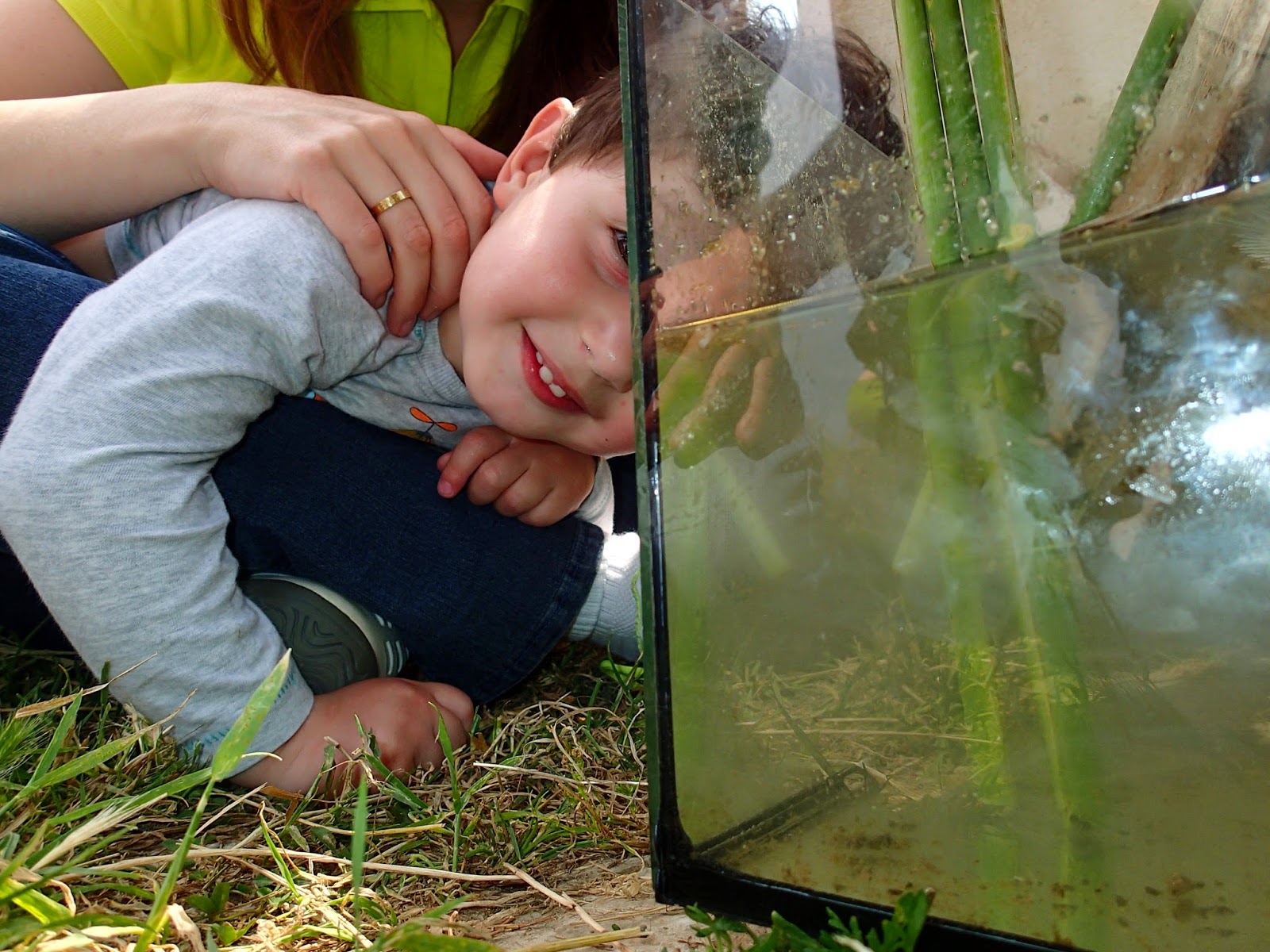
 *Our work was organized under the EcoFlow Project with help from the care-taking NGO, the Hellenic Ornithological Society. I want to thank participants from the Hellenic Centre for Marine Research, Athens University, and the Hellenic Ornithological Society. Another successful partnership. We will do better next time. Look at that last photo....we had a great time!


Friday, May 16, 2014

World Fish Migration Day: Vravrona Archeological Site Attika Greece 24/05


End of May 2014

When was the last time you went out to nature with scientists walking, talking, sampling?

Well...This is THE opportunity!

Ichthyologists, Hydrologists, Geologists, Potamologists, Ornithologists and other Oologists will be at Vravrona Natura 2000 site (30 km SE of Athens) to guide you and your family into the wild and mysterious world of the STREAM, WETLAND and its MIGRATORY FISHES.

YES, there are migratory fishes around, just like migratory birds. These animals make mass migrations from spawning areas to seasonal nursery grounds, to special staging areas and refuges. They move up-river, in-stream, in the floodplain, to the river mouth and out to sea. They overcome obstacles and transform themselves from 'river fishes' to 'lake fishes' and from 'sea fishes' to 'river fishes'. They are important because they create CONNECTIONS between very different worlds expanding food webs, enriching the waters.

At Vravrona we have a very very small streamlet - the Erassinos River. It flows into a shallow muddy bay near the famous archaeological site. The stream has just one native wholly freshwater fish, the Marathon Minnow but this tiny fish doesn't migrate very much, it is a poor disperser - a 'marsh fish' and it is Endangered. Ok. BUT, the really widespread fishes that are more common in the stream and its river mouth do move a lot: European Eels and Grey-mullets. These fish are not just tiny and cryptic they are the basis of important food webs - they feed the birds! Also, they require unobstructed passage to fresh waters, they need waters during the long summer drought when local farmers greedily divert the stream's water to their fig groves....These fishes require special habitats as nursery grounds and for long-distance migrations. Also, some migrant fish are threatened: the European Eel is categorized as Critically Endangered.

What is being planned on this scientist-guided excursion:

We will use nets and electrofishing devices to carefully collect the fish alive, show them to you in portable aquaria, and then return them back to their waters. And why are we so interested in fish? Many reasons: Some consider them and their world a "natural heritage". Some consider them beautiful. Some work to understand resource management through their needs... Some of us think that they may be good indicators of the state of the aquatic ecosystems.....

For aquatic scientists fishes are a baseline for natural history, can they become a "conservation icon" for wetlands, streams and coasts? Society will decide.

Come and learn and enjoy the fun of 'fishing' with the scientists.

This event is supported by the World Migratory Fish Day 

by HCMR

The EcoFlow Project

and the Hellenic Ornithological Society

Save the Date: 
Vravrona Archeological Museum Parking Lot; Saturday 24th of May, 10:00 - 12:00 AM. 

For more information please feel free to call us: 2291 0 76389 or 6973591204 
(please ask for Ms. Christina Papadaki at HCMR)


Saturday, May 10, 2014

Evros Delta: An ecotouristic glance!

A Dalmatian Pelican sails into the wind over Drana Lagoon in the Greek part of the Evros Delta; the hills in the distance are in Turkey.
May 8th 2014

My friends Maria-Daphne and Theodora and I visited the Evros Delta after our ferry boat trip from Samothraki...just before my flight back to Athens from nearby Alexandroupolis. It was a windy, hazy day, not for photography. The western Greek side of the Delta is only 20 minutes from Alexandroupolis Airport; it beckons to anyone who wants to see this legendary wetland National Park. Since the girls were rather new to birding, I thought I'd show-off one of my most beloved places to them.

First we stopped at the Evros Delta Visitor Centre where we met Eleni Makrigianni who has been working on conservation here for many years. We enjoyed the facility – admired my friend Vassilis Hatzirvassanis’ art and interpretation work. In fact, this Centre was the first one we worked on together back in 1999 (a project prepared by OM EPE and OIKOS Ltd for the Ministry of Environment).

And then we headed off for an hour’s drive in the Delta (yes right before my flight...). You can't possibly “see” the Delta in one hour. It is one of our largest wetlands and right on the edgy frontier with Turkey. But I wanted to take the girls down to the Drana Lagoon and I promised flamingos….

Anyway, we found some birds, not many in the fierce wind. I tallied about 37 species. And we got lost. Not using the GPS we wondered into some narrow tracks and had to drive back backwards - a long ways backwards - and carefully, not to fall into the deep drainage ditches!

We really enjoyed this rapid glance.
We even saw a fleeting red fox and had close looks at a Greek Tortoise. Beautiful flocks of wild Mute Swans, Shelducks, Pygmy Cormorants and waders. Brilliant Bee-eaters, Red-backed Shrikes and Black-headed Buntings and a magnificent Black Stork. And the prairie-like plains of the Delta – splashes of yellow mustard, bright purple milk thistles, herb-rich wet meadows.

So, even without flamingos it was well worth it…and I did catch my flight back to Athens!

Three suggestions for enjoying the Delta:

1) Please employ one of the really good local ecoguides or take a guided mini-bus tour (ask the Visitor Centre at Loutra Traianoupolis!).
2) Definitely try the boat rides.
3) Give it time and time it accordingly - Winter, Mid Spring, Autumn is best.


Samothraki Nature Observatory: HCMR's Wetland Inventory!

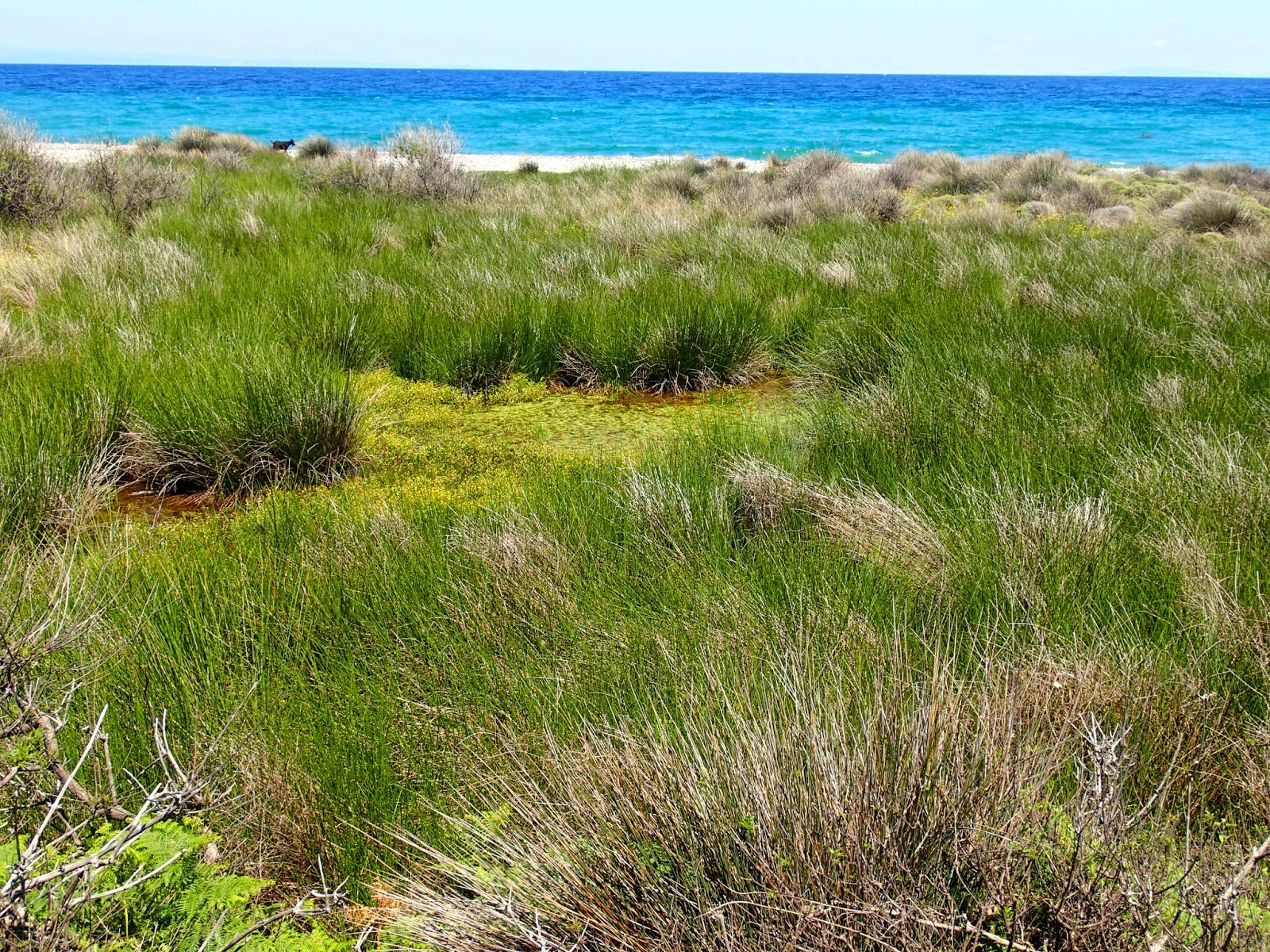
The southern and southwestern part of the island is much dryer with very few wetlands or surface waters.

Early May 2014

Wetlands are special places where enough water gathers to influence vegetation and soils in such a way that distinct landscape elements are created– semi-aquatic oases. These are especially important in the seasonally-very-dry Mediterranean islands.

On Samothraki, one of the most beautiful Mediterranean islands,  there are many, varied and truly unique wet places.

We visited the island this spring for HCMR survey work and a collaboration. Besides our wonderful work with the Social Ecology group of  Alpen-Adria University and our planning for a Samothraki Nature Observatory 'linking network', we focused on wetlands for a couple of days: the benefits were incredible!

We visited more than twenty-five wetland sites; 15 sites host wetlands larger than 2000 m2. Many more are “micro-wetlands” that cannot yet be fully assessed but we did pin-point 12 such micro-wetlands and described them for the first time. We carefully took notes on vegetation and  the aquatic fauna; photos and video and mapped the sites using GIS tools. 

Of course, as was expected, wetlands are one of the island's most threatened ecosystems. Most are very small and directly connected to water run-off regimes that are gravely influenced by increased waters abstraction, barriers to fish movement, habitat degradation and general mis-management and careless under-appreciation of wetland values.

I post our preliminary sightings and some wetland photos to show you what its like in Spring up there.

I thank Nikos, Anastasia, Natalia for strenuous work in the field with me. And we all thank the well organized University team from abroad (Marina, Panos, Aggelos….everyone!). Our researches are still at the embryonic stage – but wonderful things seem to be happening on the island. We’ve got work to do for Samothraki. 

Snapshots from the Spring trip follow...


* Final Google Earth shot shows a map of Samothraki - with the sites to be visited numbered. The 00 symbol refers to sites that had not been explored befor our Spring visit. This is therefore an incomplete 'working map' created during the survey; it is indicative of the distribution pattern - most wetlands are in the more humid northern shore and we found no inland wetlands yet!