Saturday, May 10, 2014

'Big river' electrofishing by boat: Sperchios River Delta!

Entering the deep and wide "Yperchilistis" - a semi-artificial channel of the Sperchios; north of the natural meandering channel.

Early May 2014

The WFD field monitoring electrofishing teams and the KRIPIS project ichthyologists met at the Sperchios Delta for a special kind of sampling.

We used a traditional fisher’s boat with a four-person team to sample two +500 m sites along the lowest stretches of the river, near its river-mouth, within the Sperchios Delta. At this time of the year the river is in freshet and its freshwaters are not being funneled yet into the cotton and rice fields. After about the tenth of May much of the lower river’s main channel is diverted. A drastic change is said to take place in the lower river distributaries and the river mouth (higher salinities etc.).

The two main distributaries of the river are unusual and different. The first and largest is 'heavily modified' by being totally straightened and fed by polluted waters from a dis-functioning Sewage Treatment Plant of Lamia (it is called the "Yperchilistis"). The result is a eutrophic lowland canal-like river; however the channel is deep (+2 m) and water is fresh and flowing fast at a conductivity of only 400 μS/cm during early May.  The second river is the original meandering natural channel. It is very degraded by reduced water flow and incredible silting-in of the original channel. Water is very slowly flowing (despite the freshet), and the silted-in conditions are shallow (about 1 m or so). The river channel is still meandering but the increased salinity has killed much of the deciduous trees (dead poplars were seen).  Conductivity was 1200 μS/cm in Early May.

The results

The channeled river was full of fish, especially large-sized freshwater fishes, particularly dominated by the Greek Barbel (Luciobarbus graecus). 12 fish species were found in total. My opinion was that younger fishes were seen in smaller numbers.  The second morphologically more “natural channel” had less fish, dominated by mugilids (Grey-mullets). Freshwater species were much scarcer as was the presence of smaller freshwater fishes (several Rutilus sp. Sperchios were found). Total species count: Only 6 species in the 'natural' but degraded channel.

Some thoughts

Sampling the lowermost parts of large rivers in Mediterranean areas especially areas affected by increased salinity and pollution should be done in mid spring – before river fresh waters are channeled away to water agricultural crops. It is an interesting time to see where the fish are during this time. Later in the summer - conditions degrade drastically and it is probably impossible to sample using electrofishing methods.

Some photos of our work below. I thank Vassilis Tachos, Dimitris Kommatas, Alkis Economou, Elena Oikonomou, Leonidas Vardakas and Nikos Koutsikos great participation. The local fisherman, Vassilis Routzos guided us well.


Thursday, May 1, 2014

Samothraki Nature Observatory : An Idea Developing...


Early May 2014 - Preparing for a Trip to Samothraki

Samothraki Nature Observatory – Παρατηρητήριο Σαμοθράκης: A scientific network to support nature conservation on Samothraki

Samothraki is an island on Greece’s northeastern Aegean frontier with renowned cultural landscapes and a rich biodiversity. The island needs immediate 'attention' to better develop nature conservation and steps towards sustainable development.  Samothraki has certain environmental problems associated with poorly planned development that impact the natural environment. Unfortunately, these pressures and problems have been poorly addressed despite steps taken to create protected areas on the island (Natura 2000 site). Generally, sensitive local residents and academic visitors are aware of the major problems impacting the natural environment on the island; these include: overgrazing, water resource mismanagement, poorly planned building, distasteful architecture developments, uncontrolled sprawling touristic development, wetland exploitation, forest mismanagement, wildlife poaching and overfishing.  Samothraki should take advantage of its natural heritage and biodiversity but this must be done with care based on scientific understanding and direction.

Despite the above anthropogenic threats to the island’s nature, Samothraki still supports a rich and wild character. This has attracted scientists and research groups to the island who have studied various aspects of nature and culture for many years now. Our group at IMBRIW - HCMR has proposed and made initial steps towards the creation of a linked network of scientists and residents who will promote conservation on Samothraki; we are calling this loose scheme "The Samothraki Nature Observatory- Παρατηρητήριο Σαμοθράκης". This is moving ahead since we have established collaborations with other academic forces and have a memorandum with the Samothraki Municipality. We already have one PhD Candidate dedicated to making Samothraki her research case-study area and our aquatic research work is taking place within a long-term research framwork (see: http://imbriw.hcmr.gr/en/samothraki-island-lotic-ecosystems/).

Of course, as aquatic scientists our research aspect must necessarily focus on studying the island's "waters"; that is, all aspects of assessment, conservation and management of waters, aquatic, semi-aquatic ecosystems, and river basins. 

Main aims of the Samothraki Nature Observatory scheme, as we see them now, are as follows: 

1. Promotion of scientific research actions and long-term monitoring of the natural and cultural environment aimed at providing useful and practical guidance the conservation and rational management of the environment. 

2. Promotion and support for the completion of an integrated protected area on the island; the creation of the so-called “Samothraki National Park" - a vision which will upgrade and integrate current poorly-managed protected area frameworks.  

3. Creation of an international 'arena' and 'retreat' for the support of researchers and research groups on the island. Within the "Observatory" initiative we are planning to help support visiting researchers and promoting education and continuing education programs in close association with the local authorities and local community in the future. 

This is an "idea" that is developing....Perhaps as our collaborations with others grow, more aims and organization will enter the Samothraki Nature Observatory scheme. A physical weakness is that we do not live on Samothraki - so our scheme is necessarily a linking of visitors, friends of the island.

 This month, the IMBRIW team is meeting with Austrian colleagues in Samothraki. We hope to discuss how this scheme can grow. Good Luck!

-----------------------------------------------------------------------------------------------------------

We recently published our initial stream assessment compilation for Samothraki based on our past studies and experiences on the island; this paper is available at:

https://www.researchgate.net/publication/261877667_STREAM_ECOLOGICAL_ASSESSMENT_ON_AN_AEGEAN_ISLAND_INSIGHTS_FROM_AN_EXPLORATORY_APPLICATION_ON_SAMOTHRAKI_%28GREECE%29?ev=prf_pub


Here I provide some of my photos from our research stay during August 2013. More posts have also been made in this Blog, please search them out.


Monday, April 28, 2014

Sperchios River: Kripis Project Spring Visit...


Early April 2014

Spring photos along the length of the beautiful Sperchios River in Central Eastern Greece. 

In my mind this is one of the most beautiful rivers in Greece. What a statement! 

The is my reasoning:

a) The upper tributaries on Mount Iti National Park are spectacular (not shown here); amazing cold waters dropping into deep narrow canyons, others full of trout in Greek Fir forests.

b) No major dams on the main stem - except for some new barriers at and near the National Highway crossing.

c) Meanders! Still the river has a few true meanders in the lowermost part. 

d) Extensive riparian  forests. For a lowland river, only the Pinios of Thessaly, the Nestos and Evros can compare with its extensive lowland forests. But it is a smaller river than the above. 

e) Endemic fish bonanza. Its unique biogeographical cross-roads position lends the river an amazing situation where fishes with biogeographical origins from the north meet fishes from the unique southeast. Three taxa are local endemics to the river (Pungitius hellenicus, Alburnoides sp., Rutilus sp.).; the total list in the rivers freshwater is about 15 species. 

f) Fantastic birdlife. The lower course, its forests and wetlands and the Delta are incredibly rich and little-studied. 

g) Floods! The river still has flood-pulses that are along a natural flow regime cycle. This feeds the Delta with sediments and nutrients. 

h) Estuary-like Delta system in the Malliakos Gulf. Greece doesn't really have any true tidally-influenced estuaries. Our deltas and lagoons are tide-less really. But at the Sperchios Delta there is a tidal influence with amazing mudflats, delta islets, etc. Important as a fish nursery ground and a bird migration hotspot of international value. 

i) Fantastic landscapes and landscape features: Looming Mount Iti over the lower valley. The unique Gorgopotamos Canyon. Thermopyle with its steaming hot springs. The vast Delta wetlands and shallow green-grey-blue Maliakos Gulf. Working countryside farm villages. Ancient Oriental Plane groves over the rushing river waters. Hundreds of clean upstream headwaters. The 'presence' of wolves in the hills.

So all these riches add up; they give the river valley and delta a unique place among Greek river scenes - it is wonderful in Spring.....

This is how one falls in love with landscapes....

All photos below are from our early April 2014 trip. I will inform about locations asap. 


Add caption


A Greek Barbel Luciobarbus graecus caught with throw-net in the Delta, at the Anthili Pump Station.
Sites visited during our second biological survey (Early April 2014); site numbers are also used in the photos above.

Sunday, April 27, 2014

Wanted: Alosa fallax - Twaite Shad records from Greece!


Juvenile Alosa fallax caught by HCMR electrofishing team at Pinios River, Summer 2009.

Spring fish migration 2014...

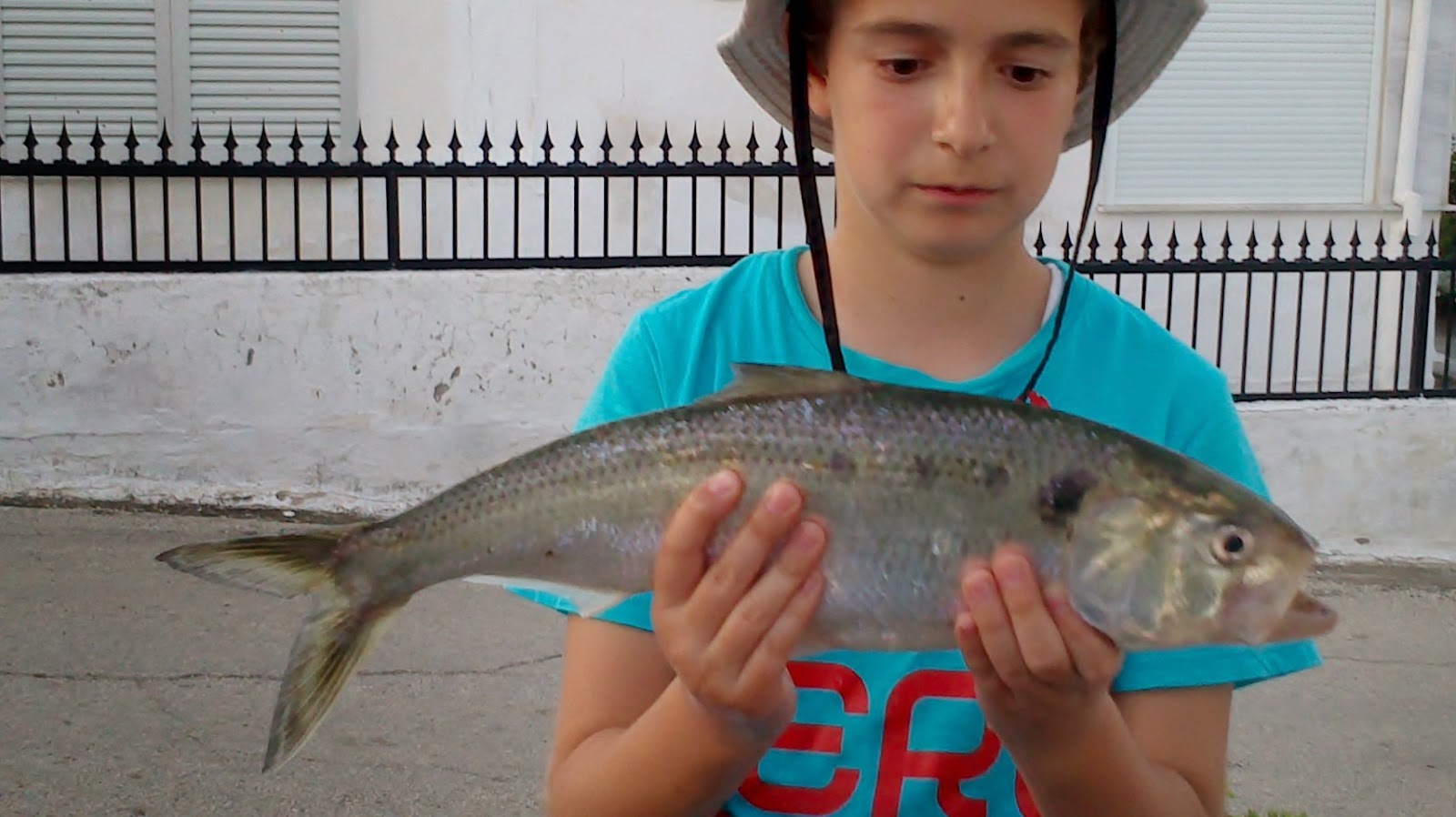
Many fishes enter freshwater from the sea. A few of these are truly anadromous long distance migrants - they journey up river to spawn (e.g. Salmon do this in the Atlantic). In Greece we have a wonderful anadromous clupeid, a Herring family fish, the Twaite Shad Alosa fallax that does this. But few people know it. And, it is a rarity, there are signs of it having declined. We must draw attention to it.

Twaite Shad or Sardelomana in Greek,  can reach up to 50 cm in size: A giant herring-like fish. Reproduction is in May (or maybe April also) in gravel beds in large rivers (mainly in northern and western Greece). Once the eggs are laid they soon hatch and the young fish migrate downstream, often staying in freshwater during the summer. The fish then migrate to sea and adults mature after 3 to 4 years.

My personal experience with this species is minimal. We have recorded the fish only twice, once in the lower Pineios of Thessaly and the lower Kompsatos (both young small-sized individuals in late Summer). But we have collected published records and some anecdotal mention of the fish from various big rivers (Axios, Amvrakikos rivers, etc). We have very interesting anecdotes of large numbers of "Sardine-like" fish running up-river from some places but these are really unconfirmed (i.e. from the Lower Alfeios etc). Such mystery talk by amateurs cannot be confirmed without a photo!!!  So we need to hunt for more documentation. My HCMR colleague, Yorgos Chatzinikolaou obtained the images featured in this post from a tributary of the River Evros, near Didimoteicho in late April 2013. It is well known that in the Evros this species migrated up from the sea to spawn and people collected to dry it (in great quantities) as far up as the Ardas river (near Kastanies). The three photos we post here are testimony that the species is still there! And evidence of the species' presence is vital to assessing this rare animal's conservation status in Greece.

A wider consortium of Greek Ichthyologists is now working together to gather information on 72 species of fishes of European Community Conservation Concern (the Natura Surveillance Project) and the Twaite Shad is one of these important species.

Please if anyone has any feeling of ever seeing or hearing about the presence of this giant 'sardine-mother' (Sardelomana in Greek) do get in touch with us AS SOON AS POSSIBLE. And please, try to get a picture - please note the date and exact location, the number of specimens, any special conditions and the fishes' size.

Keep in MIND: The reason these fish are now suffering from humans is that human-made obstacles such as dams and weirs BLOCK their natural up-stream migration. Our "barriers" and river engineering often totally impeding access to spawning grounds. River barriers to fish are sometimes unintentional and can be re-engineered: think about fish-ladders or small works around river bridge bases, road crossings, river abstraction points, river regulator weirs. These artificial barriers to river connectivity are one of the most significant and least appreciated elements degrading the natural integrity of river ecosystems. Thinking about the Sardelomana is a start. 

Adult Alosa fallax caught at spawning site in the mid Evros in Spring 2013. 

Adult Alosa fallax caught alive at spawning site in the mid Evros in Spring 2013.

Measuring total length (TL) is important as information of any photographed fish (same fish as above).