Saturday, March 2, 2013

Meeting: River habitat workshop in Cyprus


Some workshop key-players: Roberta, David, Andrea, Margarita, Nikos, Kostas, Charles, Gerald and Stam.
 February 28th 2013
In Lefkosia, Cyprus, at the well organized workshop developed by an Italian EU Life Project headed by Andrea Buffagni (CNR-IRSA).  The Water Development Department (WDD) of Cyprus hosted the event. Obviously such a happening is relevant to progress towards the application of the EU Water Framework Directive (WFD) on Cyprus. A total of nine technical presentations including work by the Italians, our team from HCMR Greece, and by local Cypriots. Andrea Buffagni and David Armanini showed us some cutting-edge developments that definitely affect policy-relevant river management and conservation in the Mediterranean. It was very kind of the Italians to choose Cyprus as the venue for this excellent technical workshop. Apart from the Italian river research shown, a lot of former work that was presented here has been supported through several contracts with the WDD.  We all learned a lot. The participation from the patient and engrossed audience was stimulating. After the workshop we continued discussion at the Fanous Lebanese Restaurant in the old city. I strongly believe the Cyprus Government should continue to support river research and applications - much of which has produced pioneering work for Mediterranean Europe! Cyprus really could become a great demonstration of "river management best-practice" at this distant edge of Europe.

For more information on the project Life INHABIT "Local hydro-morphology, habitat and RBMPs: New measures to improve ecological quality of south European rivers and lakes";
 please check: www.life-inhabit.it

Gerald with Deputy Director of the WDD opening the workshop.
WDD has the legal responsibility to manage the waters of Cyprus wisely; so this kind of workshop is introduced by the Deputy Director. 

This is Gerald Dorflinger, a seasoned potamologist; master-and-commander of the WDD hydrometric databases and more! He outlined the Cyprus' WFD obligations.
Andrea Buffagni; one of Italy's most famous potamologists. Nice to meet him again, especially in Cyprus where he has done pioneering work.

David Armanini of the Prothea Group; another Italian with lots of Cyprus experience- he talked about typology etc.
Me, trying to talk about fish in Cyprus' rivers: we found very few fish !


One of  the HCMR slides showing the distribution of alien fish speceis in 31 researched  river basin areas in Cyprus.

One of the more boring slides I presented.

Skevi Manolaki a river-plant-woman from Cyprus: plants nourish life in rivers...

Skevi has done a lot of work on the plants of the rivers - they are biological quality elements too.
Kostas Gritzalis and Gerald organizing the presentations well.
Greek, Italian, and Austrian cooperation in Cyprus. I think the American Apple computer let us down.
One of Andrea's high-tech graphics - I am sorry I cannot explain it in  just a few words - but it looks great!
Audience: Students, NGO people, Institute scientists, administrators, consultants.
This was an interesting audience and at lunch there was a great Buffet complete with Cypriot "Koupes".
Some of the audience members are experts in the field and have worked long and hard in water management: So now they hear about the "biology of the rivers"...
Question-time for the science panel was interesting because there were many good questions!
Panel at question-time: Nikos Skoulikidis from HCMR (Greece) lent support. 
With Charles Demetriou, Senior Hydrologist at WDD; he asked some difficult questions.
Iakovos Tzortzis, one of Cyprus' best potamologists with his Italian co-workers.

Gerald leads the workshoppers away for some much-needed rest at the end of the meeting.

Enjoying wine and beer at the Fanous Lebanese Restaurant.
Greeks discuss a hydrobiological question: Why the wine vanished so fast!
Italian and Austrian peace, friendship, cooperation. David knows the typology of rivers!
Young Italian and Cypriot colleagues: I am sure they will see many restored rivers in the future!


Sunday, February 24, 2013

Campaign: Rafina River after the flood!


February 24th 2013

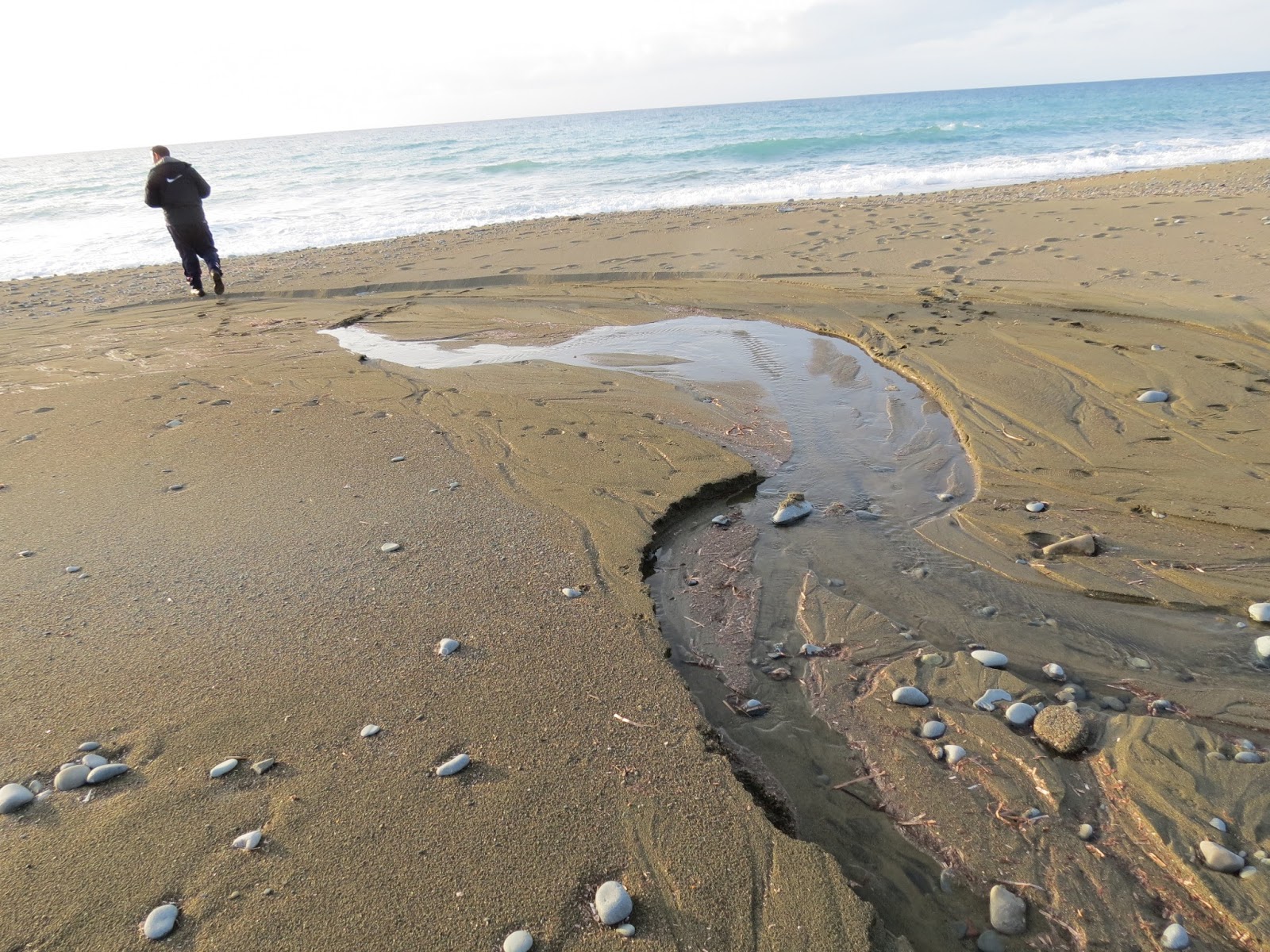
A really big flood took place on the 22nd of February here in Attika. The Rafina River spewed amazing quantities of debris and sediment into the Southern Evvoikos Gulf and a couple of days later its river mouth has totally changed. Its like a true oceanic estuary! A great sediment plume has made the surrounding bay shallow and the river mouth and channel are scoured down and open to the sea. Gravel and mud lines the beach at the river mouth. Wagtails and gulls are really happy. 

The Rafina River is one of our top priorities in conserving sites for both biodiversity and public awareness hear in the greater Athens region. Located immediately south of one of Attika's largest harbours it is easy to visit and a great place for a very short stroll and a look at a river mouth in Attika - a very rare thing! 

Sadly the decision-makers managing places like this have very little understanding of the potential here. The conservation - natural history bonanza. This place could become a wonderful foreshore parklet which focuses on the riches and wonders an urban river mouth. In the past, perhaps triggered by great floods like the current one, the river was channelled, straightened and embankments with huge boulders now line its banks. Could we imagine something slightly different and safer for the river flood-pulse, the wildlife and the people. People need nature in the city. Lets bring it back!


Monday, February 18, 2013

Re-discovering Zakynthos' Dwarf Goby at Lake Keri!


February 17th 2013

Zakynthos is an Ionian Island with a Marine National Park. A unique wetland, Lake Keri, with an area of about 28 ha exists on the Park's coastline near the village of Keri. Sadly the wetland has been trashed by former schemes to drain it and holiday homes line the riparian zone of the former lagoon system. However, one of the many reasons to save the wetland was an unsubstantiated record of an unusual inland waters fish population - a species of dwarf goby. No samples were available from former researches to find the species (and the former collected specimens were never identified or analyzed to reveal the taxonomic status to species level...). So to solve the mystery we needed specimens. My partner and I took the opportunity to investigate the wetland and do some fishing! We caught a total of three Dwarf Gobies - a species in the genus Knipowitschia. These gobies are tiny fish - the largest male we caught is nearly 4 cm!!! The other male is smaller; the female specimen even smaller. The canals are spring-fed and at one point have a lot of freshwater aquatic life; in other parts of the system they are brackish and have very little apparent life. We  spotted Grey-mullets (two species) and the Critically Endangered Eel in the drainage canals around the wetland as well. The area is certainly worthy of conservation meausures - but without knowledge of the biocommunities and their ecology how are we to know what to do next? 


Friday, February 8, 2013

Winter waters of Cyprus

                                           Local endemic Cyprus Jay subspeceis at Platania, Kakopetria on the Troodos.

Cyprus in Winter

An early February road-trip through Cyprus with my friends Aris and Jacob and still several more natrualists joining us in the field...great time! Here I share just a few snapshots from our field work - still exploring rivers and dreaming up restoration plans. This year it rained in early winter and than again in late winter - so there was plenty of water everywhere. Cyprus is warmer than Attika in winter and generally flowers bloom at least a one or more weeks ahead of things around Athens. Its a great getaway, the winter greens, and wet conditions bring everything to life.

I want to thank the Forests Department for hospitality and genuine friendship in support of a common conservation cause. 

The Kouris in full winter flow beneath the Kouris Dam in a beautiful landscape. This is an area where we want to do some rather big restoration work - what an opportunity!
Tiny black tadpoles of the Green Frog at the Xeros (Livadi) river mouth pools inside the village of Pomou in Tyliria. Surprising to see tadpoles so early!
Mallards on the Germasogeia Reservoir near Lemessos. Generally the reservoirs of Polemidia, Germasogeia,  and pools downstream of Kouris Dam had a lot of waterfowl. 
Kestrel, called "'Kitsis" in Cypriot. At the Kouris Delta near Episkopi, Lemessos.  This is the commonest of the raptors in Cyprus, but we also spotted Marsh Harriers and Long-legged Buzzards.
Great Egret - rather scarce winter visitor, known as "Hanoumissa" in Cypriot - on the Germasogeia Reservoir near Lemessos.
Lemon-Green Tree Frog at the Garyllis river just north of Lemesos. At this time this species is really visible and you can hear their mallard-like calls at certain localities.

Spur-winged Lapwings at Oroklini Lake, a fantastic lagoon just 10 Kms east of Larnaka. Birdlife Cyprus is doing really fantastic work to restore and promote the wetland.

Little Eagret feeding on a Crayfish inside Leucosia's Pediaios River  Greenway.  The river had very little water but in the lower part - water is artificially provided to the river - and it is alive....
Christodoulos Makris -expert naturalist guru of Cyprus- joined us at Akrotiri to help photograph this  fantastic male Mediterranean Toothcarp - Aphanius cf fasciatus - we are researching the genetics... (Photo and processing by Chr. Markis).

 Mediterranean Toothcarp at Akrotiri  Salt Lake (ex situ shot in our portable aquarium - thanks to Savas Michaelidis who helped us catch this little-known fish). 
The tiny Xeros of Agia Marina at Agia Marina Village in the north  coast, near Pomou.   Iakovos thinks about refrence conditions - what it was like before the dam???
Aris and Jacob photographing, identifying, perhaps even tasteing mushrooms....The trees  - this is  on the stream below Lefkara. Note the willows along the stream - rather scarce in Cyprus.


Please go and find Ch. Makris' fantastic book "Butterflies of Cyprus"(2002) before yuo visit Cyprus!  Even in  February at least 5 species were flying!

This is a unique structure built by our brothers on the other side of the Green Line in a reservoir near Lefka. My new telephoto lens is working wonders...

Margarita from the WDD with Iakovos mesmerised by the beauties of the Garyllis Valley.  Please lets clean-up this stream!

Athena, Iakovos, Margarita - their so lucky to be living in Cyprus!!! Garyllis Valley downstream of Agia Irini near Lemessos. 
The Xeros "of Lefka" flowing into the braided channels in the Green Line. Note how the water totally vanishes a few kms downstream.
One of the most beautiful rivers valleys on the island, the Xeros (Lefka) - near-wilderness and most beautiful in mid-winter!!!


Friday, January 18, 2013

Why conservation science?


Thinking about the Cyprus Expedition - Niki's shots from July 2012

Some of us are lucky enough to work in institutions that specifically have a mandate to do useful science - applied approaches that may benefit both our communities, our culture, our natural heritage. I work in such a place, the Hellenic Center for Marine Research. 

I'm just thinking that it may be important to actively promote more, deeper and better work on reaching out to the society, in order to positively affect  society and nature. Let me give some examples of how this may be better developed:

- Don't focus on science just for science's sake- find something useful to do. Useful for protecting the natural heritage. Make the science, technology and research we do immediately helpful towards pressing issues that need conservation solving - need support from scientists. 

- Involve scientists in conservation projects. Conservation is a multi-faceted wildly integrated and difficult venture. Many environmental, physical and natural scientists are not aware of conservation here in Greece. They have a distorted and often prejudiced approach towards "conservationists" (who are rudely called "ecologists"by the public). Environmentalist scientists are unusually rare here - this niche is taken over by various do-gooders in NGOs, and amateur "tree-hugging" types. 

-Scientists should work with environmental NGOs. NGOs may have a serious mandate and good business sense for fund-raising - and scientits will learn and will contribute to conservation actions through this cooperation. 

-Conservation science is a new integrated approach; also other scientific pursuits use the conservation adjective now, see: conservation biogeography, conservation biology. These new streams of "hard", real scientific work are catching on. 

-Get scientists to teach environmentally connected topics. Teaching is often something that make people learn and think. If more of our scientists teach the public, the authorities, they may see the connections among their science and the usefulness of doing specific projects. Also younger people such as students may be even more passionate for "protecting" nature. 

-Get scientists to contribute to society in any way. This is outreach. 

-Get scientists on TV or in motion pictures, on YOUTUBE or on blogs. Get them to show why they do what they do. Often behind all the conservative standards and protocol is a soft, glowing love for nature. Bring more of that out. If you bring it out- it becomes part of your identity. That way you do more useful science, science that speaks out and helps society. 

Below are some shots taken by my friend Niki Chartosia who is now Visiting Professor at the University of Cyprus. We worked together during a day in the field at streams below the villages of Moutoulas and Gerakies in the Troodos. The shots show Vassilis Hatzirvassanis and I doing a scientific survey - obviously behind this is a passion for nature - the beauty, the wilderness. And the conservation questions - such as how to deal with a beautiful invasive trout species - the Rainbow Trout!.