Thursday, December 13, 2012

Meeting: IUCN FW KBAs Sarajevo BIH

Mid December 2012

Sometimes conservation workshops are world class! 
This one was: IUCN Freshwater Key Biodiversity Areas Workshop for the "Mediterranean Balkans Hotspot". 

Anyone who knows a little about 'saving places', knows that the inventory and evaluation process is critically important, especially when opportunties arise. So are geographical boundaries- critical lines on maps. That is exactly what the IUCN Freshwater Biodiversity Unit is helping us do. Thanks to the organizers....Experts from Croatia, BIH, Germany, Spain, the UK and Greece met here, and we are helping to draw catchment site boundaries, correcting really messed-up GIS model hydrosheds, arguing about species' distributions, thinking about what to do next.... 

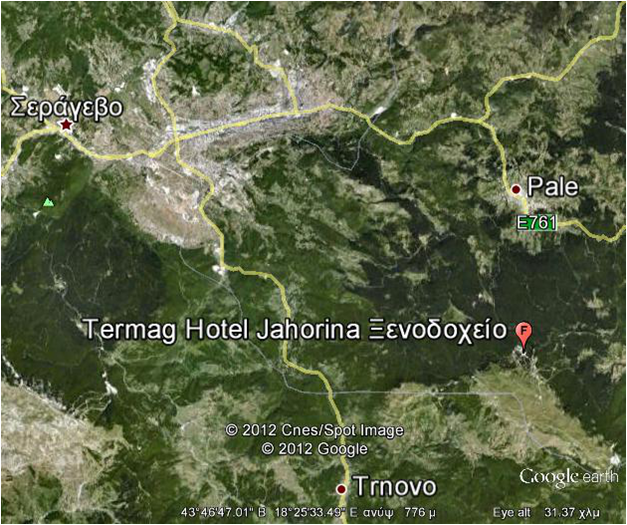
The meeting could not take place at a more distinctive locale. A place divided by political boundary lines drawn in blood by civil war. One of the worst chapters of modern European history took place here. This is Bosnia & Herzegovina near Sarajevo. In contrast to this recent past, the location is now a peaceful mountain resort.  Based at a wonderful hotel, near the Olympic Ski Area of Jahorina, in a wintry, totally snowed-in landscape. Pure white spruce forests with temperatures dipping down to -12 in the morning! 

I thank my Greek colleagues Panayiota Maragou and Yannis Bazos for taking some of the following pics.


Just to remember who was at this meeting:
Aljoša Duplić (State Institute for Nature Protection), Dejan Kulijer (National Museum of Bosnia and Herzegovina), Drazen Kotrosan (National Museum of Bosnia and Herzegovina), Geert De Knijf (Research Institute of Nature and Forest, INBO), Ioannis Bazos (University of Athens), Jörg Freyhof (iDiv), Krešimir Žganec (University of Zagreb), Marko Ćaleta (University of Zagreb), Panagiota Maragou (WWF Greece), Stamatis Zogaris (Hellenic Centre for Marine Research), Ulrich Eichelman (EuroNatur / River Watch Austria), Zoran Marčić (University of Zagreb), Zoran Mateljak (WWF Mediterranean Programme), William Darwall (IUCN), Savrina Carrizo (IUCN) and Violeta Barrios (IUCN). Many thanks to all of you! 

And here is the report that IUCN produced from this and other workshops in the Mediterranean:

 Darwall, W., Carrizo, S., Numa, C., Barrios, V., Freyhof, J. and Smith, K. (2014). Freshwater Key Biodiversity Areas in the Mediterranean Basin Hotspot: Informing species conservation and development planning in freshwater ecosystems. Cambridge, UK and Malaga, Spain: IUCN. x + 86pp.

Sunday, November 25, 2012

Book: Discovering Pikrodaphne


November 21st 2012

During a public meeting at the Agios Dimitrios City Hall - the Mayor presented us with a richly illustrated book on the Pikrodaphne Stream - a unique album full of wildlife 96 pages long, a hardcover monument to the stream.. 

Title: Discovering Pikrodaphne: A tour of the nature of Pikrodaphne Stream (in Greek).

The text is by well-known naturalist Martin Gaetlich - a man with a passion for urban wildlife issues and by the Municipality of Agios Dimitrios (The Mayor and her staff helped also). 

The work is edited by expert book-creator Nikos Petrou, president of the Hellenic Society for the Protection of Nature - http://www.eepf.gr/en/about

It was designed by Aris Vidalis with photographs by M. Agiazmatzi, A.Vidalis, M.Vlachou, Ch.Vlachos, M.Gaetlich, M.Kotsakis, Ch.Belias, N. Paterakas and N. Petrou. (Photos were given freely by the photographers for the cause). Unfortunately the book is not available in book-stores and one must probably have to talk to the Municipality to get a copy. Soon in will be out-of-print. Try to find a copy!

Mayor M. Androutsou talked fondly of the book during the  recent public meeting on Pikrodaphne Stream.  The cover of the book features an Olivaceous Warbler on an Oleander bush (Pikrodaphne= Oleander in Greek).

Martin Gaetlich, writer of Pikrodaphne, now living in Ireland. I first met Martin back in 1984 when he was one of the most passionate activists in the Hellenic Ornithological Society. We worked on several projects together. I hope he will continue to have a conservation presence in Greece.


Saturday, November 24, 2012

Meetings: Pikrodaphne Stream Public Meeting


November 21st 2012

Once in a while we have a public audience. In this case at Agios Dimitrios City Hall. During the last few months my friend and co-worker at HCMR, Elias Dimitriou, has been heading a project to study and protect Pikrodaphne Stream. In this case the synergy is high, the local municipality of Agios Dimitrios is really involved, as are NGOs. The idea is to help save the urban stream from ridiculous and expensive plans to practically channelize it all with rip-rap and gabbion. The plans are being supported by the superior government at the level of the Periphery of Attika - so the conflict is not going to be easy.

In the pics below we see the Municipality's mayor Mrs. Maria Androutsou and her team hosting speakers from HCMR, Univ. Athens, Polytechnic of Athens, the Hellenic Society for the Protection of Nature, the Hellenic Ornithological Society and local environmentalists. What a gathering!

(Most of the photos that follow were taken by expert flash-photographer and behind-the-scenes hero, Aris Vidalis)

If you can read Greek have a look at Elias' project website: http://www.remapikrodafnis.gr


At center, Ch.Belias with the Mayor (in red), a strong force for the Environment within the Municipality's initiative.

Ch. Anagnostou (HCMR) - Stream degradation and impacts on the Coastal Zone.

E. Dimitriou, S. Zogaris (HCMR) - taking questions.

A. Argyraki (Univ.Athens) - Geochemistry of Attika Basin Streams.

N. Mamasis (National Polytech.Athens) - Flood risk and mitigation with reference to the Philothei Stream.

E.Dimitriou (HCMR) - Results of a four month study of the Pikrodaphne Stream.

M. Theodorakopoulos (Intermunicipal Initiative for Pikrodaphne Stream) - Conservation history.

M. Tzali (Hellenic Ornithological Society) - Wetlands of Attika.

Ministry of Environment Representative (Green Fund) - Funding the Pikrodaphne initiative.

M. Androutsou (Mayor, Agios Dimitrios Municipality) - Introduction.

M. Androutsou (Mayor, Agios Dimitrios Municipality) - supporting the project and promising future participation.

Y. Karaouzas (HCMR) - Macrobenthos indicators and the urban stream syndrome. 


N. Petrou (Hellenic Society for the Protection of Nature-HSPN) - a positive illustrated end-show.

N. Petrou (Hellenic Society for the Protection of Nature-HSPN) - biodiversity in the city of Athens.

About 80 members of the public were present in the audience  - but they were interested.

E. Dimitriou (HCMR) - Thanking the Green Fund and the Municipalities for supporting the cause.

A beautiful photographic interpretive display at the City Hall , reads "Discovering Pikrodaphne". The same title was given to a wonderful book produced by HSPN for the Municipality (designed by A. Vidalis). The fascinating well-written and superbly illustrated account (96 pp.) was  launched on the day of this meeting also. 

Wednesday, November 21, 2012

Beasts of the Sea: A tuna in the Evvoikos Gulf


November 2012

And without the wildlife a wilderness seems totally dead. And what good is a mega-fish like a huge tuna? Why protect a fish? Should we factor in the utilitarian and ecosystemic values? Or should we go straight to our moral obligations to protect all wild living species? What value is a rarity to us - and this is RARE.... It is our lack of understanding and sensitivity that has caused a catastrophic population crash in the first place.....Finally, a photograph sensitizes: the beasts are still here! And the sea is our last wilderness....


In the southern Evvoikos Gulf just east of Athens. An anonymous photographer took the picture.  I have seen  various tuna species before - but most just caught in nets. Once I saw a very large one from the ferry. Is it because we do not see these beasts in the wild that we don't care for them?

This is the original frame. Could it be just luck - that you capture a tuna like this? Anyway I would like to ask the photographer to please come out and claim the photo - it was found by a friend of mine on the Internet. I know the location due to the scarred Attika landscape in the background.  

Thursday, November 15, 2012

Expedition: Pavliani Valley and Tziros Pond on Mount Iti

Mid November 2012

Sometimes you find something remarkable, especially when you never thought such a thing could ever exist - in context. My followers know that I love to explore new places, to map the waters of Greece,  often with the help of rather interesting locals. Last weekend I was invited to a seminar at one of Greece's Environmental Education Centers at the village of Ypati near Mount Iti (near Lamia- 3 hours north of Athens). So after the seminar I took advantage of the situation and did some electrofishing - and work - exploring the streams of Mount Iti National Park (this will be show-cased in an upcoming blurb, maybe...). Anyway, on the last day of the expedition on Mount Iti we actually descended a bit to the rather well-known village of Pavliani (at 850 m.elevation - this is about 2 hours northwest of Athens). Here I had heard talk of a "lake". Well, we found both the pond and the man who is behind an ingenious ecotouristic venture. Vangellis, a local artist, became our friend and guide. His dream is to "open-up" the Pavliani Valley to nature-loving visitors - and I think he also really loves to bring out a laugh or two. He is behind the creation of special wooden structures and trail-signs that really lend "colour" to this beautiful place. Local people donate petty-cash and he builds and clears trails etc etc. So you can follow his trail down the Pavliani Valley to a spring-fed pond and marsh - wow!!! Most lakes or ponds on mountain sides in Greece are artificial, so I expected a tiny artificial pool where goats are watered etc. No way - this is extra special....natural!....and with jungle-like riparian woods all around - fantastic. And inside the lake we electrofished and found a species of Pelasgus (a kind of rare minnow). What a discovery! 


Tziros Pond, at about 760 m. asl. is a natural spring-fed wetland!

My guides. Vangellis on left is local artist-nature lover who create's inspirational signage and tree-house structures in the Pavliani Valley. Stelios is leader of the Environmental Education Center at Ypati and Stylida (near Lamia). 

A happy explorer with local activist Thanassis who spends most of his time trying to protect the wider Mount Iti area.  Thanassis is a great photographer and eco-reporter and I will show-off some of his photos next blog. 

Typical signage by Vangellis - he has created about 100 such signs -some are really quite humorous - this one reads: "The Amazon Jungle" and it leads to a secret spot in the Tziros Pond.
These are the sort of signs Vangellis does. Some are hand-written by him, others by visiting schools and volunteers. Do you like it?

Close-up of Myriophylum and Potemogeton in Tziros Pond. The pond was alive with wildlife - Alpine newts, huge medicinal leaches, etc. But locals say no Eels reach here.
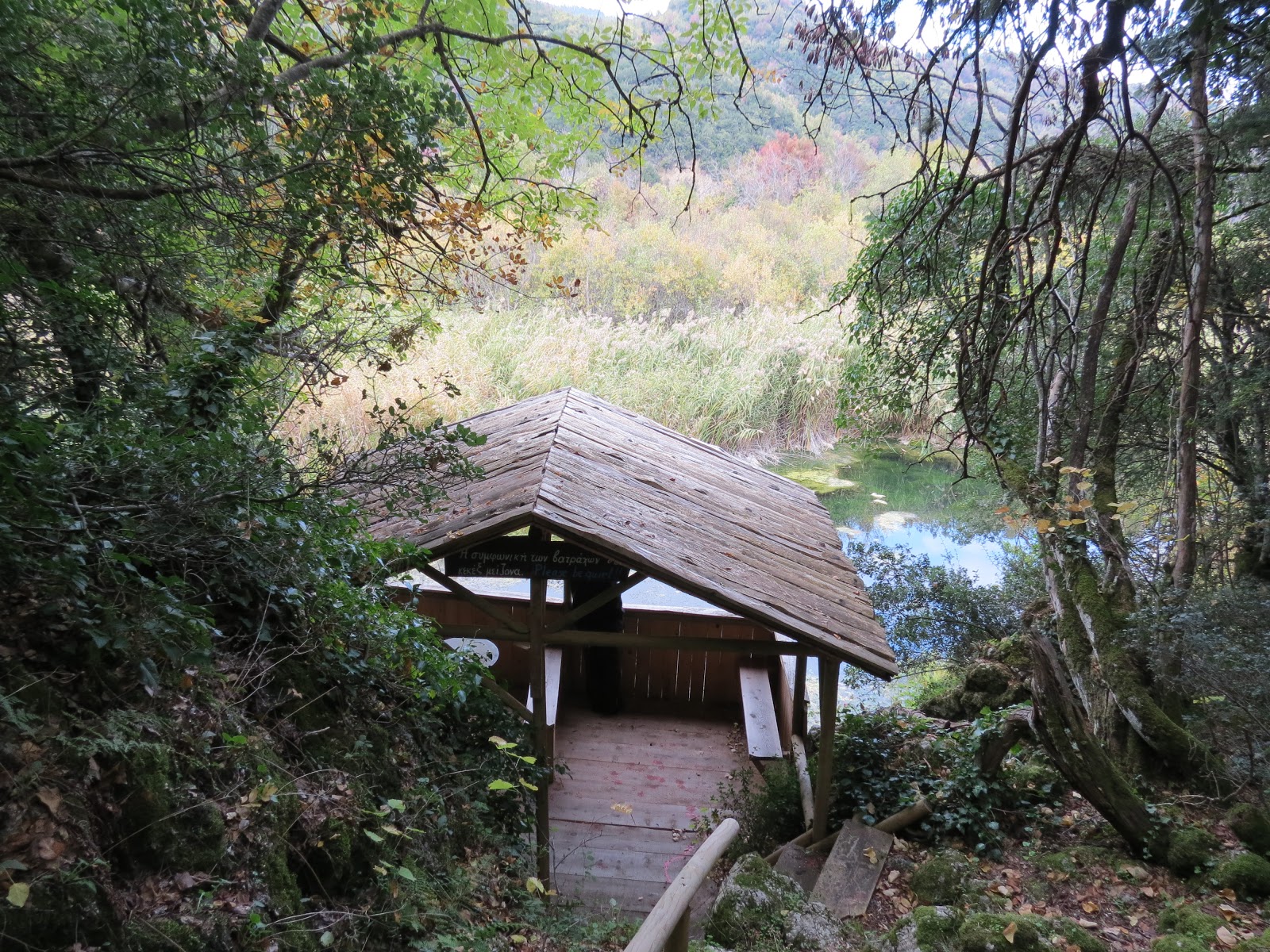
Amazingly harmonic look-out house created by Vangellis overlooking the Tziros Pond. The guy is an amazing carpenter - reminding me of tree-house experts featured in the books of Richard Louv. Check it out....
What would a pond be without a look-out? I love wilderness and being alone- but in this case Vangellis really helps the youth go out  to discover such wonders. To live the peace.

In the Pavliani Valley about 50' downstream - it is beautiful and wild - inspiring a feeling of being in the motion-pic AVATAR. Perhaps a little over-done here - but that's Vangellis.


Friday, November 9, 2012

Campaign: Pikrodaphne Stream has Eels!


Grey Wagtail in the Pikrodaphne Stream
October 9th 2012
A really great birder, Michalis Kotsakis found a huge Eel slithering upriver near the river-mouth of Pikrodaphne -  a small urban stream here in Metropolitan Athens. So I went over to investigate the situation - alone. Early morning before work at the office - and I was busy - so I just took the S-R L24 (expensive electrofishing devise), a dip-net, that's all. The water is really polluted here - our HCMR team is monitoring this.... So when you know how bad it is, you don't really want to step in. But Eels!

I caught 7 individuals while electrofishing a stretch of about 150 meters. The polluted water's conductivity was high, so I used low voltage (about 300 volts) and low frequency - about 30 hz. The Eels were hiding in the deeper waters, under rocks and cement undercuts, below bridges (always in water deeper than 25 cm). Eels are IMPORTANT - a migratory fish that is now characterized as Critically Endangered! So finding them in the middle of the city is no small thing..........

There were grey-mullet downstream but I caught only one of those. Anyway, I now see this dirty small stream with new eyes - it is alive! BUT something needs to be done. My best pic. here is the Grey Wagtail (Motacilla cinerea), I took it while lugging the electrofisher, nets, etc - thanks!