Wednesday, October 10, 2012

Sites: Hello to Turkey from the Greek side of the River....


October 10th 2012

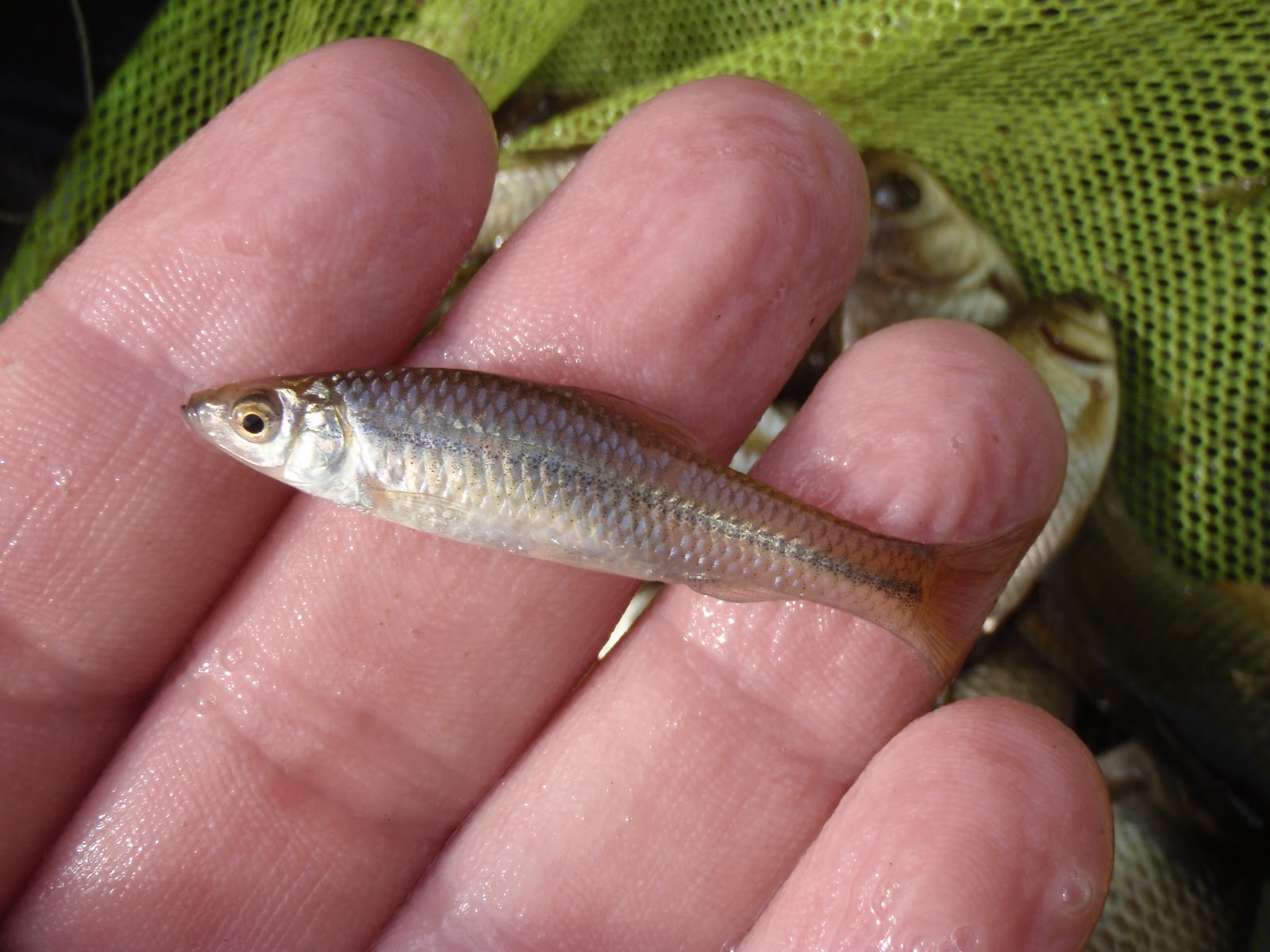
On the Evros River today (Greek-Turkish Border). We're sampling - fish, waters, everything..... Second time I've electro-fished at this beautiful site south of Tychero Village, where the Provatonas Stream creates a confluence with the mighty Evros. The Evros is our Danube- many Turks and Greeks I know love it. However, its ridiculous - I always feel really nervous near this border. Its a true no-man's land, it has a spooky feeling. You're always alone here - no one or someone - some army, some refugees, its no-ones' river.

But its a special feeling....You walk up to this serene river valley scene - then you feel a frontier - some kind of invisible wall. Jays and woodpeckers fly across the river, changing countries. Fish swim across too. You hear a tree frog singing from the Turkish side, then a marsh frog from the Greek side. Cormorants fly down the middle. You hear things mostly - you see only nature.

Then you think of  a Peace. Why are we at cold war? You see the old clothes washed up on the banks - thousands of refugees crossing the river to Europe. Many people drown here. You see the big Turkish flag down-river, then the Greek army trucks, mine-signs, FRONTEX gaurd jeeps. Its sounds like some kind of industrial operation - and it makes some people nervous.

In February 1997 a friend Tassos Verouchis from Karystos was killed by a mine just upriver. He was a soldier at the time, wandering down to the river to fish, with another chap - both were killed. I was in the army then too - but I didn't go fishing....I recalled this today, as I said it to our crew: "'we are on a border (!!), a place so beautiful and wild, yet human-kind can be so cruel here"'. I'm talking to myself.

So, our crew - a girl from Alexandroupolis a local from Marisia village, Yorgos and Athena - we sampled here today. I sampled the fish. Caught 17 species. But I electrofished in a rather unorthodox way; one electro-anode and one net, on just one bank - the Greek side of the river. I should have done this using more nets, more people. Ok, this in not Europe!

Although everyone knows that I often kill fish to take samples sometimes even I can get sentimental too. In this river, I found a long-line with large hooks while electrofishing and suddenly a big carp came up - hooked on the line. HUGE for a carp in my experience - about 50 cm. I was amazed by the injured mouth of the fish - probably caused by being on the hook for days - the long-line probably forgotten. So I released the fish into the river. It felt good to release a big fish.

Lets make Peace.


Tuesday, October 2, 2012

Nature Visit to Kuwait in late September

Kuwait City from the Port Area, note that most of these buildings have been created after the war; plus 16 kilometers of the shoreline is accessible on a coastal corniche with many opportunities to see beach wildlife.

September 2012

Mid and late September is actually a good time to visit Kuwait to see nature - who could have imagined? Temperatures had dropped a little...and the humidity was very low compared to others GCC states further south. And the bird migration is in full swing: hundreds of buzzards, hawks, harriers, eagles on some days. Other days were near birdless- but worthy of exploration. We spent some time in nature here. You need to get up really early to go out into the desert - but it usually pays off. Aris and I celebrated our new book release with Nancy, Mike and Graham- and with thanks to KUFPEC for supporting our volunteer efforts. Local birders and conservationists were so hospitable: Mohammad Al-Kanderi showed us some real Kuwaiti hospitality out on the hummock dunes near Jahra. Ali Alhafez and friends helped us explore the "inner city". The experts at the Kuwait Aquarium and at Kuwait Institute of Scientific Research took us behind the scenes. KEPS staff and volunteers met with us and took us to their facilities. Ichthyologist extraordinaire Dr. Jim Bishop guided us on the mudflats of Kuwait Bay and showed us the mudskippers. Another friend took us out to sea. Pekka Fagal took us up to the Iraqi border to see Babblers......Yes, we found the Afgan Babblers! With other friends we met to talk about environmental education, marine issues and how to help stop shooting and poaching. Again, we feel so much gratitude to the Kuwaitis and expats who treated us as friends.


Aris Vidalis and Mohammad enjoying Arabic coffee and dates on the mini-dunes, just an hour's drive outside the city.
These footprints at Jahra Pool Reserve are from poachers looking to catch birds they have shot on morning forays.

With friend from the Environmental Protection Authority being guided out to Jahra Pool Reserve. 
Jahra Pool Reserve - more water means more reeds, not always perfect habitat. So habitat management is really something very important here. We talked about this a lot.
Aris doing some fantastic work out on the very muddy mudflats. You could easily find dozens of mud skippers of at least two species. It was a highlight of our fish-watching experience in Kuwait.
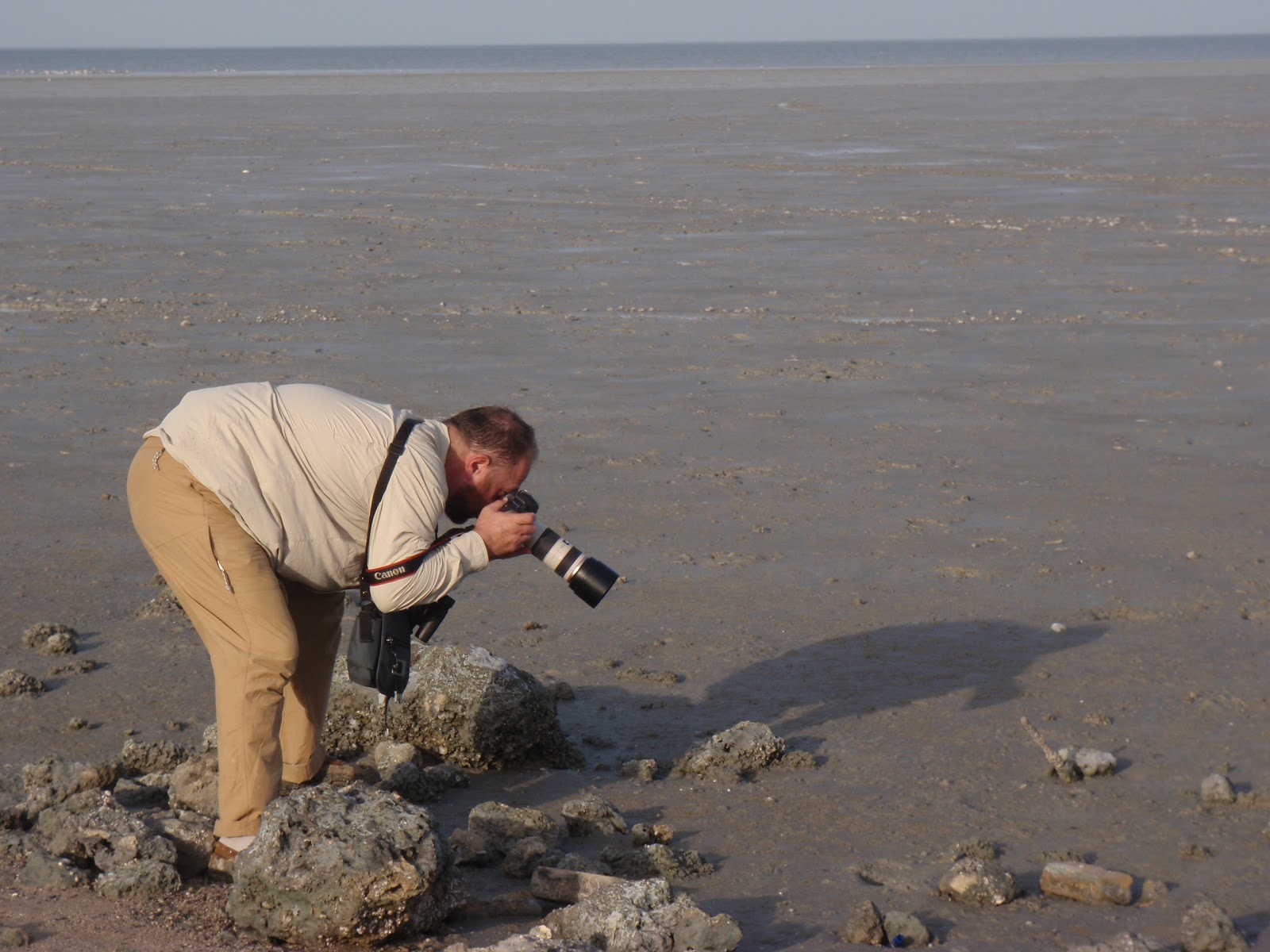
Dr. Bishop helping a Greek naturalist out to the mud at Kuwait Bay mudflats. This place was swarming with mud skippers and birds. 

Jahra East Outfall. An amazing wetland area that is largely slated for development. These are tidal creeks full of fish and birds - many waders coming in to roost here at high tide.

Expert bird-guide Pekka showing us around the Northeast corner of the country. Local birders know how and where to find birds and they know the problems birds are facing here in fine detail. 

Day-trip from Kuwait City. Yellow pin (where the babblers are), Yellow lines (international borders with Iraq and Iran). 
With Pekka 9 kms from the Iraqi Border (at Abdali, Boudai Farms) where those amazing Babblers live.


Afgan Babbler (Argyra huttoni) photographed by Aris Vidalis while we where guided by Pekka Fagel who found the bird; This amazing bird is found only here outside of Iraq; Kuwait is an accessible place to see it in the Western Palaearctic listing region. Thanks Pekka, thanks Aris...

Mutla Ranch way to the northwest of Jahra. One of the little-known oases that are great for migrant birds some days. 


A dead sparrow. Shot for "target-practice" by locals who drive by in huge SUVs and target anything accessible in the air.
This is a Blue-cheeked Bee-eater: We found it exactly like this - shot and  impaled in a tree within a  farm's wind-break, somewhere north of Kuwait Bay.
Steppe Buzzards found in one of the farms. Kuwait is one of the few countries in the Middle East were the slaughter of migrants is so commonplace still. Here in Greece we still recall when buzzards were rare because of this kind of senseless shooting.
Close-up of the Steppe Buzzard - in the early autumn thousands of these birds pass through the country flying southward.
Confiscated decoys found by the EPA manager of Jahra Pool Reserve. You don't easily see ducks so close-up in Kuwait!!! Same problem was endemic in Greece a few years back.
We visited the Aquarium - the manager and curator and his team are wonderful people. They had a bunch of sea turtles that had been entrapped in power-stations and fishing gear. They will soon be released out to sea again. 
Divers ready to clean the big tank - no fear of the Sharks.
Sand Tiger from South Africa - a rather BIG idividual. The Aquarium at the Kuwait Scientific Center is on of the largest in the region - it needs to be supported and promoted as a treasure of Kuwait!
Dates. The ones on the right are freshly picked and are the tastiest. Sorry I didn't buy any - have to go back in Autumn again.
Protection of the vegetation as Sabah Al-Ahmad Reserve. The effects of the fence are obvious. Good work Kuwait!
Desert landscape near Jahra. Very interesting low rock formations.  This place on the coast near Jahra is unprotected  - it is called Quaisat Villas - I particularly liked the combination of hummock dunes, abundant camels, tiny water puddles and the grand Kuwait Bay mudflats nearby...
A Bedouin's camp out there, somewhere. The tree is "overgrazed" by the camels.
This is what camel overgrazing looks like on the hummock dunes outside Jahra somewhere. The  numbers of camels has increased in the last decade.
Landscape change comes in many forms. This is one problem in Kuwait, lots and lots of power-lines on gigantic pylons. Is it a necessity or a monstrosity?
Look at the fantastic beachfront habitat with fabulous mudflat near the Port of Kuwait. Rapidly developing Kuwait is very close at becoming a very beautiful city - it needs a little-more nature/humans interface. Plenty of opportunities we think.
Sometimes, some people care about birds and are aware of the bird shooting problem. This is in Khiran, near  the southeastern part of Kuwait.
All I need is a snorkel, flippers and a tropical sea - I think. However without the good friends and friendly locals you cannot easily do this in the northern Arabian Gulf. 
Happy times on the Sea. The Arabian Gulf is like paradise backed by ta flaming dry desert and a largely industrialized coastline.  
Visibility was about 4 m. at Khiran. This is low-visibility conditions during this time perhaps due to the sediments of the Delta Plume or from the shrimp trawling disturbance of the depths. 
Ok, this may be "wonderful fun" but sometimes the young men on the technology can be a  nuisance.
Here we see one of the young men on a Jet Ski swerving at lightning speed near a family with children - for fun!
Friends Anand and Aris at one of our most interesting snorkeling spots at our outing at Khiran. I counted about 14 fish species in a few minutes in this area - the water had less then 2 m. visibility with there was a strong tidal current. But lots of fish....
The Environmental Education Center for Students in Kuwait City.  A new initiative that may help inspire awareness.


Friday, September 14, 2012

Try fishwatching...

Trout found on the lower slopes of Mount Iti near Lamia - a "'rarity"' since no one really new trout inhabited the Sperchios river basin! It looks a lot like a Salmo fariodes (West Balkan Trout) so it could be an introduced species or something totally new. However the spot where we found it -near a trout farm on the Gorgopotamos has an active trout farm (Photo by Nikos Petrou).
Sept 14th 2012

Here in Athens in the last few weeks we have been overwhelmed by some pretty amazing rare bird finds. The act of locating, correctly identifying, and "managing" the find of a vagrant bird is always a highlite in natural history. It also gets publicity- inspires social hype and pride. Athens has about 30 or so avid birders, I mean real hard-core birders, including a few twitchers among them. They are constantly out there hunting to find a rare bird. They have found some good stuff this summer: Buff-Breasted Sandpiper at the Airport, Dotteral nearby, and now a Pectoral Sandpiper at Alyki Loutsa Lagoon (again near the Airport).

This reminds me of fishing. I mean even when we are out sampling a river stretch using electricity - we look-out for rarities. Unexpected finds. It brings some hype to the science. Finding an unknown trout in a river - which was thought never had trout - this really bring out a "Wow" in our small isolated community of fish-fanatics. But is it possible to twitch like a birder while fish-watching?

Sure! Fishwatching is exactly like birding. And finding rarities is really totally open to a lot of relativity. What is a rarity? It can be many things: A new species for science, a new locality record, a new alien or non-indigenous species record; a new "lifer" record (a new species for your personal list) or just a really good view of an uncommon fish!

I make new records like this all the time. My largest fish in a particular area, my largest school of a species of fish, largest school of large fish. I have site lists, and I do a lot of this fishwatching stuff especially in the summer  - in the sea. Also really weird unsolved sightings also involve "rarities".

The pic I am featuring today is taken by my friend Nikos Petrou at the Gorgopotamos river in the summer of 2011 (Gorgopotamos is a tiny ice-cold tributary of the Sperchios near Lamia - somewhere way north of Athens). Nikos then published the photo in his really great book "Greece: Country of Diversity". In the caption it reads something like this: "Unknown trout species found by Stamatis Zogaris and the author at Gorgopotamos". I feel totally famous and honoured to have the pic published! The problem is... I still don't know what trout species it is - and nobody really cares to actually try to identify it. Our group of fish "experts" even published a note about new sightings in Greece and just called it an "unidentified trout species". So don't expect flocks of fishwatchers traveling to the Gorgopotamos to see and photograph the trout. But please, someone has to give it a name......


Tuesday, September 11, 2012

Techniques: Nature Blogging

Mike Pope is an South African expat living in Kuwait - his birding blog is a great example that should be followed by more naturalists.

Sept 11th 2012

E-Communication technology is said to bring the faraway close-up but to keep the close rather distant. I'll stand on the first aspect: blogs and birding. There are thousands of them - web log sites of "what I've seen", "what I've photographed", etc. These are particularly suited to show how naturalists take notes - to display their experiences....

Nature-recording blogs are very easy to do using blogspot and other such platforms. I highly recommend anyone using facebook or other social media create a blog. To post things and esp. photos in a more organized manner in a blog.

I will mention my experience with Mike Pope's blog in Kuwait. This is a simple blog by a great photographer and naturalist- it is such an elegant site - so simple and beautiful but also carefully tracking his pursuits and documenting wonderful experiences in nature. Of course the blog is really specific and focused on Kuwait. So part of its success is its focus and consistancy. Please have a look:

http://kuwaitbirding.blogspot.gr/